
Blog
What Is a Disposable Protective Coverall? A Technical Guide

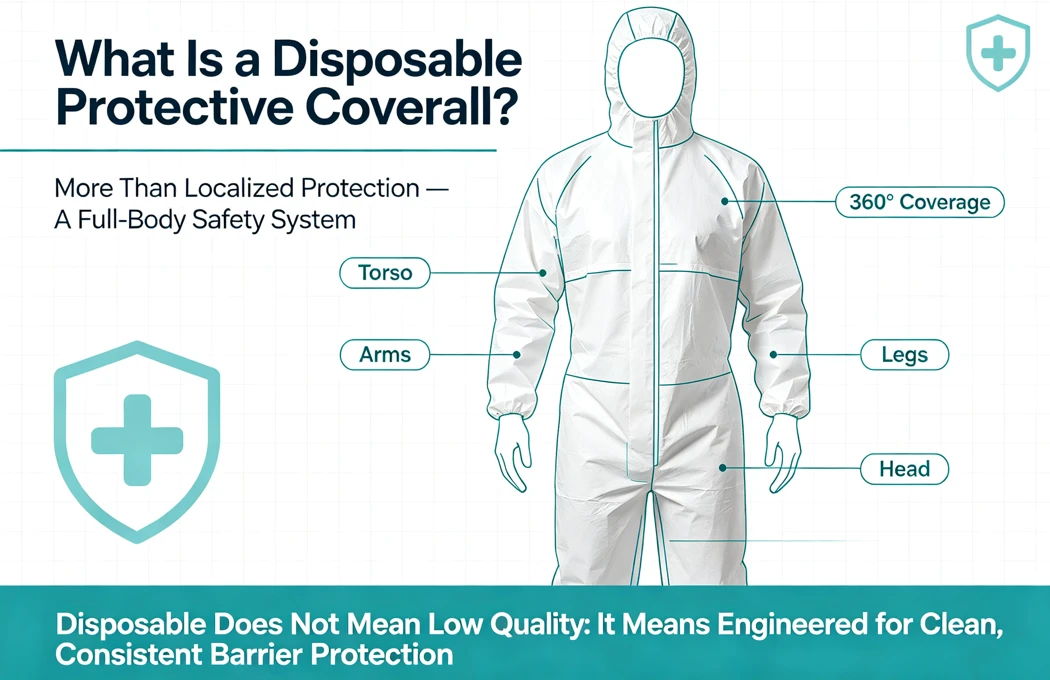
In the hierarchy of Personal Protective Equipment (PPE), the disposable protective coverall serves as the ultimate barrier between a worker and environmental hazards. Unlike isolation gowns or aprons that provide localized protection, a coverall is designed to provide 360-degree coverage for the entire body, including the torso, arms, legs, and often the head.
For procurement managers and safety officers, understanding the nuances of these garments is critical. A “disposable” designation does not imply low quality; rather, it indicates a specialized engineering approach focused on preventing cross-contamination and ensuring a fresh, untainted barrier for every use.
The Technical Definition of a Disposable Coverall
A disposable protective coverall is a single-use, full-body garment engineered from non-woven or plastic-based synthetic fibers. Its primary function is to shield the wearer from particulate matter, liquid splashes, biological pathogens, or chemical agents, depending on its specific material composition.
The “disposable” aspect is a strategic choice for high-risk environments. By using single-use materials, facilities eliminate the risks associated with inadequate laundering of reusable garments, which can harbor residual contaminants or lose their barrier integrity over multiple wash cycles.
Core Material Components: The Science of Protection
The performance of a coverall is almost entirely dictated by its fabric. In the manufacturing sector, specifically within Hubei’s non-woven production hubs, four primary materials dominate the market:
1. Spunbonded Polypropylene (SBPP)
This is the most basic form of non-woven fabric. It is highly breathable and cost-effective but offers limited liquid resistance. It is primarily used for “nuisance” dust protection or in low-risk environments like food processing or basic maintenance.
2. SMS (Spunbond-Meltblown-Spunbond)
SMS is a trilaminate fabric. The “Meltblown” center layer acts as a microscopic filter, while the “Spunbond” outer layers provide structural strength. This material is a staple in medical settings because it balances high breathability with a strong defense against fluids and bacteria.
3. PP+PE (Laminated Polypropylene)
By laminating a Polyethylene (PE) film onto a Spunbonded Polypropylene base, manufacturers create a total liquid barrier. This fabric is non-breathable but offers excellent protection against heavier fluid splashes and chemical sprays.
4. Microporous Film (SF)
SF fabric consists of a non-woven base laminated with a specialized film containing millions of microscopic pores. These pores are small enough to block liquid water and blood-borne pathogens but large enough to allow moisture vapor (sweat) to escape. This makes SF the gold standard for high-level protection combined with wearer comfort.
| Feature | SBPP | SMS | PP+PE | Microporous (SF) |
|---|---|---|---|---|
| Breathability | High | Medium-High | Low | Medium |
| Liquid Barrier | Low | Medium | High | High |
| Particle Filtration | Basic | Excellent | Total | Total |
| Durability | Moderate | High | High | Very High |
Design Elements and Construction
A professional-grade disposable protective coverall is more than just fabric; it is a complex assembly of design features aimed at maximizing safety:
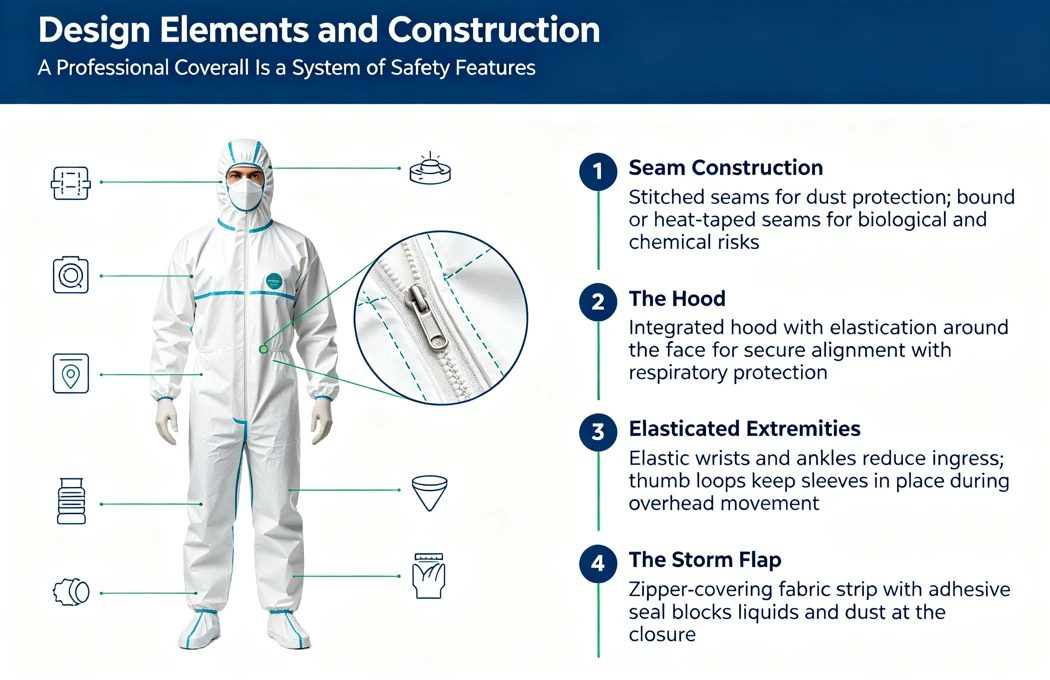
- Seam Construction: Stitched seams are common for dust protection. However, for biological or chemical risks, manufacturers reinforce seams with binding or heat-applied tape to prevent liquids from penetrating through the needle holes.
- The Hood: Most coveralls include an integrated hood with elastication around the face to ensure a snug fit with a respirator or face mask.
- Elasticated Extremities: Manufacturers add elastic to the wrists and ankles to help prevent contaminants from entering the garment. Some designs include thumb loops to prevent the sleeves from riding up when the wearer reaches overhead.
- The Storm Flap: This is a strip of fabric that covers the zipper, often with an adhesive seal, preventing liquids or dust from entering through the teeth of the zipper.
Key Applications Across Industries
Disposable coveralls are utilized across a spectrum of sectors, each requiring a different balance of protection and comfort:
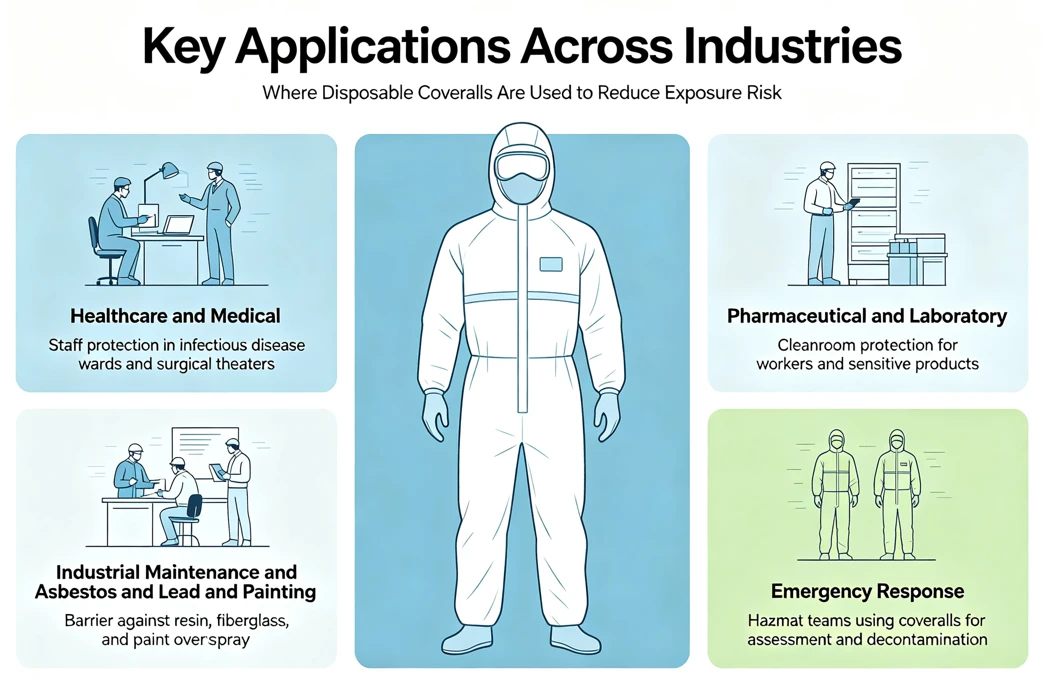
- Healthcare and Medical: Used in infectious disease wards and surgical theaters to protect staff from blood, body fluids, and viral pathogens.
- Pharmaceutical and Laboratory: Essential for cleanroom environments where the goal is to protect the product from human shedding (skin cells and hair) as much as protecting the worker.
- Industrial Maintenance and Painting: Protects workers from resin, fiberglass, and paint overspray.
- Asbestos and Lead Abatement: Workers handling asbestos or lead need high-filtration coveralls to prevent toxic microscopic fibers from contacting the skin or contaminating personal clothing.
- Emergency Response: Used by hazmat teams for initial site assessments and decontamination.
Standards and Certifications
When evaluating a disposable protective coverall, industry professionals look for specific international certifications to verify performance:
- ISO 13485: Reflects a manufacturer’s commitment to quality management systems specifically for medical devices.
- CE Certification: Indicates compliance with European safety standards.
- EN 14126: The specific standard for protective clothing against infective agents (critical for medical-grade coveralls).
- Type 3/4/5/6: These European “Types” define the level of protection, ranging from Type 6 (light spray) to Type 3 (liquid-tight jet sprays).
Choosing the Right Disposable Protective Coverall
Selecting the appropriate garment requires a risk assessment of the specific environment. Below are technical options based on material and application:
- For High-Fluid Medical Environments: Healthcare workers often choose an SMS non-woven medical suit because it balances filtration performance with air permeability.
- For heavy liquid splash protection: A PP+PE Laminated Suit provides an impermeable barrier essential for chemical or deep-cleaning tasks.
- For general hygiene and basic dust protection: A standard PP Non-Woven Coverall offers a cost-effective solution for low-risk areas.
For a full range of full-body protection solutions, you can explore the Body Protection Category.
Conclusion
A disposable protective coverall is a critical component of safety infrastructure. By understanding the differences between material technologies like SMS and Microporous films, and recognizing the importance of seam construction and international standards, procurement professionals can make informed decisions that ensure both worker safety and operational efficiency. In the world of PPE, the right coverall does more than cover the body; it provides the confidence to work in hazardous environments.
FAQ
1. Are all disposable coveralls waterproof?
No. Standard Spunbonded Polypropylene (SBPP) is not waterproof. SMS is water-repellent but can saturate under pressure. Only PE-laminated (PP+PE) or Microporous (SF) fabrics are considered truly waterproof or liquid-tight.
2. How do I know if a coverall is medical grade?
Look for EN 14126 certification and ISO 13485 manufacturing standards. These indicate the garment has been tested against biological hazards and produced under a medical-grade quality management system.
3. Can I reuse a “disposable” coverall if it looks clean?
It is strongly discouraged. The structural integrity of the non-woven fibers and the elastic components can degrade after one use. More importantly, microscopic contaminants that are invisible to the eye may remain on the surface, posing a cross-contamination risk.
4. What does “GSM” mean in coverall specifications?
GSM stands for “Grams per Square Meter.” It measures the weight and thickness of the fabric. A higher GSM usually indicates a thicker, more durable garment, though it may also reduce breathability.