
Blog
PP+PE Laminated Fabric for Disposable Protective Clothing

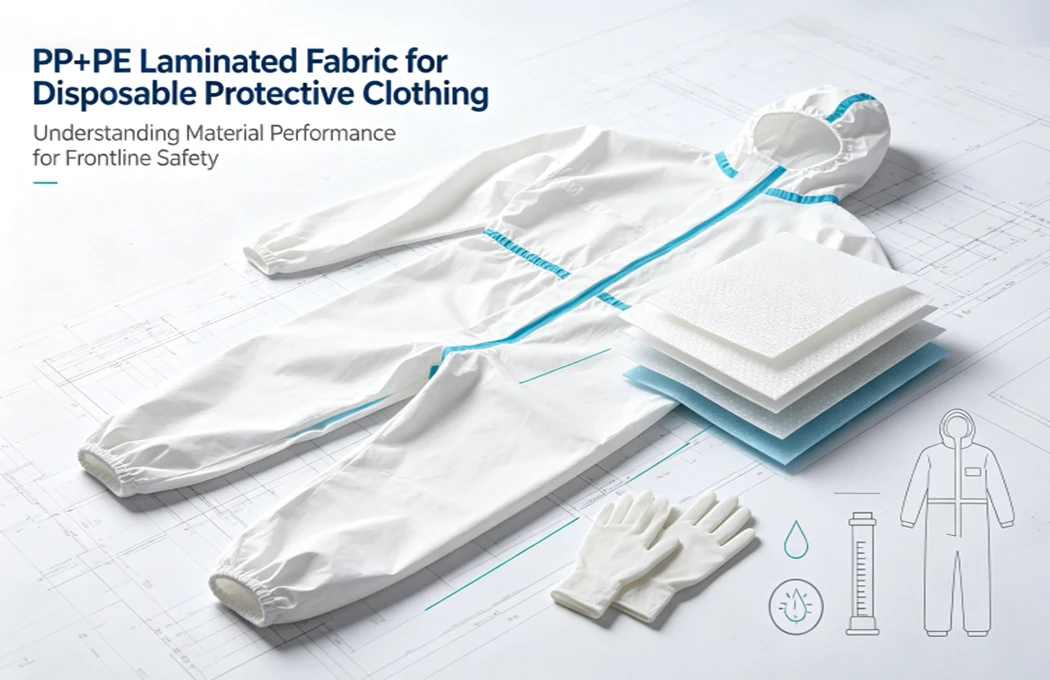
In the landscape of Personal Protective Equipment (PPE), the efficacy of a garment is fundamentally determined by its substrate material. Among the various non-woven technologies available today, PP+PE laminated fabric stands as a cornerstone for high-risk environments requiring superior fluid resistance and microbial barriers. As global standards for infection control and industrial safety become increasingly stringent, procurement managers and technical engineers must understand the nuances of this material to ensure the safety of frontline workers.
The evolution of protective materials has moved from simple dust filtration to advanced biological barrier protection. PP+PE (Polypropylene + Polyethylene) laminated fabric is engineered specifically to bridge the gap between comfort and absolute fluid impermeability. While Spunbond and SMS materials provide breathability, the introduction of a monolithic PE film via lamination transforms the fabric into a high-performance shield suitable for surgical and heavy-duty isolation applications.
What is PP+PE Laminated Fabric?
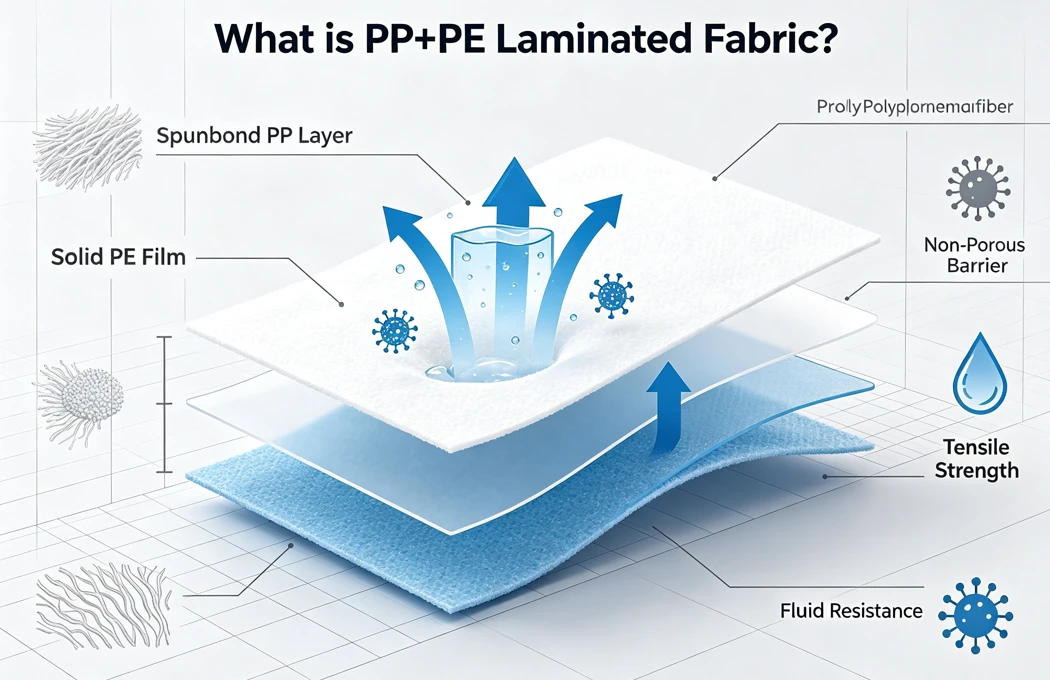
PP+PE laminated fabric is a composite material engineered by bonding a layer of Spunbond Polypropylene (PP) with a solid layer of Polyethylene (PE) film. Unlike simple SMS (Spunbond-Meltblown-Spunbond) fabrics which rely on the “tortuous path” of fibers to trap particles, the PE layer in a laminated structure provides a non-porous barrier.
The Polypropylene base provides the structural integrity—tensile strength, tear resistance, and a soft tactile feel—while the Polyethylene film acts as the functional barrier against liquids, blood-borne pathogens, and chemical splashes. This combination creates a “shield” that is essential for isolation gowns, coveralls, and other protective apparel used in high-fluid scenarios.
The Material Science of Lamination
To appreciate the value of PP+PE, one must look at the mechanical interaction between the two polymers. The manufacturing process typically involves:
- The Substrate (Spunbond Polypropylene): Manufacturers extrude molten polymer through spinnerets to create continuous filaments. They then lay the filaments on a conveyor belt and thermally bond them to form the non-woven substrate.
- The Barrier (PE Film): Produced via a casting or blowing process. Controlling the thickness and uniformity of this film is critical, as even a microscopic pinhole can compromise the integrity of the fabric.
- The Lamination Process: Bonding these layers through thermal lamination, which avoids secondary chemicals and glues that might cause skin irritation or degrade over time.
Technical Specifications and Performance Standards
In the medical sector, the performance of PP+PE laminated fabric is measured against the AAMI PB70 standard and the European EN 14126 standard.
AAMI PB70 and EN 14126 Compliance
PP+PE is the material of choice for AAMI Level 3 and Level 4 protection. While AAMI Level 1 and 2 often utilize SMS fabric, Level 3 requires the material to withstand significant water pressure (Hydrostatic Head > 50cm). The solid PE film in a laminated fabric easily exceeds these requirements.
| Property | Spunbond (PP) | SMS Fabric | PP+PE Laminated |
|---|---|---|---|
| Fluid Resistance | Low (Hydrophobic only) | Moderate (AAMI L1-L2) | High (AAMI L3-L4) |
| Viral Barrier | No | Minimal | Yes (ISO 16604) |
| Breathability | High | High | Low |
| Tensile Strength | Moderate | High | Superior |
| Common Use | Basic Gowns/Caps | Surgical Gowns | Critical Isolation |
Under EN 14126 (specifically ISO 16604), materials are tested for resistance to penetration by blood-borne pathogens. The non-porous nature of the PE film makes it one of the most reliable barriers for healthcare workers dealing with infectious diseases.
PP+PE vs. Microporous Film (SF): Making the Right Choice
A common point of confusion for procurement specialists is the difference between standard PP+PE laminated fabric and Microporous Film (SF) fabric.
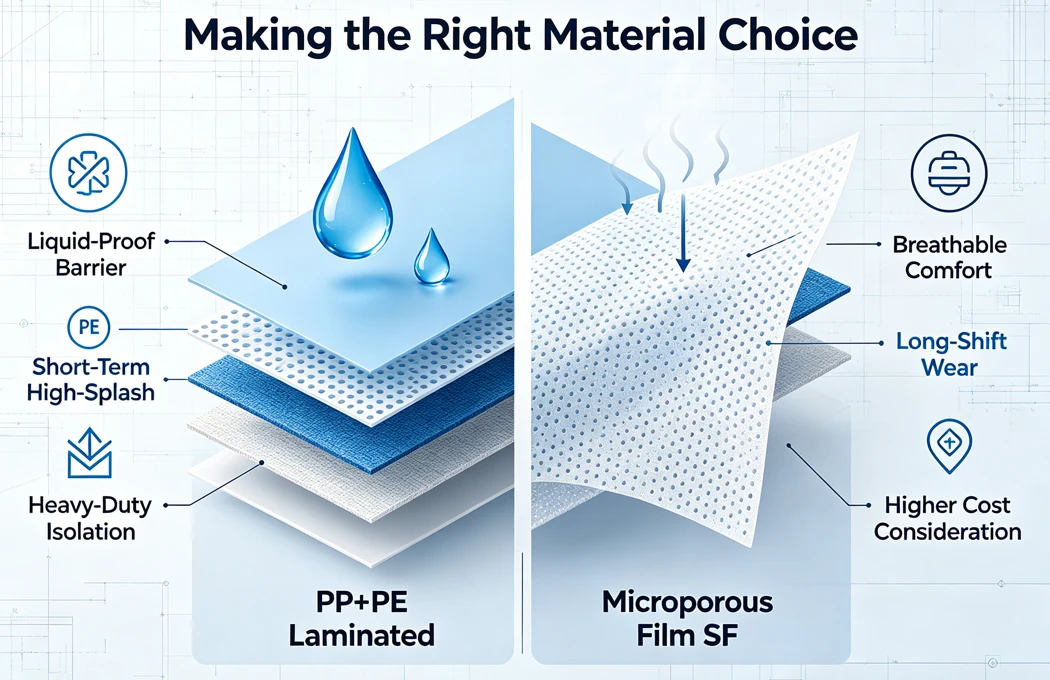
- PP+PE Laminated: Uses a solid, non-breathable PE film. It offers the highest level of liquid protection. Because it is non-porous, it is virtually “liquid-proof.” It is ideal for short-term, high-splash procedures.
- Microporous Film (SF): Involves a film with billions of microscopic pores that block liquid droplets but allow moisture vapor (sweat) to escape. While more comfortable for long shifts, it can be more expensive.
For heavy-duty isolation gowns used in decontamination or high-volume fluid surgeries, the absolute barrier of a solid PP+PE protective clothing laminate is often the prioritized technical requirement.
Critical Factors in Procurement and Quality Control
When evaluating a manufacturer of PPE, technical audits should focus on the consistency of the lamination. Advanced manufacturers often produce their own PE and CPE films to ensure the raw materials meet strict micron-thickness tolerances.
Evaluating Peel Strength and Seam Integrity
The durability of the garment depends on more than just the fabric weight (GSM). Professionals look at:
- Peel Strength: This test measures how strongly the PE film bonds to the PP base. If the peel strength is too low, the layers may delaminate during movement, creating weak spots.
- Tensile Strength and Elongation: Protective clothing must withstand the rigors of a fast-paced environment without snapping.
- Seam Integrity: For PP+PE garments, manufacturers heat-weld waterproof tape over the stitching to create a liquid-tight seam. This construction provides a strong barrier against liquid penetration.
Selecting the Right Material for Specific Applications
The versatility of PP+PE laminated fabric allows it to be used across diverse industries where liquid hazards are present:
- Healthcare & Hospitals: Isolation gowns in ERs, ICUs, and aerosol-generating procedures. It is also standard for shoe covers and sleeve protectors.
- Food Processing: In meat packing and dairy processing, workers handle organic fluids and need protective garments to reduce exposure risks. The non-absorbent nature of PP+PE prevents the garment from becoming heavy.
- Industrial Cleaning: For workers handling non-hazardous liquids or performing pressure washing, PP+PE provides a cost-effective, high-barrier solution.
- Pharmaceutical & Lab: When handling compounds that require strict particulate control, workers can benefit from the smooth PE film surface because it helps reduce particle shedding.
Conclusion
PP+PE laminated fabric remains one of the most reliable and cost-efficient materials in the PPE industry. By combining the mechanical strength of polypropylene with the impenetrable barrier of polyethylene, it provides a vital line of defense for workers in high-risk environments. As the industry moves toward more specialized protection, understanding the interplay between these layers allows for better procurement decisions and better safety outcomes. For those managing supply chains, prioritizing high-quality lamination and verified performance standards ensures that the end-user receives the best possible protection.
FAQ
1. Is PP+PE laminated fabric breathable?
No, standard PP+PE laminated fabric is designed as a total liquid barrier and is not breathable. For environments where heat stress is a major concern and high breathability is required alongside liquid protection, Microporous (SF) fabric may be a more suitable alternative.
2. Can PP+PE protective clothing be reused?
Most PP+PE garments are designed for “disposable” or limited-use applications. While the material is durable, the structural integrity of the seams and the sterile nature of the garment cannot be guaranteed after washing or heavy chemical decontamination.
3. What is the difference between PP+PE and SMS fabric?
SMS is made of three layers of polypropylene (Spunbond-Meltblown-Spunbond) and is breathable but has lower fluid resistance. PP+PE is a two-layer composite with a solid plastic film, offering much higher fluid protection (AAMI Level 3/4) but no breathability.
4. How does Hubei Ruichen ensure the quality of its PP+PE fabric?
Hubei Ruichen maintains vertical integration by producing the PE and CPE films in-house. This allows for rigorous quality control over the film thickness, uniformity, and the lamination process, ensuring the final protective products meet international CE and ISO 13485 standards.
5. What AAMI level does PP+PE laminated fabric typically meet?
Depending on the weight (GSM) and seam construction, PP+PE laminated fabric is typically used for AAMI Level 3 and Level 4 gowns. These levels are intended for high-fluid-risk scenarios where resistance to pressurized liquid and viral penetration is mandatory.