
Blog
Types of Disposable Protective Clothing Explained

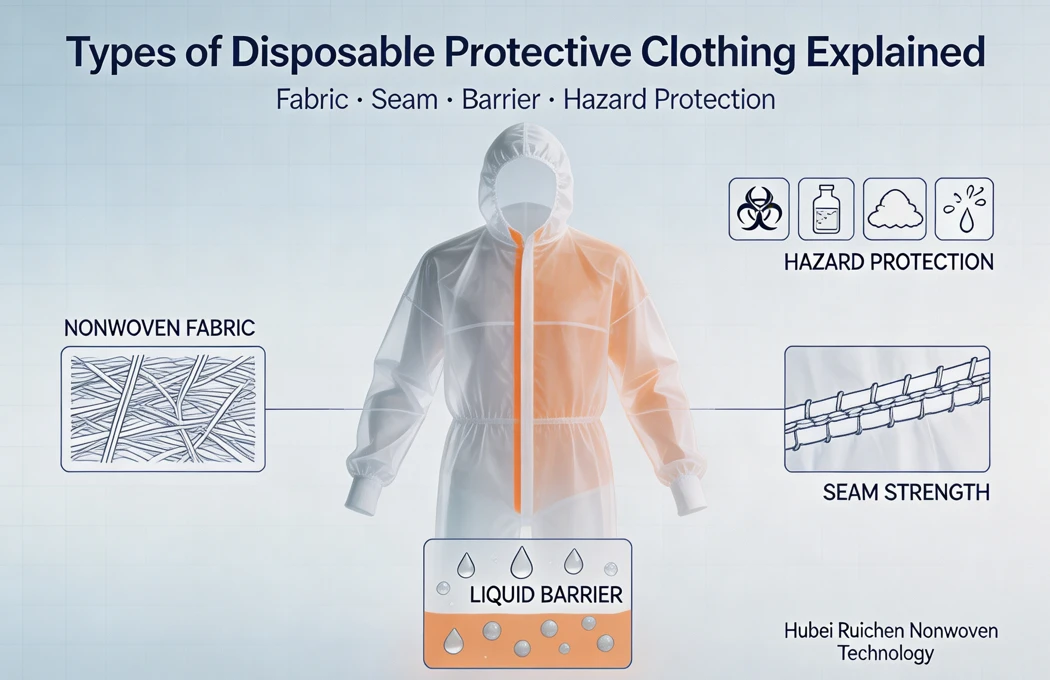
In the global supply chain for Personal Protective Equipment (PPE), the term “protective clothing” encompasses a vast range of engineered garments. For procurement managers and safety officers, selecting the correct types of disposable protective clothing is not merely about comfort; it is a critical calculation of risk mitigation, regulatory compliance, and material performance.
The effectiveness of any disposable garment depends on the synergy between the base non-woven fabric, the garment’s construction, and the specific hazards of the environment. As a manufacturer specializing in non-woven technologies, Hubei Ruichen understands that the nuances in fabric weight, seam integrity, and barrier properties determine whether a product provides adequate protection or fails in a critical moment.
Material Science in Non-Woven Protective Apparel
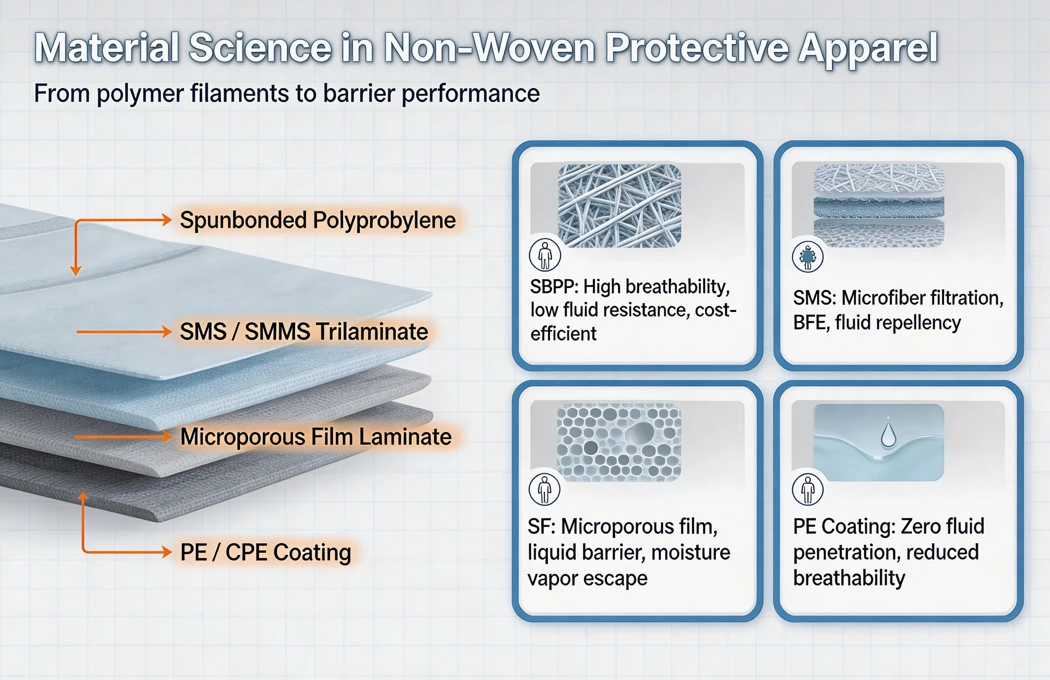
The foundation of all disposable protective clothing types lies in the polymer science used to create non-woven fabrics. Unlike traditional textiles, these materials are engineered for specific barrier functions.
Spunbonded Polypropylene (SBPP)
SBPP is the primary building block of the disposable industry. It is produced by extruding molten polymer through spinnerets to create continuous filaments, which are then cooled and bonded.
- Application: Basic hygiene, food processing, and hospital visitor gowns.
- Performance: High breathability, low fluid resistance, and excellent cost-efficiency.
SMS and SMMS Trilaminate Fabrics
SMS (Spunbond-Meltblown-Spunbond) represents a significant leap in protection. The meltblown layer consists of extremely fine microfibers that act as a filter against bacteria and particulates.
- Application: Surgical gowns, high-end isolation gowns, and scrub suits.
- Performance: High Bacterial Filtration Efficiency (BFE) combined with fluid repellency.
Microporous Film Laminates (SF)
This material bonds a non-woven fabric with a specialized microporous film. The film contains millions of tiny pores that are too small for liquid water to pass through but large enough to allow moisture vapor to escape.
- Application: Type 5/6 coveralls, chemical handling, and pharmaceutical manufacturing.
- Performance: Superior liquid barrier and particulate protection for high-risk environments.
Polyethylene (PE) and CPE Coatings
For environments requiring 100% liquid impermeability, non-woven fabrics are often coated with a layer of Polyethylene.
- Application: Decontamination, heavy fluid contact areas, and laboratory aprons.
- Performance: Zero fluid penetration, though with reduced breathability.
Classification of Disposable Protective Clothing Types
Protective garments are classified based on the level of coverage and the specific protection they offer to the wearer.
Isolation Gowns
Isolation gowns are perhaps the most common type of disposable protective clothing used in healthcare. They are designed to protect the torso and arms from splashes and the spread of microorganisms.
- Design: Often feature tie-backs or hook-and-loop closures. The back is typically open or overlapping to allow for breathability.
- Critical Zones: The front of the gown and the sleeves are the primary areas of protection.
Protective Coveralls
Coveralls provide a full-body barrier, including the legs and often the head via an integrated hood.
- Design: Features a front zipper and elasticated wrists and ankles. In high-risk models, manufacturers cover the zipper with a storm flap to provide an additional barrier against contaminants.
- Seam Integrity: High-performance coveralls use taped or heat-sealed seams rather than standard stitching to prevent liquid seepage through needle holes.
Lab Coats and Professional Jackets
For lower-risk environments, such as electronics assembly or clinical labs, lab coats provide a professional appearance while protecting against non-hazardous dust and minor spills.
- Design: Usually feature snap buttons or zippers and may include multiple pockets for functionality.
Technical Comparison of Protective Clothing Types
| Feature | Isolation Gowns | Protective Coveralls | Lab Coats |
|---|---|---|---|
| Coverage Area | Torso, Arms (Open Back) | Full Body (360°) | Torso, Arms (Knee Length) |
| Primary Use | Healthcare / Clinical | Industrial / Chemical / Viral | Lab / Light Industrial |
| Material | SMS / PP+PE | Microporous / SMS | SBPP / SMS |
| Protection Level | AAMI 1-4 | Type 3-6 | Low Risk / Hygiene |
| Donning/Doffing | Fast / High Risk of Back Exposure | Slower / Highest Protection | Fast / Low Protection |
International Standards and Testing Protocols
When evaluating types of disposable protective clothing, technical specifications are verified through standardized testing.
AAMI PB70 Standards (Healthcare)
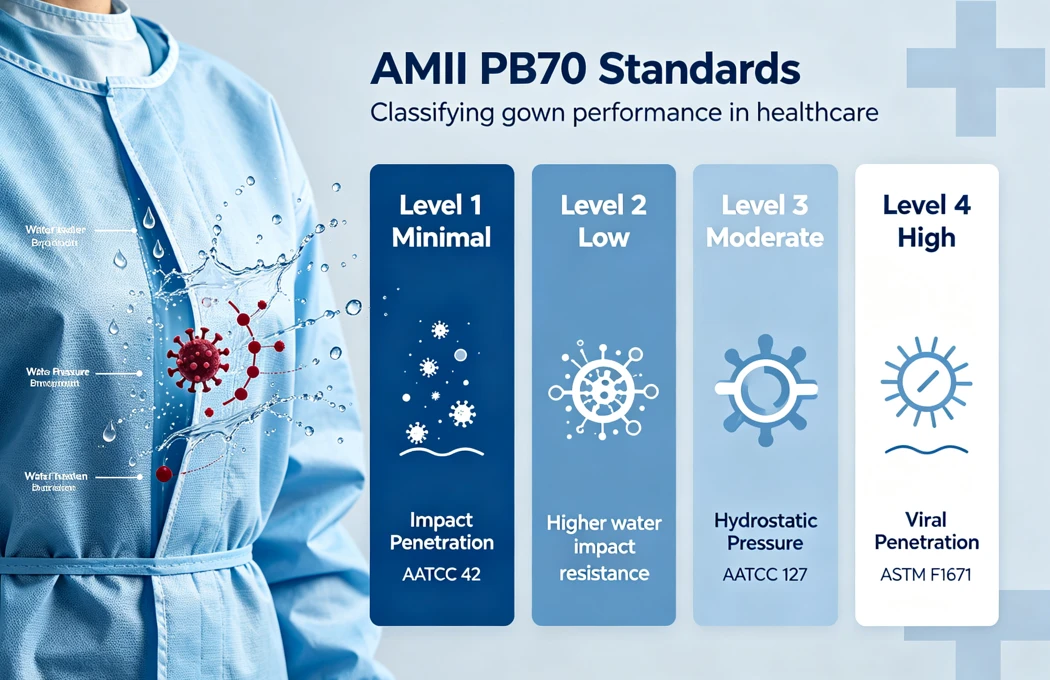
The Association for the Advancement of Medical Instrumentation (AAMI) classifies gowns by their liquid barrier performance.
- Level 1: Minimal fluid risk, tested via Impact Penetration (AATCC 42).
- Level 2: Low fluid risk, requires higher resistance to water impact and hydrostatic pressure.
- Level 3: Moderate fluid risk, tested via Hydrostatic Pressure (AATCC 127).
- Level 4: High fluid risk, must pass viral penetration tests (ASTM F1671).
European “Type” Standards (Industrial)
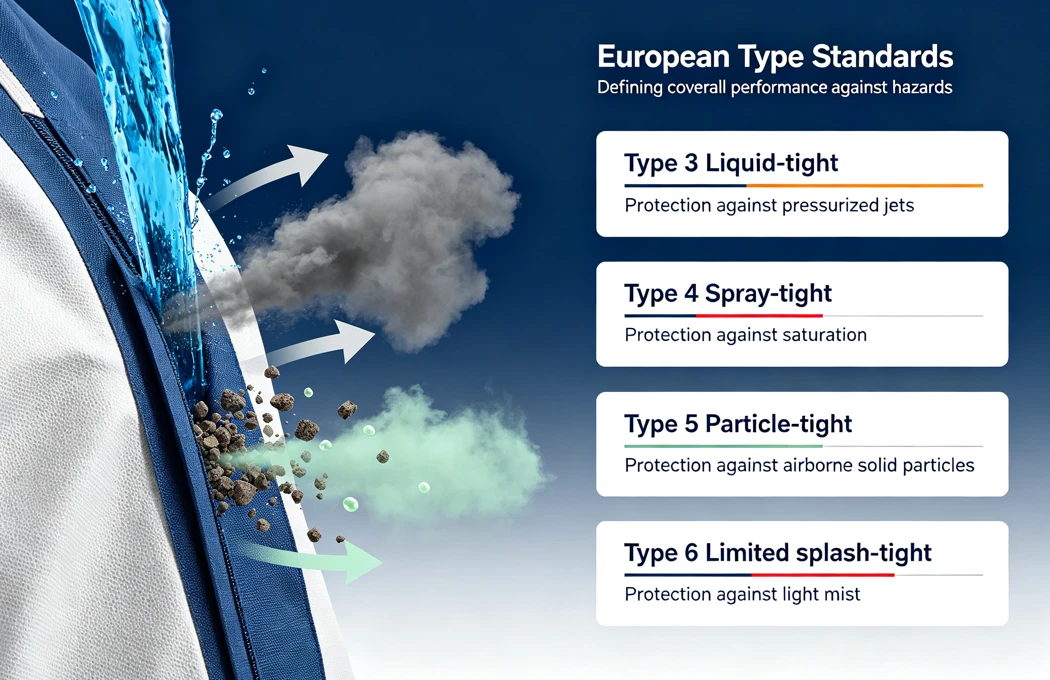
For coveralls, the CE “Type” system defines the garment’s ability to withstand different physical states of hazards.
- Type 3: Liquid-tight (protection against pressurized jets).
- Type 4: Spray-tight (protection against saturation).
- Type 5: Particle-tight (protection against airborne solid particles).
- Type 6: Limited splash-tight (protection against light mist).
Selection Criteria for Procurement Professionals
Choosing the right disposable PPE requires an analysis of the work environment and the duration of use.
Seam Construction and Integrity
The method used to join fabric panels is a critical failure point in protective clothing.
- Serged Seams: Standard stitching for low-risk dust protection.
- Bound Seams: Reinforced stitching for better strength.
- Taped Seams: Overlaid with waterproof tape to ensure no liquids or particles can penetrate the seam.
Breathability vs. Barrier
There is often an inverse relationship between protection and comfort. High-barrier garments like PE-coated suits can lead to heat stress. Procurement teams should look for “breathable” laminates (Microporous SF) that offer high protection while maintaining a high Moisture Vapor Transmission Rate (MVTR).
Manufacturing Quality and Traceability
Reliable protection starts at the factory level. Hubei Ruichen Protective Products Co., Ltd manages the entire production cycle, including the manufacturing of PE and CPE films. This vertical integration ensures consistent quality control and cost-efficiency for bulk orders.
Browse our high-performance protective clothing catalog
Conclusion
The diversity of disposable protective clothing types ensures that every industry, from medical to chemical processing, can find a tailored safety solution. By understanding the material properties of SMS and Microporous fabrics and adhering to international standards like AAMI and CE Types, buyers can ensure the safety of their workforce. As manufacturing technologies continue to advance, the next generation of disposable PPE will offer even higher levels of protection without sacrificing wearer comfort.
Reference Sources
CDC: National Institute for Occupational Safety and Health
AAMI: Association for the Advancement of Medical Instrument
FDA: US Food and Drug Administration PPE Regulations
OSHA: Occupational Safety and Health Administration
FAQ
1. What is the difference between an isolation gown and a surgical gown?
Surgical gowns are used in sterile environments and have higher requirements for critical zones like the chest and sleeves. Isolation gowns are typically used for general patient care and are often non-sterile with an open-back design for comfort.
2. Can I reuse disposable protective clothing?
No. Disposable PPE is designed for single-use only. The non-woven fibers and filter layers degrade after use and lose their barrier properties. Reusing these garments risks cross-contamination and safety failure.
3. Why is SMS material preferred for medical gowns?
SMS material features a meltblown layer that provides excellent bacterial filtration. It is fluid-repellent yet breathable, making it the industry standard for moderate-risk clinical environments where protection and comfort are both required.
4. What does Type 5/6 mean on a coverall label?
A Type 5/6 rating indicates the coverall is certified to protect against hazardous dry particles (Type 5) and limited liquid splashes or sprays (Type 6). This is the most common standard for industrial safety suits.
5. Are there antistatic disposable protective clothing types?
Yes. Many industrial coveralls are treated with an antistatic coating during the manufacturing process. This is essential for work in electronic assembly or environments where explosive vapors may be present.
One thought on “Types of Disposable Protective Clothing Explained”