
Blog
PP, SMS, and SMMS Fabric: A Technical PPE Comparison

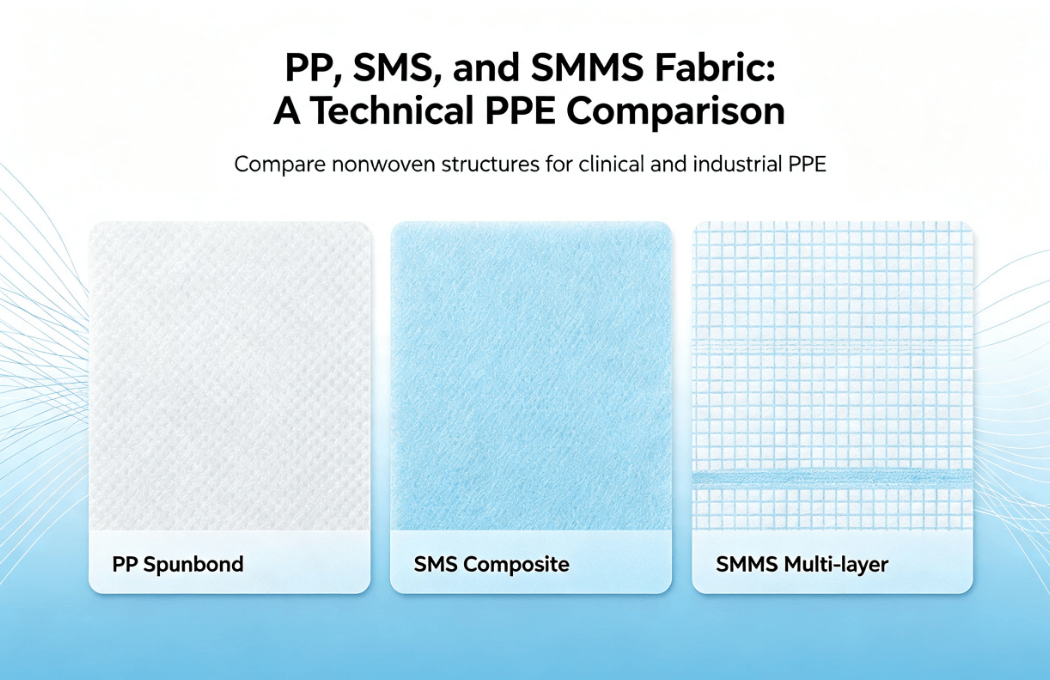
In the global personal protective equipment (PPE) industry, the choice of material is the single most critical factor determining the safety, comfort, and compliance of the finished product. For procurement managers, hospital infection control specialists, and safety engineers, navigating the acronyms of nonwoven fabrics—PP, SMS, and SMMS—is essential for matching the right level of protection to specific clinical or industrial risks.
Hubei Ruichen Protective Products Co., Ltd, situated in Xiantao, the heart of China’s non-woven production, recognizes that a “one-size-fits-all” approach to materials often leads to compromised safety or unnecessary expenditure. With over a decade of professional manufacturing and trading experience, our team emphasizes the importance of material science in protective clothing. This guide provides a technical breakdown of these three core nonwoven materials, their manufacturing structures, and their performance in real-world applications.
What Is Spunbond Polypropylene (PP/SBPP)?
Spunbond Polypropylene, often referred to as PP or SBPP, is the foundational material for many disposable protective products. It is a single-layer nonwoven fabric created through a continuous process where polypropylene chips are melted and then spun into long filaments. These filaments are laid onto a moving belt and bonded together—either thermally or chemically—to form a fabric.
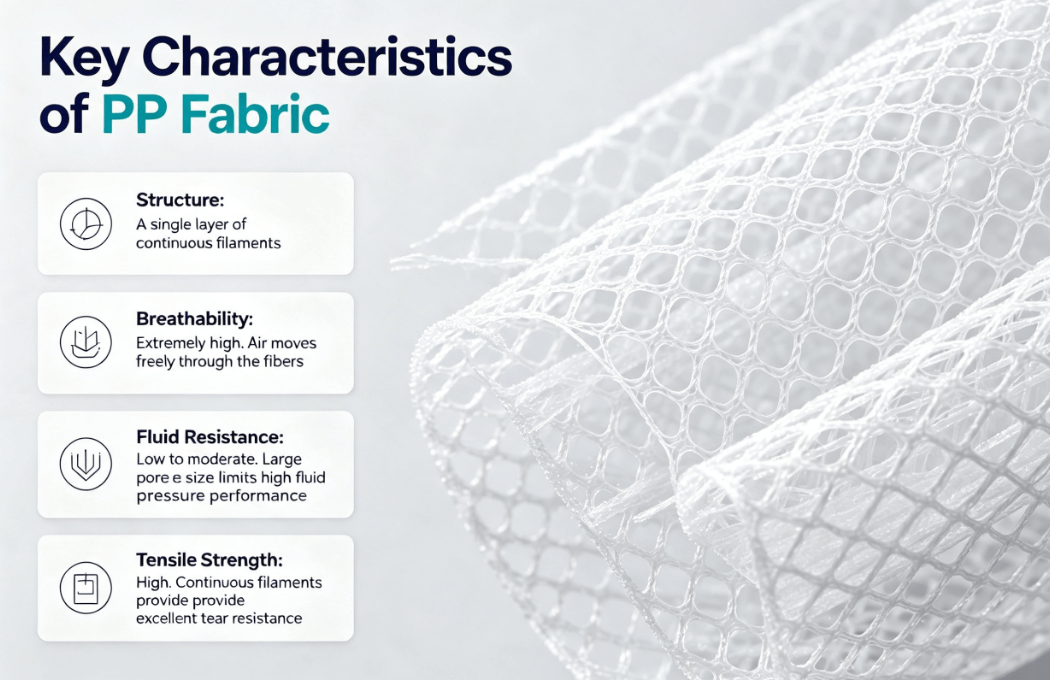
Key Characteristics of PP Fabric
- Structure: A single layer of continuous filaments.
- Breathability: Extremely high. Because it lacks a filtration layer, air moves freely through the fibers.
- Fluid Resistance: Low to moderate. While naturally hydrophobic (water-repellent), the large pore size between the fibers means it cannot withstand high fluid pressure.
- Tensile Strength: High. The continuous filaments provide excellent tear resistance.
Typical Applications of PP
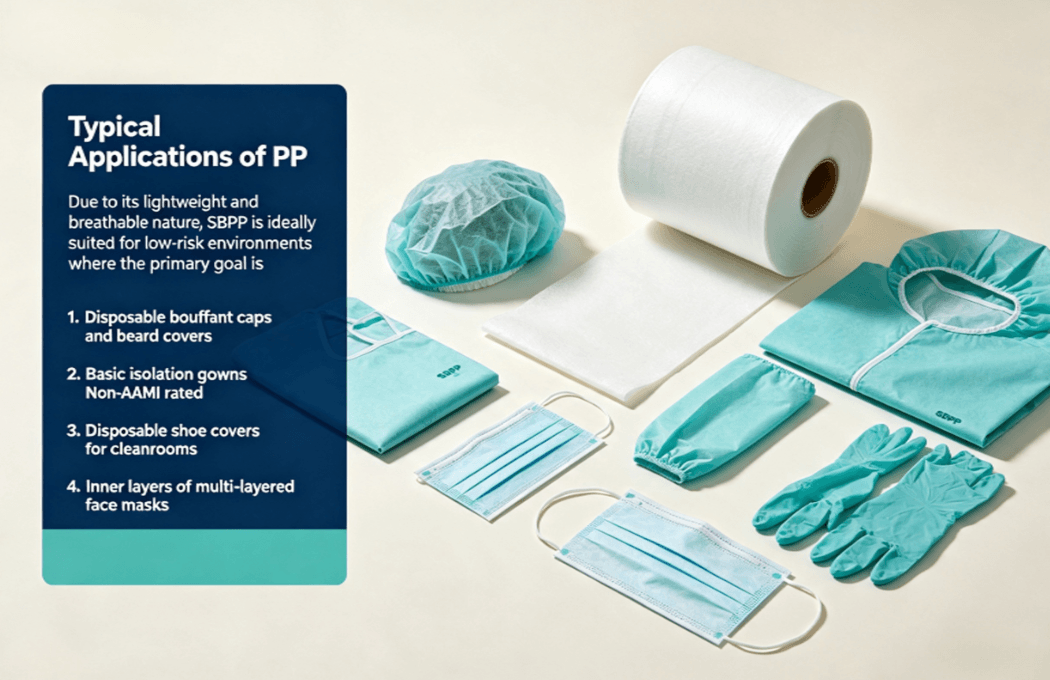
Due to its lightweight and breathable nature, SBPP is ideally suited for low-risk environments where the primary goal is hygiene rather than a biological barrier. Common products include:
- Disposable bouffant caps and beard covers.
- Basic isolation gowns (Non-AAMI rated).
- Disposable shoe covers for cleanrooms.
- Inner layers of multi-layered face masks.
Compared with single-layer PP nonwoven fabric, SMS nonwoven fabric provides improved barrier performance because its meltblown middle layer helps reduce pore size and enhance resistance to fluid penetration.
What Is SMS Nonwoven Fabric?
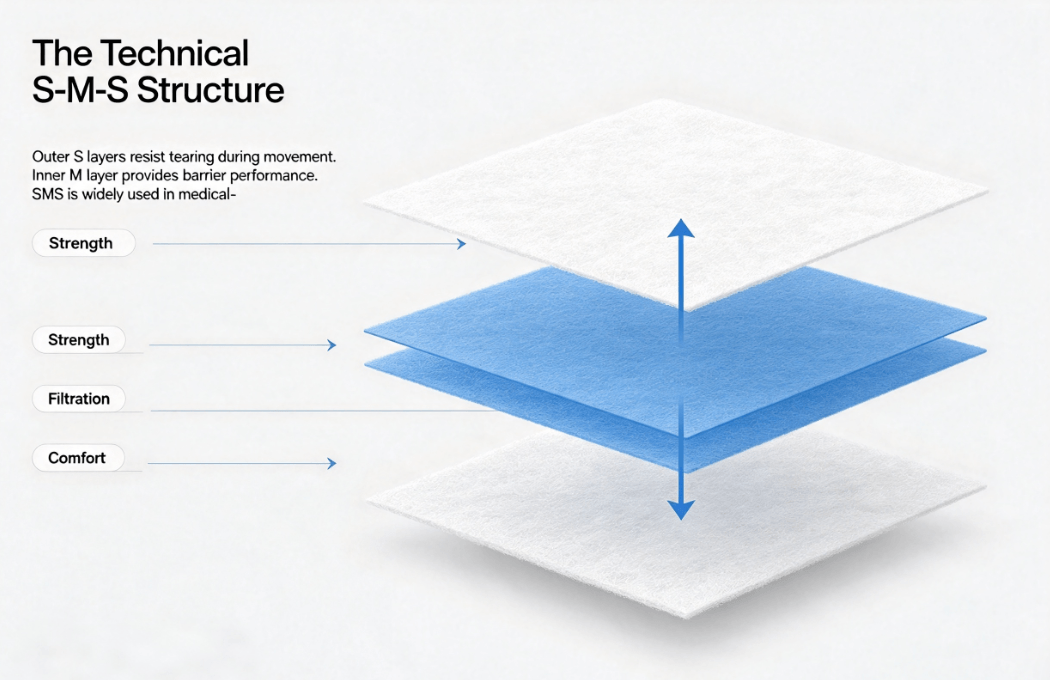
SMS (Spunbond-Meltblown-Spunbond) is a three-layer nonwoven fabric commonly used in medical and protective apparel. Its structure combines outer spunbond layers for strength with a central meltblown layer that improves filtration and fluid resistance.
| Feature | PP Nonwoven Fabric | SMS Nonwoven Fabric |
|---|---|---|
| Structure | Single-layer spunbond | Three-layer S-M-S |
| Breathability | High | Moderate to high |
| Fluid Resistance | Basic | Improved |
| Barrier Performance | Low to moderate | Moderate to high |
| Typical Application | Basic PPE | Medical protective apparel |
The Technical S-M-S Structure
The outer “S” layers provide the mechanical strength, durability, and abrasion resistance needed to help prevent the garment from tearing during movement. The inner “M” layer provides fine filtration and contributes to the fabric’s resistance to fluid penetration and airborne particulates. This three-layer structure gives SMS fabric a balanced combination of barrier performance, breathability, and wearer comfort, making it widely used in medical and protective apparel.
What Is SMMS Nonwoven Fabric?
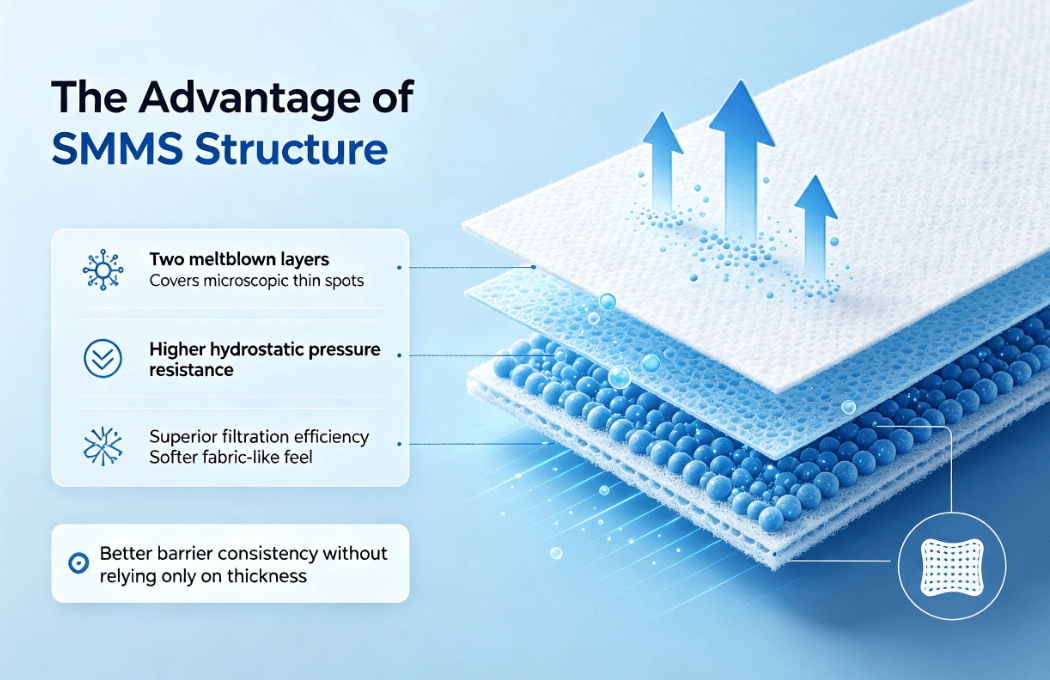
As medical standards have evolved, particularly with the rise of more stringent AAMI (Association for the Advancement of Medical Instrumentation) and EN standards, the industry has moved toward SMMS. This material adds a second meltblown layer to the structure (Spunbond-Meltblown-Meltblown-Spunbond).
Why the Extra M Layer Matters?
It is a common misconception that SMMS is simply “thicker” than SMS. The advantage lies in uniformity and pore density. By using two meltblown layers, manufacturers can ensure that any microscopic “thin spots” in one layer are covered by the second.
This results in higher hydrostatic pressure resistance, meaning the fabric can withstand more fluid pressure before “soak-through” occurs. It also provides superior filtration efficiency and enhanced protection against airborne particulates. Interestingly, SMMS often feels softer and more “fabric-like” than traditional SMS, which improves user compliance and comfort during long procedures.
SMS vs. SMMS Fabric: The Technical Comparison
When choosing between SMS and SMMS for products like surgical gowns or heavy-duty coveralls, the differences often come down to the specific protection levels required (e.g., AAMI Level 2 vs. Level 3).
| Feature | SMS Fabric | SMMS Fabric |
|---|---|---|
| Structure | 3-Layer (S-M-S) | 4-Layer (S-M-M-S) |
| Filtration Efficiency | Moderate to High | High to Very High |
| Fluid Resistance | Good (Suitable for AAMI Level 2) | Excellent (Suitable for AAMI Level 3) |
| Pore Size | More variable | Highly uniform and dense |
| Breathability | Good | Moderate (Slightly lower than SMS) |
| Common Use | Standard Isolation Gowns | Surgical Gowns / Sterilization Wraps |
Choosing Based on Fluid Exposure
For healthcare procurement, the decision is often driven by the anticipated volume of fluid exposure. SMS is typically sufficient for procedures with low-to-moderate fluid risk, such as standard patient care or minor surgical procedures. SMMS is the preferred choice for surgical environments where high volumes of irrigation fluids or blood are expected, requiring a more robust biological barrier.
Application Scenarios in Modern Healthcare and Industry
Understanding the material science allows facilities to optimize their PPE inventory. Here is how these materials are deployed across different sectors.
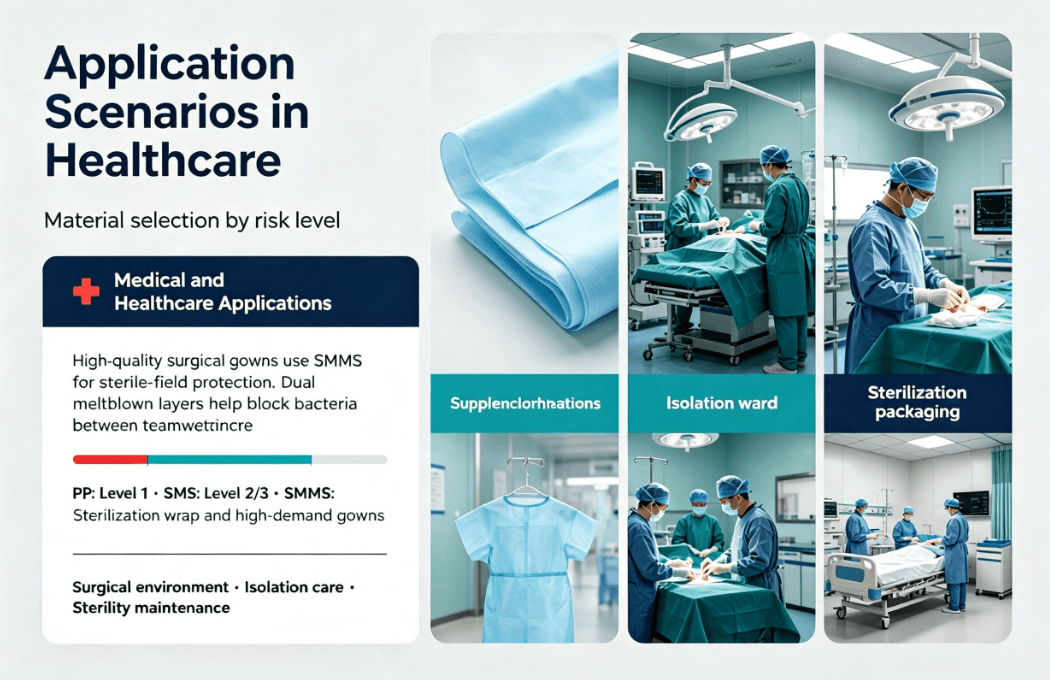
Medical and Healthcare Applications
In surgical environments, high-quality gowns utilize SMMS to meet the rigorous demands of the sterile field. The dual-meltblown layer ensures that bacteria from the surgical team do not contaminate the patient, and vice versa. For isolation gowns, the choice ranges from PP (Level 1) to SMS (Level 2/3) depending on the risk level. Additionally, SMMS is the gold standard for sterilization wraps, allowing for gas penetration while maintaining a microbial barrier.
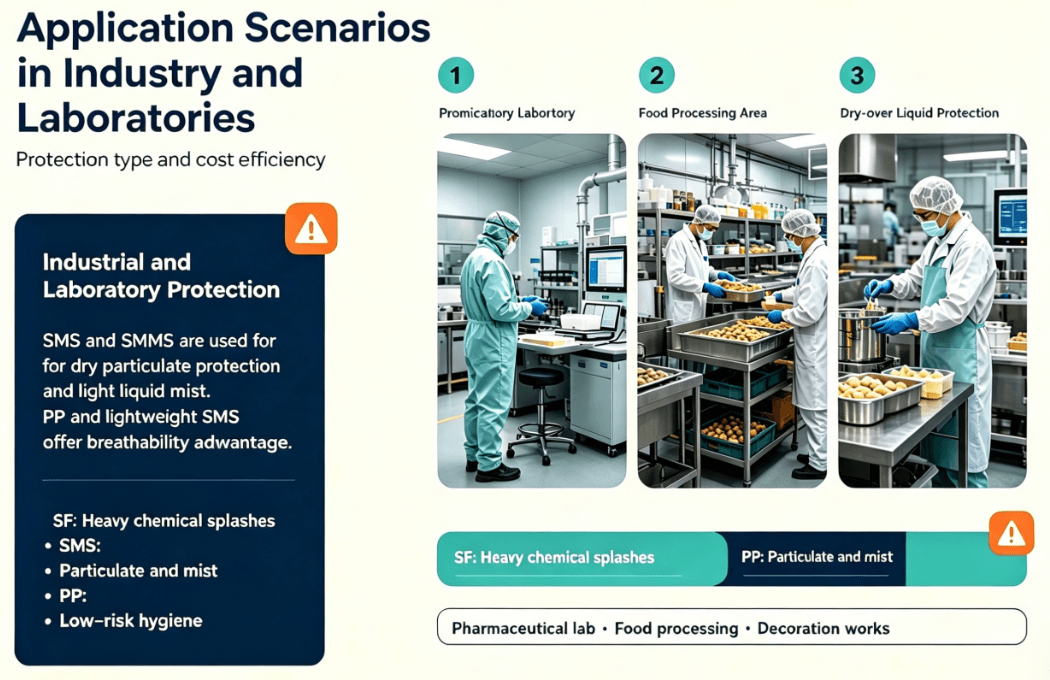
Industrial and Laboratory Protection
While SF (microporous film) is often used for heavy chemical splashes, SMS and SMMS are frequently utilized for dry particulate protection and light liquid mist in pharmaceutical labs. In food processing and decoration works, PP and lightweight SMS are preferred for their cost-effectiveness and breathability in high-temperature environments.
Manufacturing Considerations: Quality and Consistency
From a manufacturer’s perspective, the quality of SMS and SMMS is not just about the “letters” in the name, but the GSM (Grams per Square Meter) and the quality of the polypropylene resin used. At Hubei Ruichen, we emphasize that the “M” layer must be produced with precise control over air-blowing pressure and temperature.
If the meltblown fibers are too thick, the filtration fails; if they are too thin, the fabric loses its physical integrity. We produce the PE and CPE films ourselves to save costs and maintain quality control. Our CE, ISO9001, and ISO13485 certifications serve as a guarantee that the material has undergone rigorous testing for tensile strength, fluid penetration, and biocompatibility.
Conclusion
Choosing between PP, SMS, and SMMS is a balancing act between protection, comfort, and cost. PP is your choice for basic hygiene and particulate protection, while SMS offers the versatile middle ground for standard clinical barriers. SMMS provides the high-level security required for invasive surgical environments. As a leading manufacturer in Xiantao, Hubei Ruichen Protective Products Co., Ltd is dedicated to helping our global partners navigate these choices. By understanding the material science behind the product, procurement teams can ensure the safety of their staff while optimizing their supply chain efficiency.
FAQ
1. Is SMS fabric waterproof?
SMS is hydrophobic, meaning it repels water and resists fluid penetration. However, it is not “waterproof” in the same way as a plastic sheet. Under high pressure, fluids will eventually penetrate the pores. For 100% fluid proofing, a PE-laminated fabric (PP+PE) or SF material is usually required.
2. Does a higher GSM always mean better protection?
Not necessarily. While a higher GSM (weight) usually indicates a thicker fabric, the internal structure is more important. A 35GSM SMMS fabric may offer better filtration than a 45GSM PP fabric because of the specialized meltblown layers.
3. Can SMS or SMMS be reused?
Most SMS and SMMS protective products are designed for single-use to prevent cross-contamination. While the material is durable, the integrity of the meltblown filtration layer can be compromised by laundering, chemical cleaning, or intense sterilization heat.
4. How do I know if a gown is made of genuine SMMS?
Professional buyers should request a technical data sheet (TDS) and look for hydrostatic pressure test results. Genuine SMMS will show significantly higher fluid resistance values and a more uniform texture compared to standard SMS of the same weight.
5. What is the main benefit of SMMS over SMS in surgery?
The primary benefit is the increased reliability of the barrier. The extra layer of meltblown fabric reduces the risk of “pinholes” or weak spots, ensuring that the surgical field remains sterile even during long procedures involving significant fluid contact.