
Blog
Isolation Gowns Infection Control: Clinical Evidence & Selection Guide

Isolation gowns play an important role in infection control. Healthcare workers use them to protect skin and clothing from blood, body fluids, respiratory secretions, and contaminated surfaces.
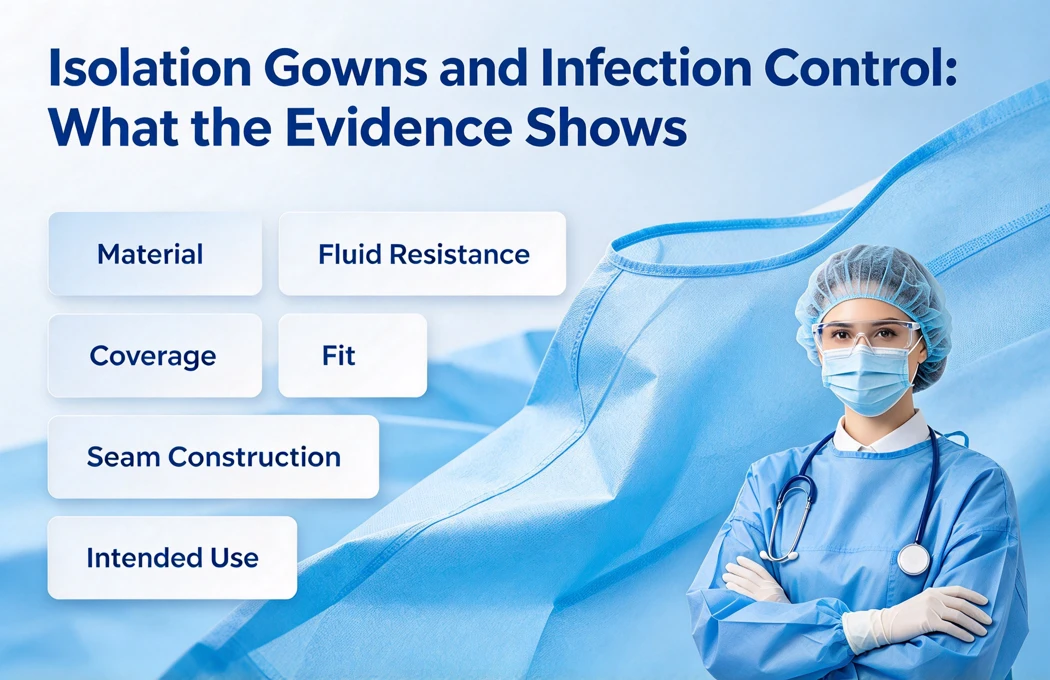
However, gown performance depends on more than wearing a disposable garment. Material, fluid resistance, coverage, fit, seam construction, and intended use all affect protection.
For healthcare procurement teams, understanding the evidence for isolation gowns infection control can make product selection more consistent. The right gown should match the expected exposure level and the requirements of the intended application.
Key Takeaways
- Isolation gowns help reduce contamination of clothing and skin during patient care.
- Gown selection should match the expected level of fluid exposure.
- AAMI PB70 provides a framework for evaluating liquid barrier performance.
- PP, SMS, PP+PE, and CPE gowns offer different combinations of protection and comfort.
- Buyers should review product specifications and applicable test documentation before placing bulk orders.
What Is the Role of Isolation Gowns in Infection Control?
Isolation gowns create a physical barrier between healthcare workers and potentially contaminated materials.
During patient care, workers may encounter blood, body fluids, respiratory secretions, or contaminated surfaces. When an infection-control protocol requires gown use, the garment helps limit contamination of the wearer’s skin and clothing.
Nevertheless, isolation gowns work as one part of a broader infection-control strategy. Depending on the situation, healthcare facilities may also require hand hygiene, gloves, masks, eye protection, environmental cleaning, and other precautions.
Evidence for Isolation Gowns Infection Control
The evidence for isolation gowns infection control supports using appropriate gowns as part of contact and transmission-based precautions when exposure to contaminated materials is expected.
However, a gown does not guarantee protection from infection. Its performance depends on the barrier properties of the material, garment construction, exposure conditions, and correct use.
Proper donning and doffing also matter. Incorrect removal can transfer contaminants to the wearer. Therefore, procurement teams should consider gown design together with staff training and established infection-control procedures.
Understanding AAMI PB70 Barrier Levels
AAMI PB70 provides a standardized framework for classifying the liquid barrier performance of protective apparel used in healthcare settings.
| AAMI Level | General Barrier Level | Typical Application |
|---|---|---|
| Level 1 | Minimal | Basic care with limited fluid exposure |
| Level 2 | Low | Procedures with greater fluid exposure |
| Level 3 | Moderate | Higher-fluid-risk procedures |
| Level 4 | Higher barrier performance | Applications requiring more demanding barrier testing |
These levels help buyers compare liquid barrier performance. However, procurement teams should not select a gown based on the AAMI level alone.
Instead, consider the expected exposure, garment construction, applicable testing, and facility requirements together. Buyers should also request technical documentation and applicable test reports for the exact product under consideration.
Isolation Gown Materials: PP, SMS, PP+PE and CPE
Material selection plays an important role when choosing isolation gowns.
Different materials offer different combinations of breathability, liquid resistance, coverage, and comfort. Therefore, buyers should match the material to the working environment rather than choosing only by material name or price.
PP Isolation Gowns
Spunbond polypropylene (PP) provides a lightweight option for disposable gowns. The material offers basic protective coverage while allowing a relatively breathable construction.
PP gowns can suit applications with limited fluid exposure when the product specifications meet the requirements of the intended use.
For example, a lightweight gown may work well for routine tasks where the main requirement is disposable coverage rather than a high liquid barrier.
SMS Isolation Gowns
SMS combines Spunbond, Meltblown, and Spunbond layers. This multilayer construction can provide a balance between barrier performance and breathability.
Ruichen offers an SMS Sky Blue Dust-Resistant Isolation Gown for medical, healthcare, laboratory, industrial, and cleanroom applications. The product uses 30–50 GSM material and supports OEM customization.
This type of gown can suit buyers who need a nonwoven construction with a balance of protection and wearer comfort.
PP+PE Isolation Gowns
PP+PE gowns combine polypropylene nonwoven material with a polyethylene film layer. The PE layer adds a liquid-resistant barrier to the nonwoven base.
Ruichen’s PP+PE Long Sleeve Isolation Gown for Laboratory Protection is designed for laboratory and related work environments. Buyers can also request OEM customization for specific procurement requirements.
This construction can be considered when a standard nonwoven gown does not provide the required level of liquid resistance.
CPE Gowns
CPE, or Cast Polyethylene, is a film material that provides strong resistance to liquid penetration.
A CPE gown may therefore suit applications where liquid exposure represents a primary concern. However, film-based materials generally provide less breathability than many nonwoven constructions.
As a result, buyers should consider both barrier requirements and wearing conditions, especially when workers may wear gowns for extended periods.
CPE Gown vs. SMS Gown: What Should Buyers Consider?
There is no universal answer when comparing CPE and SMS gowns. Each material has different characteristics, so the better option depends on the application.
| Factor | SMS Gown | CPE Gown |
|---|---|---|
| Material | Multilayer nonwoven | Cast polyethylene film |
| Breathability | Generally higher | Generally lower |
| Liquid resistance | Depends on construction and testing | Strong liquid barrier |
| Typical consideration | Balance of coverage and comfort | Higher liquid exposure |
| Main purchasing factor | Protection and breathability balance | Liquid resistance |
For routine patient-care environments, SMS may offer a practical balance between protection and comfort.
By contrast, applications with significant liquid exposure may require CPE or PP+PE constructions with suitable documented barrier performance.
Therefore, buyers should start with the exposure risk and then compare material options against the required specifications.
Choosing Isolation Gowns for Healthcare Applications
When choosing isolation gowns, procurement teams should evaluate several factors before placing a bulk order.
1. Fluid Exposure
First, determine the expected level of liquid exposure.
Basic care may require limited fluid resistance, while procedures involving larger amounts of blood or body fluids may require a stronger barrier.
2. Coverage
Next, check the gown’s coverage.
Important details include sleeve length, gown length, back coverage, cuffs, neckline, and closure design. These features affect how well the garment covers the wearer during different activities.
3. Material
Compare PP, SMS, PP+PE, and CPE according to the application’s barrier and comfort requirements.
For example, PP may suit lightweight coverage, while SMS can provide a balance between breathability and protection. PP+PE and CPE can offer additional liquid resistance when the application requires it.
4. Seam Construction
Seam construction can affect overall garment integrity.
Depending on the product, manufacturers may use stitched, welded, taped, or other seam constructions. Buyers should confirm that the seam design and construction support the intended product performance.
5. Documentation
Finally, review the product documentation before confirming a bulk order.
Useful documents may include:
- Product specifications
- Applicable test reports
- Material information
- Packaging details
- Quality certifications
- OEM specifications, when required
This documentation allows procurement teams to compare products using measurable specifications instead of relying only on product descriptions.
Isolation Gowns for B2B Procurement
The disposable gown market includes products made from different materials and designed for different applications.
Consequently, buyers should avoid selecting gowns based only on unit price or material name.
A practical procurement process can follow this sequence:
Application → Fluid Exposure → Material → Barrier Performance → Size → Packaging → Documentation → MOQ
For example, a lightweight PP gown may meet the requirements for basic disposable coverage. An SMS gown may provide a more balanced combination of breathability and barrier performance.
Meanwhile, PP+PE or CPE may be considered when the application requires stronger liquid resistance.
Ruichen provides disposable isolation gowns in PP, SMS, and PP+PE constructions for B2B buyers. OEM options include size, color, packaging, and branding requirements.
Recommended Isolation Gown Solutions
Buyers comparing different gown constructions can review several Ruichen options according to their application requirements.
For lightweight disposable coverage:
[Disposable PP Long Sleeve Isolation Gown]
For SMS nonwoven protection:
[SMS Sky Blue Dust-Resistant Isolation Gown]
For laboratory applications using a PP+PE construction:
[PP+PE Long Sleeve Isolation Gown for Laboratory Protection]
These products provide different material options for healthcare, laboratory, industrial, and cleanroom applications. Buyers can compare construction, specifications, packaging, and OEM requirements before selecting a suitable product.
Conclusion
Isolation gowns provide protective coverage when healthcare workers may encounter contaminated materials or body fluids.
The appropriate gown depends on the expected exposure, not simply on the material name.
When choosing isolation gowns, buyers should evaluate fluid resistance, material, coverage, seam construction, applicable barrier standards, and supplier documentation.
PP, SMS, PP+PE, and CPE gowns each offer different characteristics. Matching the garment construction to the intended application can help healthcare facilities establish a more consistent PPE procurement process.
Hubei Ruichen Protective Products Co., Ltd. provides disposable isolation gowns in multiple material constructions for medical, healthcare, laboratory, industrial, and cleanroom applications. OEM customization is available for B2B orders.
Frequently Asked Questions
What is the role of isolation gowns in infection control?
Isolation gowns create a physical barrier that helps protect healthcare workers’ skin and clothing from potentially contaminated materials during patient care.
What is the evidence for isolation gowns infection control?
Evidence supports using appropriate gowns as part of infection-control precautions when workers may encounter contaminated materials or body fluids. Facilities should also follow other applicable infection-control measures.
What is the difference between an SMS gown and a CPE gown?
SMS gowns use multilayer nonwoven material and generally provide greater breathability. CPE gowns use polyethylene film and generally provide stronger liquid resistance. The appropriate choice depends on the exposure and application.
How do buyers choose isolation gowns?
Buyers should consider fluid exposure, material, barrier performance, coverage, seam construction, size, packaging, applicable standards, and technical documentation.
Are PP isolation gowns suitable for medical applications?
PP gowns can suit medical applications that require lightweight disposable coverage when their documented specifications meet the requirements of the intended use.
When should buyers consider PP+PE isolation gowns?
Buyers can consider PP+PE gowns when an application requires a nonwoven gown with an additional polyethylene film barrier for increased liquid resistance.
What should buyers check when purchasing disposable gowns?
Buyers should review product specifications, applicable test reports, material information, quality certifications, packaging, MOQ, lead time, and OEM capabilities.
Is CPE always better than SMS for infection control?
No single material suits every application. CPE generally provides stronger liquid barrier properties, while SMS generally offers greater breathability. Buyers should select the construction according to the expected exposure and application requirements.