
Blog
Isolation Gown Manufacturer: Guide to Bulk & Custom Supply

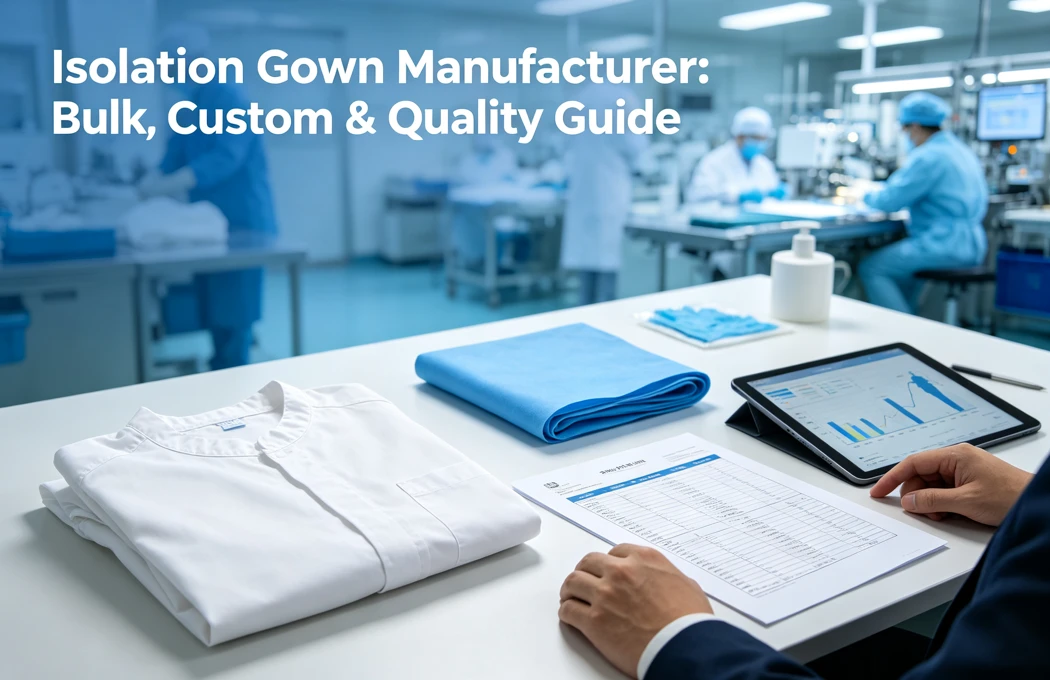
Choosing the right isolation gown manufacturer is important for hospitals, medical distributors, healthcare suppliers, and other organizations purchasing disposable protective apparel in bulk. Buyers need to evaluate more than unit price. Material selection, barrier performance, production capacity, quality control, customization capability, documentation, and export experience can all affect long-term supply reliability.
For bulk procurement, a qualified manufacturer should be able to clearly explain how its isolation gowns are made, which materials are available, what testing is performed, how products are inspected, and which customization options can be supported.
This guide explains what B2B buyers should evaluate when sourcing disposable isolation gowns from a manufacturer or supplier.
What Should You Look for in an Isolation Gown Manufacturer?
A reliable isolation gown supplier should provide more than a product catalog. Buyers should evaluate the manufacturer’s complete supply capability from raw materials to finished-goods inspection and shipment.
1. Manufacturing Capability
Start by confirming whether the supplier is an actual manufacturer, a trading company, or a combination of manufacturing and export operations.
For bulk orders, ask about:
- Production facilities and equipment
- Available nonwoven materials
- Daily or monthly production capacity
- Standard and custom product capabilities
- Quality inspection procedures
- Production lead times
- Packaging capabilities
- Export experience
Production capacity should also be evaluated together with raw-material availability. A factory may have sufficient production lines but still experience delays if required fabrics, packaging materials, or customized colors are unavailable.
2. Material and Barrier Performance
Isolation gowns can be manufactured from different nonwoven structures, including PP, SMS, and laminated materials.
However, buyers should not select a gown solely by material name. The appropriate product depends on the intended application and the required barrier performance.
For example, a lightweight PP gown may be suitable for lower-risk applications, while SMS or laminated structures may be selected when greater resistance to fluid penetration is required.
3. Quality Management and Testing
A medical PPE supplier should be able to explain how quality is controlled during incoming material inspection, production, and finished-product inspection.
For manufacturers operating within medical-device quality systems, ISO 13485:2016 provides requirements for a quality management system specific to medical devices.
Buyers should nevertheless verify the actual certification scope and determine whether it applies to the products and manufacturing activities being purchased.
4. OEM and Customization Capability
B2B buyers may require customized:
- Material
- GSM
- Size
- Sleeve design
- Cuff style
- Color
- Waist closure
- Neck closure
- Logo
- Polybag
- Carton marking
- Barcode
- Packaging quantity
A capable manufacturer should provide a clear sample approval and mass-production process before starting a customized order.
5. Bulk Supply and Export Experience
International buyers should also evaluate whether the supplier can consistently handle:
- Commercial invoices
- Packing lists
- Shipping documents
- Product specifications
- Certificates
- Test reports
- Carton labeling
- OEM packaging requirements
This information is particularly important for distributors and healthcare procurement teams purchasing repeated container or pallet quantities.
What Materials Are Used for Disposable Isolation Gowns?
Different materials provide different combinations of breathability, strength, softness, and resistance to liquid penetration.
PP Nonwoven
Polypropylene nonwoven is lightweight and commonly used for disposable protective apparel.
It can be suitable for applications where basic disposable coverage and comfort are more important than high liquid-barrier performance.
SMS Nonwoven
SMS combines spunbond and meltblown layers to provide a balance between strength, softness, breathability, and barrier performance.
For example, an SMS short sleeve isolation gown can be considered for healthcare environments requiring disposable coverage and a lightweight construction.
PP+PE Laminated Nonwoven
A PE laminated structure can provide greater resistance to liquid penetration than a basic nonwoven structure.
A PP+PE long sleeve isolation gown may therefore be specified for applications where additional liquid resistance is required.
How Should Buyers Compare Isolation Gown Materials?
Instead of assuming that one material automatically corresponds to a particular protection level, buyers should request the manufacturer’s actual test information for the finished gown.
Important parameters may include:
| Specification | What Buyers Should Check |
|---|---|
| Material | PP, SMS, PP+PE or other specified structure |
| GSM | Actual fabric weight and tolerance |
| Liquid resistance | Applicable test results |
| Seam construction | Ultrasonic welding or other construction |
| Sleeve | Short or long sleeve |
| Cuff | Elastic, knit or other specification |
| Size | Finished garment dimensions |
| Packaging | Pieces per bag and carton |
| Intended use | Healthcare or other specified application |
Understanding AAMI PB70 Levels for Isolation Gowns
ANSI/AAMI PB70 provides a classification system for protective apparel and drapes used in healthcare facilities based on liquid-barrier performance. The FDA recognizes PB70 as a consensus standard for evaluating and labeling gown barrier performance.
The four commonly referenced levels are:
| AAMI PB70 Level | General Risk Description | Typical Examples |
|---|---|---|
| Level 1 | Minimal risk | Basic care and standard isolation |
| Level 2 | Low risk | Blood draw, suturing, ICU and pathology applications |
| Level 3 | Moderate risk | Arterial blood draw, IV procedures and trauma care |
| Level 4 | High risk | Long, fluid-intensive procedures and certain high-risk applications |
These application examples are based on FDA descriptions of the AAMI PB70 classification system.
Why Material Alone Does Not Determine the AAMI Level
This is an important point for procurement teams.
An isolation gown should not be labeled as Level 1, 2, 3, or 4 simply because it uses PP, SMS, PP+PE, or another material.
The classification relates to the tested barrier performance of the protective apparel, not simply the name of the fabric.
Therefore, buyers should ask the manufacturer for applicable test reports and product documentation supporting the claimed performance.
FDA’s recognized standards database currently includes ANSI/AAMI PB70:2022 and ASTM F3352/F3352M for isolation gowns intended for use in healthcare facilities.
How to Customize Isolation Gowns for Bulk Orders
For distributors, hospitals, and institutional buyers, customization can help align the gown with specific procurement requirements.
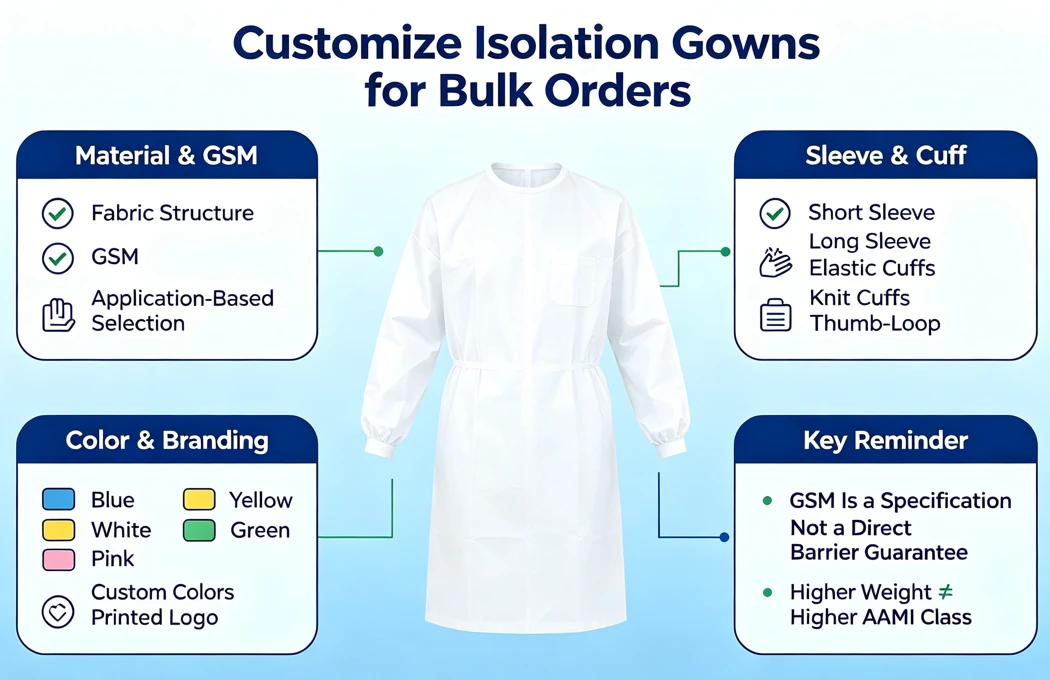
Material and GSM
Buyers can specify the desired material structure and GSM based on the intended application.
GSM should be treated as a specification rather than a direct guarantee of barrier performance. Higher fabric weight does not automatically mean a gown has a higher AAMI classification.
Sleeve and Cuff Options
Common configurations include:
- Short sleeve
- Long sleeve
- Elastic cuffs
- Knit cuffs
- Thumb-loop options where applicable
Long sleeves and secure cuffs may be specified when greater arm coverage is required.
Size and Dimensions
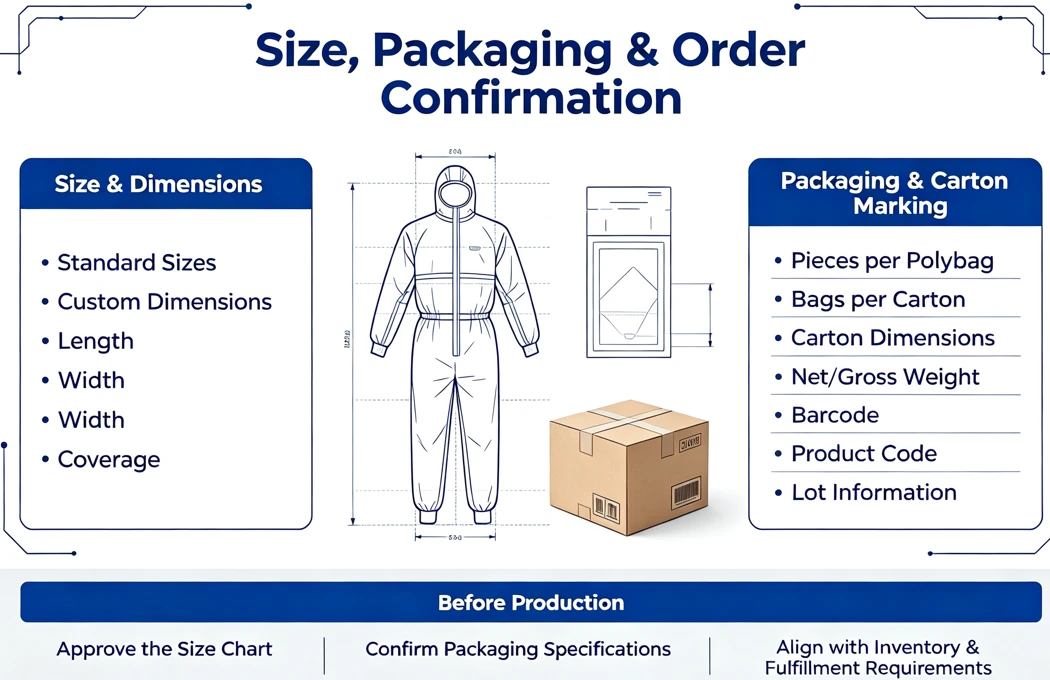
Manufacturers can usually provide different sizes or customized dimensions.
For bulk orders, buyers should approve a final size chart before production because seemingly small dimensional differences can affect fit, coverage, and packaging.
Color and Branding
Common colors include:
- Blue
- White
- Yellow
- Green
- Sky blue
- Pink
- Custom colors
OEM buyers can also request printed logos, product labels, carton markings, or customized packaging.
Packaging and Carton Marking
Packaging specifications may include:
- Pieces per polybag
- Bags per carton
- Carton dimensions
- Gross and net weight
- Barcode
- Product code
- Lot or batch information
- Customer branding
Clear packaging specifications help distributors manage warehouse inventory and downstream fulfillment.
What Quality Tests Should an Isolation Gown Manufacturer Provide?
Quality control should cover both raw materials and finished garments.
Raw Material Inspection
Before production, manufacturers can inspect incoming materials for specifications such as:
- GSM
- Width
- Appearance
- Uniformity
- Tensile performance
- Material structure
The exact inspection parameters should correspond to the approved material specification.
Finished Product Inspection
Finished gowns should be checked for:
- Dimensions
- Sewing or welding quality
- Cuff construction
- Closure performance
- Fabric defects
- Packaging quantity
- Labeling
- Overall appearance
Liquid Barrier Testing
For gowns marketed with liquid-barrier claims, buyers should request test documentation supporting the stated performance.
Depending on the product and applicable standard, testing may address water impact penetration, hydrostatic pressure, or other relevant barrier properties.
FDA’s recognized standards database lists ASTM F1670, ASTM F1671, ASTM F3352 and ANSI/AAMI PB70 among recognized standards relevant to protective gowns and barrier performance.
Seam and Construction Inspection
The gown’s seams and closures are important because the finished product must provide the intended level of protection across its construction.
For disposable nonwoven gowns, ultrasonic welding may be used to join material layers without conventional needle holes.
However, the production method itself should not be treated as proof of barrier performance. Finished-product testing and inspection remain important.
Documentation and Traceability
B2B buyers should request documentation that allows the delivered products to be linked to the approved specification and production batch.
Depending on the product and market, documentation may include:
- Product specification sheet
- Test reports
- Certificate of Analysis
- Certificate of Conformity
- Quality inspection records
- Packing list
- Commercial invoice
The exact documentation should be agreed before the purchase order is issued.
What Should Buyers Ask an Isolation Gown Supplier?
Before placing a bulk order, procurement teams can use the following checklist.
Manufacturer Checklist
Manufacturing
- Are you a manufacturer or trading company?
- Where is the production facility located?
- What is your production capacity?
- What materials can you manufacture?
Product
- What material is used?
- What GSM options are available?
- What sizes and colors are available?
- What sleeve and cuff options are available?
- Is the gown sterile or non-sterile?
Testing
- What barrier-performance tests are available?
- Can you provide relevant test reports?
- What standards are the reports based on?
- Can the reports be traced to the supplied product?
Customization
- Can you customize GSM?
- Can you customize size and color?
- Can you print logos?
- Can you customize packaging?
- What is the MOQ for OEM orders?
Supply
- What is the standard production lead time?
- What is the MOQ?
- How do you manage raw-material supply?
- Can you support repeat orders?
Export
- Which markets do you currently supply?
- What export documentation can you provide?
- Can you support customized carton markings and shipping documents?
Why Work With Hubei Ruichen as an Isolation Gown Manufacturer?
Hubei Ruichen Protective Products Co., Ltd. is a China-based manufacturer and exporter of disposable nonwoven and plastic protective products.
Its isolation gown product range covers different material structures, sleeve configurations, colors, sizes, and application requirements.
For B2B buyers, the product portfolio can be used to develop customized procurement specifications based on material, garment design, packaging, and order quantity.
Ruichen’s isolation gown range includes options such as:
- Disposable PP isolation gowns
- SMS isolation gowns
- PP+PE isolation gowns
- Short sleeve isolation gowns
- Long sleeve isolation gowns
- Liquid-resistant isolation gowns
- Customized isolation gowns
Buyers can review the complete isolation gown product range to compare available configurations and identify a suitable starting specification for bulk procurement.
For OEM projects, the buyer can provide requirements for material, GSM, size, color, packaging, branding, and quantity before sample approval and production.
The key advantage of working directly with a manufacturer is that product specifications can be discussed at the production level rather than being limited to standard catalog products.
Conclusion
Choosing an isolation gown manufacturer should be based on more than price.
B2B buyers should evaluate the manufacturer’s production capability, material options, finished-product performance, quality-control procedures, customization capabilities, documentation, MOQ, lead time, and export experience.
A reliable procurement process begins with a clearly defined product specification. Buyers should also verify performance claims through appropriate test documentation rather than assuming that a particular fabric automatically corresponds to a specific protection level.
For hospitals, distributors, and international PPE importers, establishing these requirements before placing a bulk order can make supplier evaluation more transparent and help maintain consistency across repeat orders.
FAQ
1. What should I look for in an isolation gown manufacturer?
Look for manufacturing capability, appropriate material options, documented quality-control procedures, relevant product testing, OEM capability, stable production capacity, clear MOQ and lead-time information, and experience with international B2B shipments.
2. What materials are commonly used for disposable isolation gowns?
Common materials include PP nonwoven, SMS nonwoven, and PP+PE laminated nonwoven. The appropriate material depends on the intended application and required performance.
3. Does the material determine the AAMI PB70 level?
No. AAMI PB70 classification is based on the barrier performance of the protective apparel. Material type alone should not be used to assign an AAMI level. Buyers should request applicable test documentation supporting the claimed level.
4. Can isolation gowns be customized for bulk orders?
Yes. Depending on the manufacturer, buyers may customize material, GSM, size, color, sleeve type, cuffs, closures, packaging, labeling, and branding.
5. What certifications or documents should I request?
The required documentation depends on the product, intended use, and destination market. Buyers may request quality-system certificates, product specifications, applicable test reports, declarations or certificates required by the target market, and shipment documentation.
6. What is the typical MOQ for bulk isolation gowns?
MOQ varies by manufacturer, material, product configuration, color, packaging, and customization requirements. Buyers should confirm the MOQ for the exact specification rather than relying on a general industry number.
7. How long does bulk isolation gown production take?
Lead time depends on order quantity, material availability, customization, packaging, and factory production schedules. Buyers should confirm the production schedule before placing the purchase order and allow additional time for customized products.
8. Can an isolation gown manufacturer provide OEM packaging?
Many B2B manufacturers can customize polybags, labels, cartons, barcodes, product information, and other packaging elements. The exact options and MOQ should be confirmed during the quotation and sample stage.