

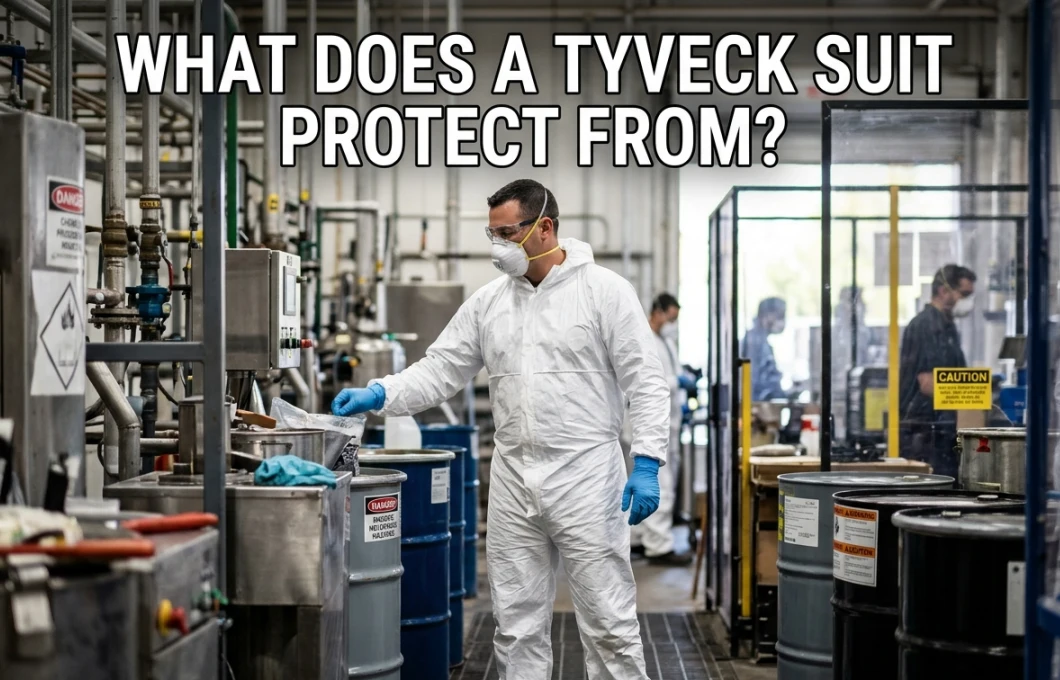
What Does a Tyvek Suit Protect From?

A protective coverall is often the first thing workers reach for when a job involves dust, splashes, or potentially harmful substances. But choosing the right suit is not as simple as looking at its material or appearance.
Tyvek® suits are widely used in industrial, laboratory, pharmaceutical, and other controlled work environments. Their lightweight construction makes them practical for tasks where workers need a barrier against airborne particles and certain forms of contamination without wearing heavy protective clothing.
So, what does a Tyvek suit protect from? The answer depends on the garment model, its construction, and the hazards involved. Understanding these differences can help safety managers, PPE buyers, and workers make a more informed choice.
What Is a Tyvek Suit?
Tyvek® is a nonwoven material developed by DuPont. It is made from high-density polyethylene (HDPE) fibers that form a lightweight, continuous web.
Unlike ordinary woven fabric, this structure provides a combination of particle barrier performance, durability, and breathability. It helps prevent many fine particles from passing through the material while remaining relatively comfortable to wear during demanding work.
Tyvek protective coveralls commonly feature a hood, elastic cuffs, an elastic waist, and ankle openings. Some designs also include a front zipper and additional protective features to help reduce gaps around the body.
These garments are used in industries where workers need to keep dust, particles, and other contaminants away from their skin and everyday clothing.
However, not every Tyvek coverall offers the same level of protection. A standard garment designed for particulate exposure should not be treated as equivalent to a specialized chemical or biological protective suit.
What Does a Tyvek Suit Protect From?
The main purpose of Tyvek suit protection is to provide a barrier against certain airborne particles and contaminants. Depending on the garment design and certification, some models can also provide limited protection against liquid splashes and specific biological hazards.
Here is a closer look at the types of exposure these garments may help control.
1. Airborne Particles, Dust, and Fibers
Fine particles are common in many workplaces. Construction sites, woodworking facilities, insulation projects, pharmaceutical production areas, and industrial maintenance operations can expose workers to dust and airborne contaminants.
Tyvek material has a dense fiber structure that helps prevent many small particles from penetrating the fabric. This makes suitable Tyvek coveralls a practical choice for tasks involving dry particulate contamination.
For example, workers handling dusty materials or cleaning industrial equipment may wear disposable coveralls to keep particles from settling on their skin and personal clothing.
The actual protection level depends on the garment’s classification. For example, Type 5 protective clothing is designed for protection against hazardous dry particulate matter when tested under the relevant requirements.
A coverall alone does not protect the respiratory system. Workers exposed to airborne hazards may also need a properly selected respirator, based on the workplace risk assessment.
2. Liquid Splashes and Non-Hazardous Liquids
Can a Tyvek suit protect against liquids?
Some Tyvek garments provide resistance to water penetration and limited protection against liquid splashes. This can be useful during cleaning, maintenance, and other activities where occasional contact with non-hazardous liquids is possible.
However, splash resistance should not be confused with complete waterproofing.
The level of protection depends on the fabric, seams, zipper construction, and garment design. Liquid can enter through openings or seams even when the fabric itself provides a barrier.
For this reason, workers handling liquids should check the garment’s specific performance classification. Type 6 garments, for example, are designed to provide limited protection against light liquid spray and splashes under defined test conditions.
When the task involves continuous liquid contact, pressurized sprays, or large quantities of hazardous liquids, a higher level of chemical protective clothing may be necessary.
3. Chemical Particles and Certain Chemical Exposures
Chemical protection is one area where workers should be particularly careful.
A suitable Tyvek coverall can help reduce contact with certain dry chemical particles and powders. Some specialized models are also designed to provide protection against specific liquid chemical hazards.
That does not mean every Tyvek suit is suitable for handling chemicals.
Chemical resistance varies according to the substance, its concentration, temperature, exposure time, and the construction of the protective garment. A material that resists one chemical may provide inadequate protection against another.
Before selecting a suit for chemical handling, safety managers should review the manufacturer’s chemical resistance and permeation data. They should also consider the required protection type and the performance of seams, closures, and other garment components.
For more demanding chemical environments, specialized chemical protective clothing may be a better option.
Choosing PPE based on the actual chemical hazard is far more reliable than assuming that all disposable coveralls provide the same protection.
4. Biological Contaminants
Tyvek protective clothing is also used in certain environments where biological contamination is a concern.
Examples include pharmaceutical production, laboratory work, healthcare support activities, and facilities handling potentially contaminated materials.
Depending on the model, the garment material may provide a barrier against certain biological agents. Some specialized garments undergo testing for resistance to penetration by bloodborne pathogens or infective agents.
Still, there is an important difference between fabric barrier performance and the protection offered by a complete garment.
Seams, zippers, cuffs, hood openings, and the fit around the wearer can all affect the overall barrier. A suit with an appropriate material does not automatically provide complete protection against viruses or bacteria.
Healthcare workers and laboratory personnel should select garments according to the exposure risk and applicable standards. Gloves, eye protection, respiratory protection, and proper donning and doffing procedures may also be required.
What Can a Tyvek Suit NOT Protect You From?
Understanding the limitations of protective clothing is just as important as understanding its benefits.
A standard Tyvek suit is not designed for every hazardous working environment.
Open flames and high temperatures
Tyvek garments are not inherently flame-resistant or flame-retardant. They should not be used around open flames, sparks, or other potential ignition sources. They can ignite, burn, and melt when exposed to sufficient heat.
Workers performing welding, hot work, or tasks involving fire hazards need protective clothing specifically designed and certified for those conditions.
All types of hazardous chemicals
A general-purpose Tyvek coverall cannot be assumed to resist every chemical. Strong solvents, concentrated chemicals, and substances with high permeation potential may require specialized chemical protective garments.
Heavy liquid exposure
Standard particle-protective garments and limited-splash coveralls are not intended to replace liquid-tight protective suits. High-pressure sprays, prolonged liquid contact, and substantial chemical splashes require a more suitable protection system.
Every biological exposure scenario
A fabric test does not guarantee that the complete suit will prevent all biological contamination. The garment’s seams, closures, fit, and overall protection classification must match the exposure conditions.
These limitations are important when selecting PPE for industrial and healthcare applications. The right suit should be chosen according to the actual hazard, not simply because it is labeled Tyvek.
Common Tyvek Suit Uses Across Different Industries
The lightweight construction and particle barrier properties of Tyvek garments make them suitable for a range of work environments.
Construction and Industrial Maintenance
Construction workers and maintenance teams may encounter dust, fibers, and debris during renovation, equipment cleaning, and insulation-related activities.
A suitable disposable coverall can help keep these contaminants away from the worker’s clothing and skin.
Pharmaceutical and Laboratory Facilities
Pharmaceutical production and laboratory environments often require clothing that helps control contamination from people and surrounding materials.
Specialized Tyvek garments are used in certain controlled environments because of their particle barrier properties. Cleanroom applications may require garments that have undergone additional processing and packaging to meet specific cleanliness requirements.
Healthcare and Medical Support
Certain Tyvek garments are used in healthcare-related environments where protection against particulate or biological contamination is needed.
However, they should not automatically be considered substitutes for medical isolation gowns or surgical gowns. Each product serves a different purpose and must meet the requirements of its intended application.
Painting and Surface Treatment
During selected painting and surface treatment tasks, workers may need protection from dust, dry particles, and limited splashes.
A suitable protective coverall can reduce contamination of personal clothing. For spray painting or exposure to solvent-based products, however, the chemical resistance and required protection classification must be checked before use.
Tyvek vs. Microporous Coveralls: What Is the Difference?
Tyvek and microporous coveralls are both used as disposable protective clothing, but their material structures and performance characteristics are different.
Tyvek uses a flash-spun HDPE fiber structure. Microporous coveralls generally use a nonwoven fabric laminated with a microporous film.
The best option depends on the work environment and the level of protection required.
| Comparison | Tyvek Coveralls | Microporous Coveralls |
|---|---|---|
| Material structure | Flash-spun HDPE nonwoven | Nonwoven fabric with microporous film |
| Particle protection | Designed to provide a barrier against fine particles | Depends on film structure and garment construction |
| Liquid resistance | Varies by garment model | Often designed for improved liquid splash resistance |
| Breathability | Allows water vapor transmission | Varies with film design and material construction |
| Typical applications | Industrial maintenance, laboratories, pharmaceutical environments | Industrial cleaning, painting, maintenance, and selected chemical splash applications |
| Protection level | Depends on garment classification | Depends on garment classification |
Neither material is automatically better for every application.
For example, a worker handling dry particulate materials may prefer a suitable Tyvek garment. Someone working in an environment with a greater likelihood of liquid splashes may need a microporous coverall with an appropriate tested classification.
Buyers should compare the complete garment’s test results rather than making a decision based on material names alone.
How to Choose the Right Protective Coverall
Selecting disposable protective clothing starts with understanding what workers may come into contact with during their tasks.
A few practical questions can help narrow down the options.
What type of hazard is present?
Identify whether the main exposure involves dry particles, liquid splashes, chemicals, biological contaminants, or a combination of hazards.
How intense is the exposure?
Occasional contact with dust is different from continuous exposure to concentrated chemicals or pressurized liquid sprays. The garment must match the expected exposure conditions.
Which protection classification is required?
Check the product’s applicable standards and certification documents. Depending on the application, buyers may need to review classifications such as Type 5 or Type 6 under EN 13034 and EN ISO 13982-1 requirements.
Does the complete garment provide sufficient coverage?
Consider the hood, cuffs, ankles, zipper, and seams. Additional taping or compatible accessories may be necessary for certain applications.
Will workers be comfortable wearing it?
Fit, breathability, freedom of movement, and the expected wearing time all influence whether workers can use the garment correctly throughout a shift.
A well-selected protective coverall should provide the required barrier without creating unnecessary restrictions during normal work.
FAQ About Tyvek Suit Protection
1. Does a Tyvek suit protect against viruses?
Some specialized Tyvek garments have been tested for resistance to penetration by infective agents or bloodborne pathogens. However, protection varies by model and complete garment construction. Always check the manufacturer’s test data and intended use before selecting a suit for biological hazards.
2. Can Tyvek suits protect against chemicals?
Certain models provide protection against specific chemical exposures, but not all Tyvek suits are chemical protective suits. Check chemical permeation data, garment classification, and exposure conditions before use.
3. Are Tyvek suits waterproof?
Tyvek material can resist water penetration, and some garments provide limited splash protection. However, standard Tyvek coveralls should not automatically be considered waterproof or suitable for prolonged liquid exposure.
4. Can you wear a Tyvek suit around fire?
No. Standard Tyvek protective garments are not flame-resistant. They can ignite, burn, and melt when exposed to heat or flames. Use protective clothing specifically designed for fire-related hazards.
5. Are Tyvek and microporous coveralls the same?
No. Tyvek uses a flash-spun HDPE fiber structure, while microporous coveralls generally combine nonwoven fabric with a microporous film. Their barrier properties, breathability, and applications can differ.
6. Are Tyvek suits reusable?
Many Tyvek protective coveralls are designed for limited use rather than repeated washing and reuse. Follow the manufacturer’s instructions and replace garments that become damaged, contaminated, or otherwise unsuitable for use.
Choose Protective Clothing Based on Your Working Environment
There is no single disposable coverall that suits every industrial or medical application. Dust control, liquid splash protection, chemical resistance, and biological barrier performance all require different considerations.
Tyvek suits are a practical option for many environments involving fine particles and selected contamination risks. However, the right garment depends on its tested performance, construction, and intended application.
For PPE distributors, importers, and industrial buyers, comparing product specifications and certification documents before placing an order can help avoid mismatches between garment performance and workplace requirements.
If you are comparing Tyvek-style and microporous protective coveralls for your market, consider the material, protection classification, garment design, and customization requirements together. This makes it easier to identify a product that fits both the working conditions and your customers’ purchasing needs.