
Blog
Disposable Protective Clothing Types: Technical Guide

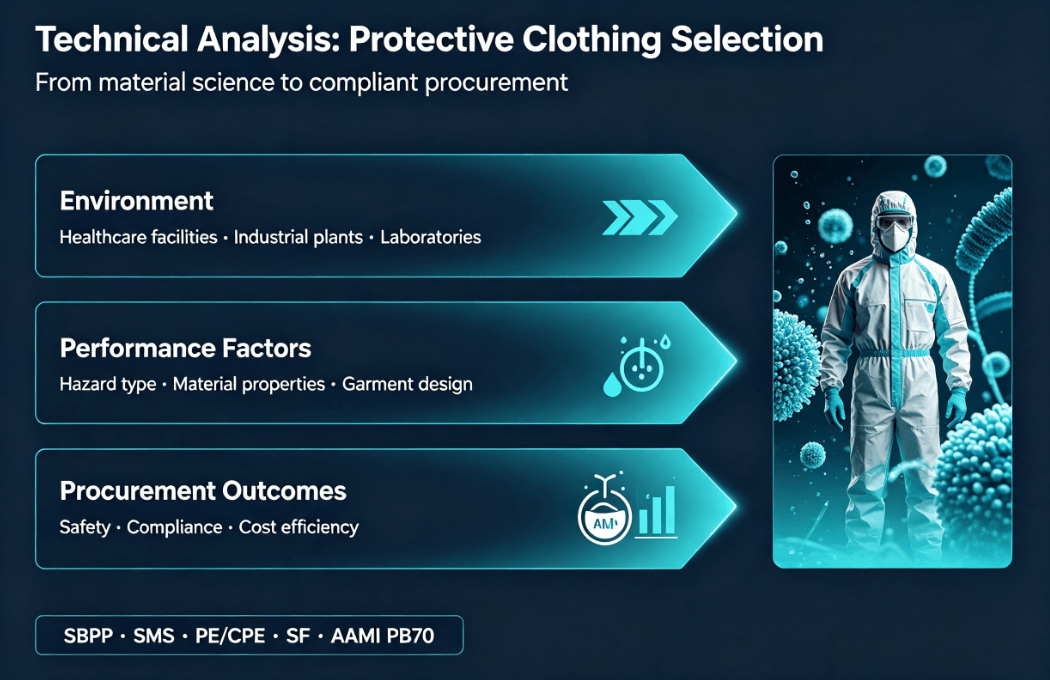
Selecting the correct disposable protective clothing is a critical decision for healthcare facilities, industrial plants, and laboratory environments. The safety of personnel depends on matching the specific environmental hazards to the material properties and design of the garment. This technical analysis explores the various types of disposable protective apparel available in the global market today.
We will focus on the material science, international standards, and practical procurement considerations. For buyers, understanding these nuances ensures both compliance and cost-efficiency.
Classification by Material Science
The barrier performance of any protective garment begins with its substrate. Manufacturers utilize different non-woven technologies to achieve specific resistance levels against fluids, particulates, and pathogens.
Spunbonded Polypropylene (SBPP)
SBPP is the most common and economical non-woven material used in the PPE industry. It is produced by extruding spun filaments of polypropylene onto a moving belt. These filaments are then thermally bonded to create a fabric that is lightweight and breathable.
SBPP is highly valued for its air permeability, which reduces heat stress for the wearer. However, it offers limited resistance to liquids. It is most suitable for basic hygiene applications where the primary goal is to prevent dust or hair from contaminating a workspace.
SMS and SMMS (Spunbond-Meltblown-Spunbond)
SMS is a multi-layered fabric designed to combine strength with filtration. The outer Spunbond layers provide physical durability and abrasion resistance. The inner Meltblown layer consists of extremely fine microfibers that act as a filter for bacteria and fine particles.
SMMS (four layers) provides an even denser filtration barrier. These materials are the industry standard for surgical gowns and high-quality isolation apparel. They offer a balanced performance profile, providing fluid resistance while allowing moisture vapor to escape.
PE Laminated (PP+PE)
PP+PE material involves a standard Spunbond Polypropylene base that is coated with a solid Polyethylene film. This lamination process creates a total barrier that is impervious to liquids.
In environments with high fluid exposure, such as decontamination units or heavy industrial cleaning, PP+PE is essential. The primary trade-off for this total fluid protection is a significant reduction in breathability. Wearers may experience rapid heat buildup during prolonged use.
SF Microporous Film
SF material represents a technological advancement in protective fabrics. It laminates a microporous film to a Spunbond base. The pores in the film are strategically sized to block liquid water and blood-borne pathogens while allowing moisture vapor to pass through.
This material is widely used for Type 5 and Type 6 protective coveralls. It provides the high-level barrier protection required for chemical or pharmaceutical manufacturing without the extreme discomfort associated with solid PE films.
Core Types of Disposable Protective Clothing
The design of a garment determines its application and the body surface area protected. Each type serves a specific role in an integrated safety protocol.
Disposable Isolation Gowns
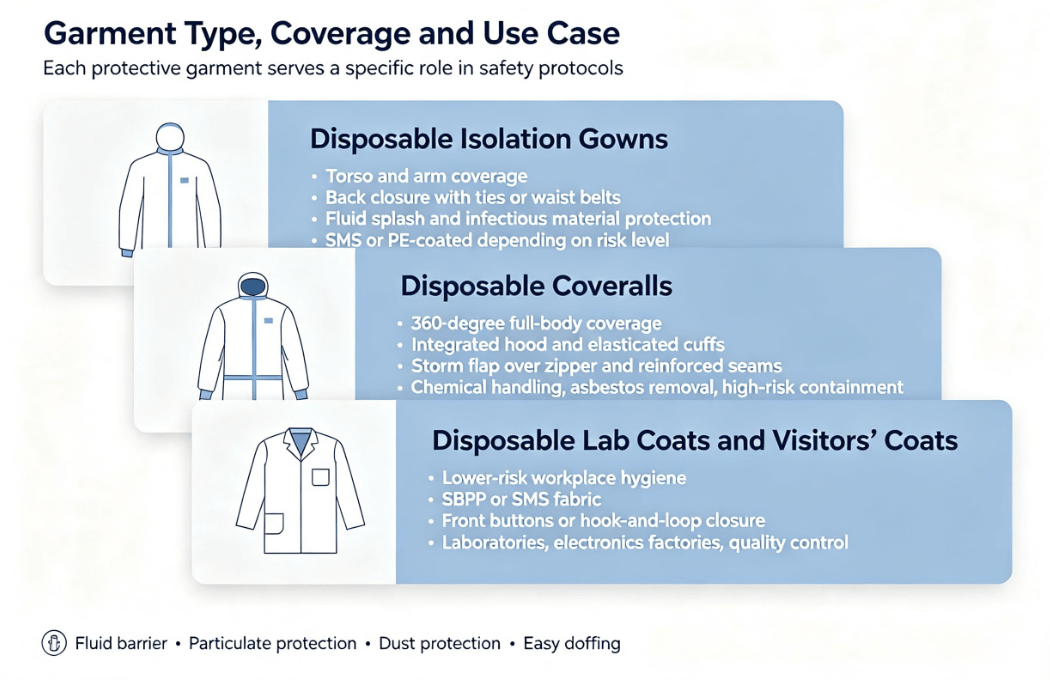
Isolation gowns are designed to protect the torso and arms from fluid splashes and infectious materials. They typically feature a back-closure design with ties or waist belts. These are the primary protective garments used in routine patient care and clinical settings.
The choice of gown usually depends on the anticipated level of fluid contact. SMS gowns are preferred for moderate risks, while PE-coated gowns are reserved for high-fluid scenarios. Proper donning and doffing procedures are essential to prevent cross-contamination.
Disposable Coveralls
Coveralls provide 360-degree protection, covering the head, torso, arms, and legs. They are designed for environments where the risk of exposure is not limited to a single direction. Most coveralls feature an integrated hood and elasticated cuffs to ensure a tight seal.
High-quality coveralls often include features like storm flaps over the zippers and reinforced seams. These garments are mandatory in asbestos removal, chemical handling, and high-risk viral containment units.
Disposable Lab Coats and Visitors’ Coats
Lab coats are used in lower-risk environments such as laboratories, electronic factories, and quality control departments. They provide a professional appearance while protecting the wearer’s underlying clothing from dust and non-hazardous spills.
These coats are usually made from SBPP or SMS fabric. They feature front buttons or hook-and-loop closures for easy removal. While they do not provide the full barrier of a coverall, they are essential for general workplace hygiene.
Specialized Apparel: Aprons, Sleeves, and Boot Covers
Full-body protection is often supplemented by smaller, targeted protective items. These accessories allow for modular protection based on the specific task.
- PE Aprons: For heavy fluid tasks.
- Oversleeves: To protect the forearms when the full gown isn’t necessary.
- Shoe/Boot Covers: Essential for maintaining “clean zone” integrity in hospitals and electronic factories.
Comparison of Common Material Performance
| Material Type | Fluid Resistance | Breathability | Particle Barrier | Typical Use Case |
|---|---|---|---|---|
| SBPP | Low | Very High | Basic | Food Service / Visiting |
| SMS | Moderate to High | High | Good | Surgical / Isolation |
| PP+PE | Total | Low | Excellent | Heavy Fluid Contact |
| SF Microporous | High | Moderate | Superior | Industrial / Pharma |
International Protection Standards
Global standards provide a benchmark for evaluating the effectiveness of protective clothing. Procurement teams must verify that products meet these specific requirements before purchase.
The AAMI PB70 Standard (USA)
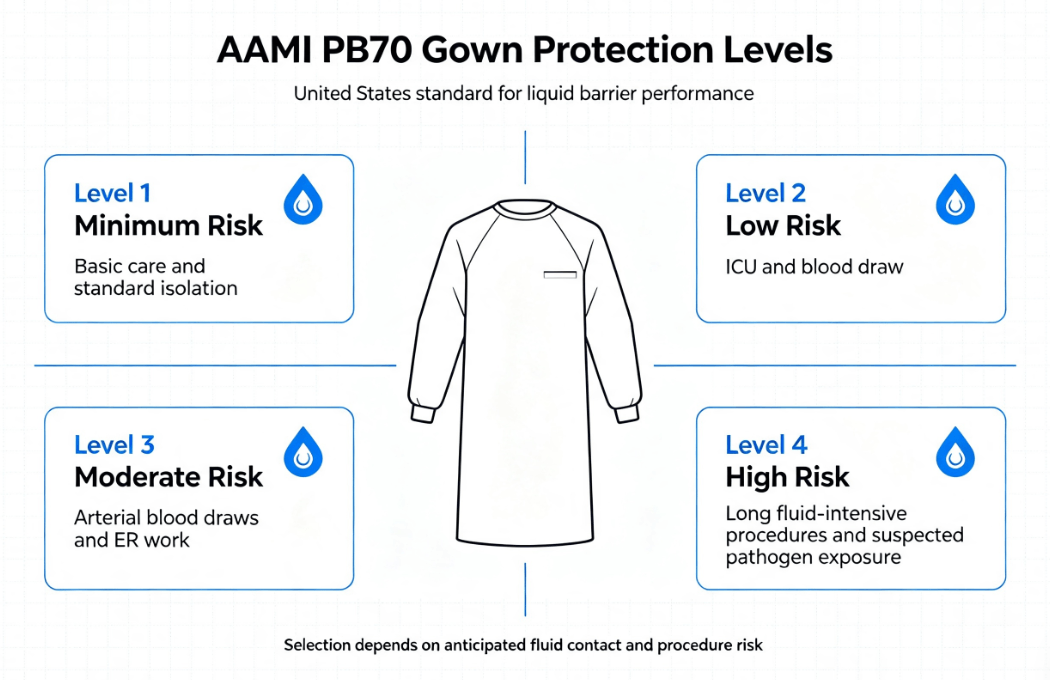
In the United States, the Association for the Advancement of Medical Instrumentation (AAMI) defines the performance of gowns. This standard uses four levels of protection based on liquid barrier performance.
- Level 1: Minimum risk; used for basic care and standard isolation.
- Level 2: Low risk; used in ICU or for blood draw.
- Level 3: Moderate risk; used for arterial blood draws and ER work.
- Level 4: High risk; used for long, fluid-intensive procedures and suspected pathogen exposure.
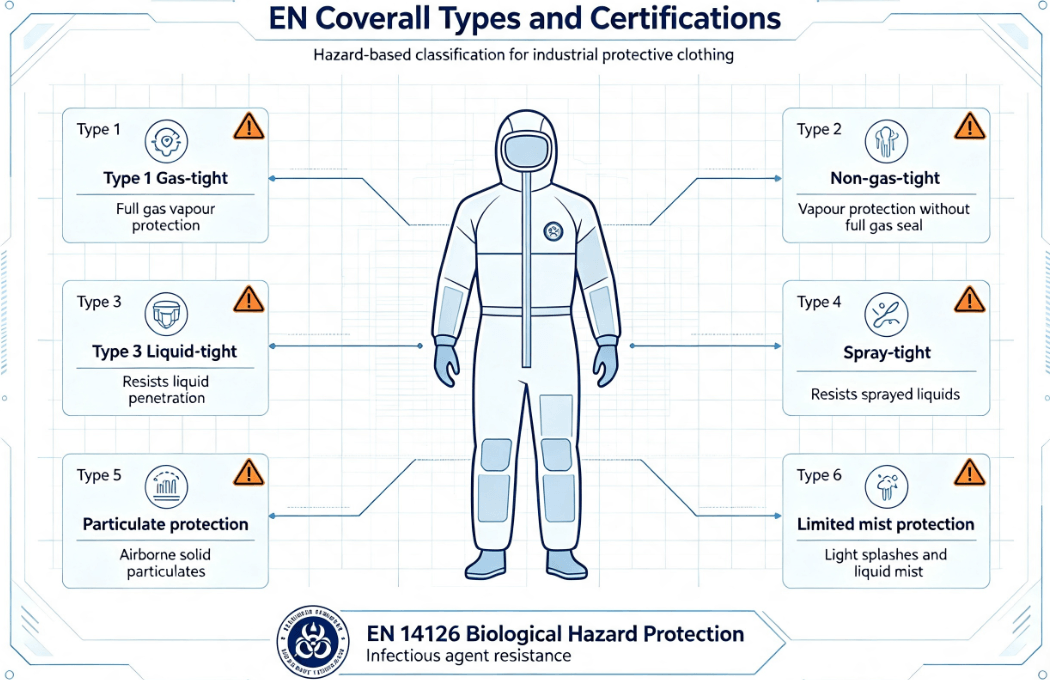
European Standards (EN) for Coveralls
European standards categorize industrial protective coveralls into “Types” based on the nature of the hazard. This classification helps industrial safety officers select the appropriate level of protection.
- Type 1 & 2: Gas-tight and non-gas-tight suits.
- Type 3 & 4: Liquid-tight and spray-tight protection.
- Type 5: Protection against airborne solid particulates.
- Type 6: Limited protection against liquid mist/light splashes.
Technical Considerations for Procurement Managers
When evaluating a manufacturer, look beyond the price. Technical specifications like seam construction and gram weight (GSM) determine the actual safety margin of the product.
Seams are often the weakest point of a garment. Serged seams are suitable for basic dust protection, but “taped seams” are required for liquid-tight (Type 4) applications. Additionally, the GSM of the fabric directly impacts the durability and barrier strength.
Buyers should also evaluate the manufacturer’s vertical integration. Suppliers who produce their own PE or CPE films often provide better cost control and more consistent material thickness. This is a significant advantage in maintaining high quality across large bulk orders.
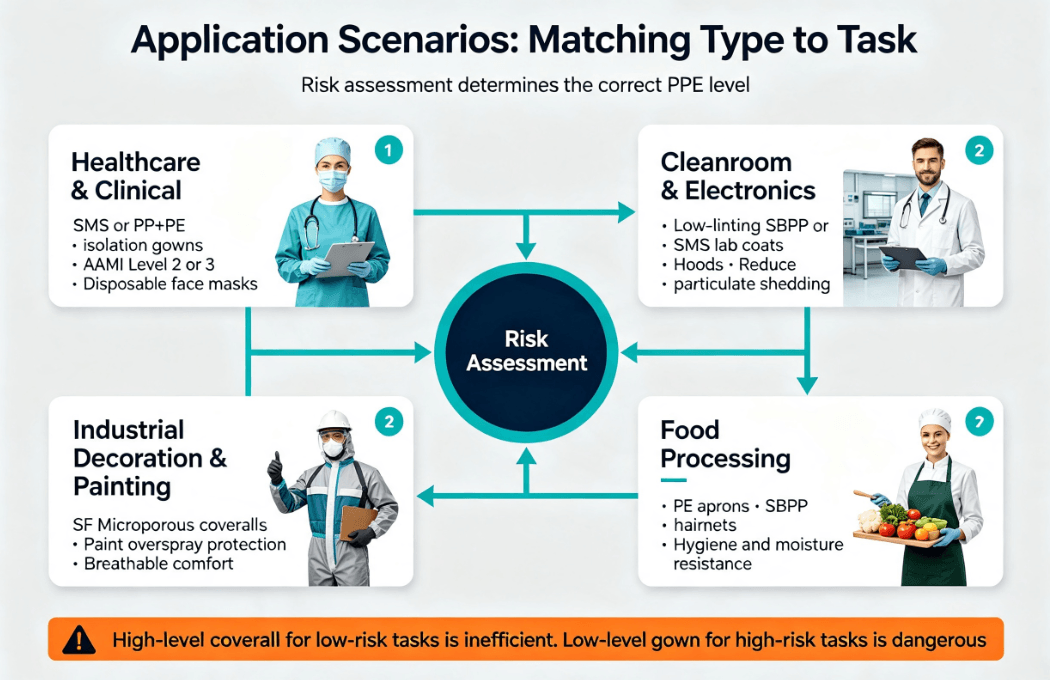
Application Scenarios: Matching Type to Task
Choosing the right PPE requires a thorough risk assessment of the specific environment. Using a high-level coverall for a low-risk task is inefficient, while using an SBPP gown in a high-risk unit is dangerous.
- Healthcare & Clinical: Primarily SMS or PP+PE isolation gowns (AAMI Level 2 or 3) and disposable face masks.
- Cleanroom & Electronic Manufacturing: Low-linting SBPP or SMS lab coats and hoods to prevent particulate shedding.
- Industrial Decoration & Painting: SF Microporous coveralls to protect against paint overspray while allowing the worker to remain cool.
- Food Processing: Polyethylene (PE) aprons and SBPP hairnets for hygiene and moisture resistance.
Conclusion
Understanding the various types of disposable protective clothing is essential for ensuring workplace safety and regulatory compliance. From the material science of SMS and Microporous films to the global standards of AAMI and EN, each technical detail plays a role in effective protection. By matching the right material and design to the specific hazard, procurement professionals can build a more resilient and cost-effective safety program.
FAQ
1. What is the difference between isolation and surgical gowns?
Surgical gowns are considered critical zone equipment used in sterile environments. They must meet higher standards for fluid resistance in the chest and sleeves. Isolation gowns are typically used for general patient care and provide protection against a broader range of non-sterile clinical scenarios.
2. Can I reuse disposable protective clothing if it is not dirty?
No, disposable PPE is strictly designed for single-use applications. The structural integrity of non-woven fibers like SMS or SBPP degrades after use. Attempting to clean or reuse these items can create invisible micro-tears that compromise the barrier against pathogens or chemicals.
3. Why is breathability important in protective coveralls?
Heat stress is a major safety concern for workers wearing full-body protection. If a garment does not allow moisture vapor to escape, the wearer’s body temperature can rise to dangerous levels. SF Microporous materials are preferred because they offer high protection while maintaining a degree of comfort.
4. What does the term low-linting mean in PPE?
Low-linting refers to fabrics that do not shed fibers during use. This is a critical requirement for cleanrooms in the pharmaceutical and electronics industries. In these environments, airborne lint can contaminate sensitive products or compromise a sterile field during manufacturing.
5. How do I verify if a coverall protects against viruses?
You must check for the EN 14126 certification on the product specification sheet. This specific standard tests the material’s resistance to penetration by blood-borne pathogens and infectious agents. It is the global benchmark for biological protection in disposable clothing.
Reference Sources
WHO technical specifications for personal protective equipment
FDA medical gowns guidance for industry and healthcare staff