
Blog
Single Elastic vs Double Elastic Disposable Hair Caps

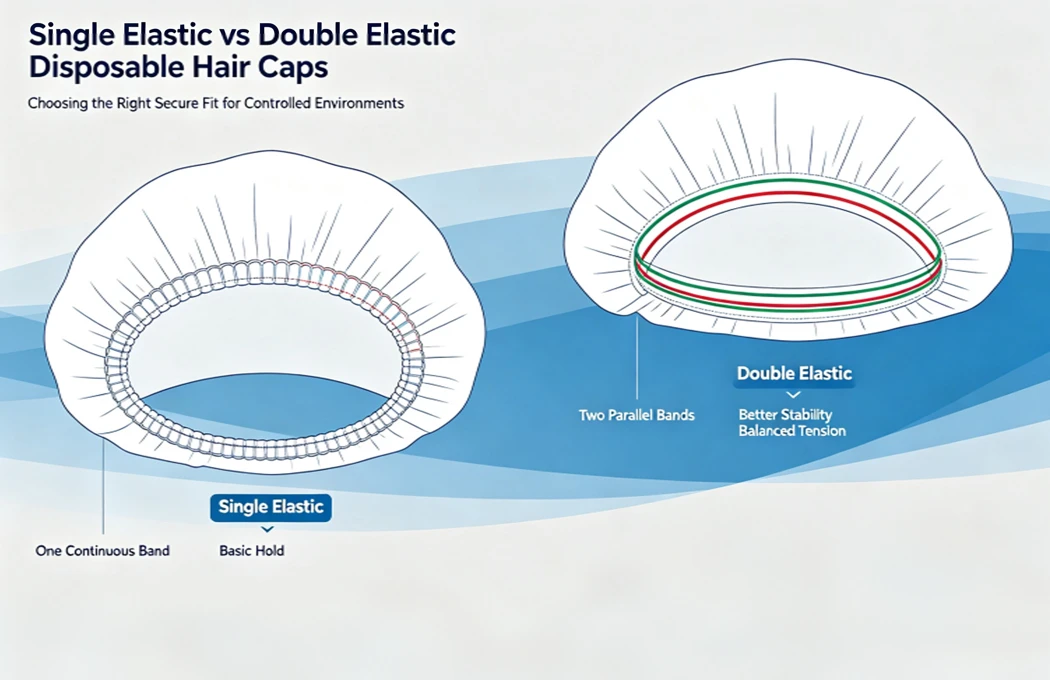
Disposable hair caps are available with different elastic configurations, with single elastic and double elastic designs being two common options for healthcare, food processing, laboratories, and other controlled environments. The main difference lies in how the elastic bands secure the cap around the head. A single elastic hair cap uses one continuous elastic band for basic positioning, while a double elastic hair cap uses two parallel bands to provide additional stability and distribute tension more evenly. For procurement teams, the choice should be based on fit, wearing time, hair containment, material, application requirements, and overall purchasing costs.
Engineering the Single Elastic Hair Cap
When sourcing personal protective equipment, procurement teams often overlook minor design specifications. However, the choice of elastic bands in headcovers plays a crucial role in workplace safety. This structural detail directly impacts worker comfort and contamination control.
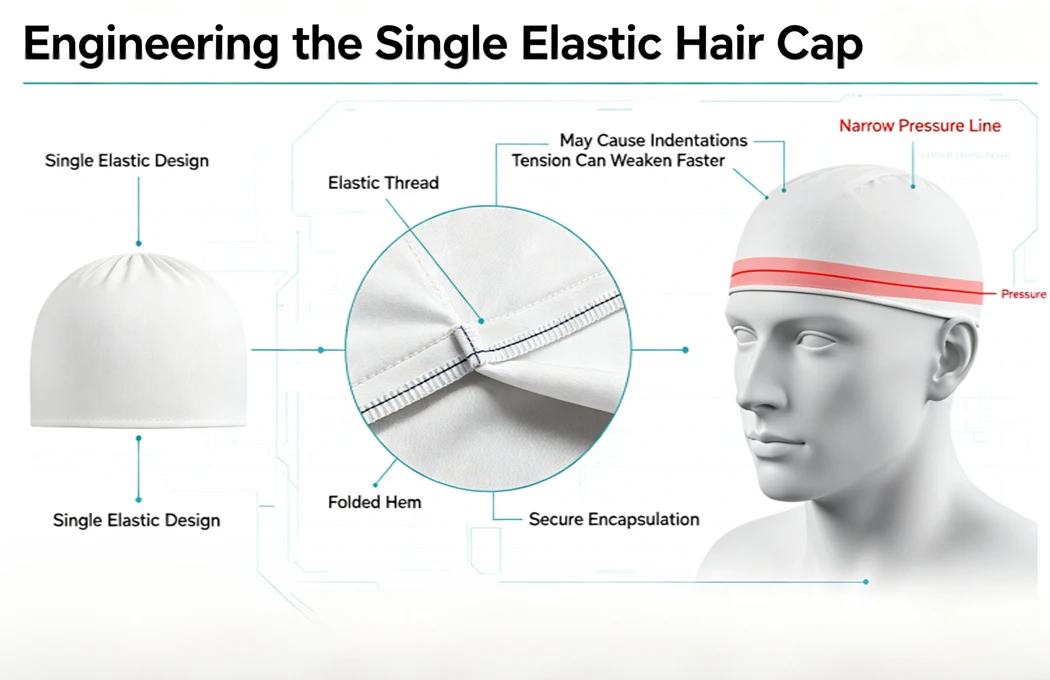
A single elastic hair cap features one continuous strand of elastic thread. This thread is securely encapsulated within the folded hem of the nonwoven fabric. It provides fundamental tension to keep the protective cover in place.
Manufacturers utilize this design for standard, low-risk environments. The single band offers a lightweight feel suitable for short-term wear. It is highly cost-effective for facilities with high consumable turnover rates.
However, the single-thread design concentrates pressure on a narrow line across the forehead. This can cause minor skin indentations during extended shifts. The tension may also weaken faster if the user repeatedly adjusts the headcover.
Structural Advantages of the Double Elastic Hair Cap
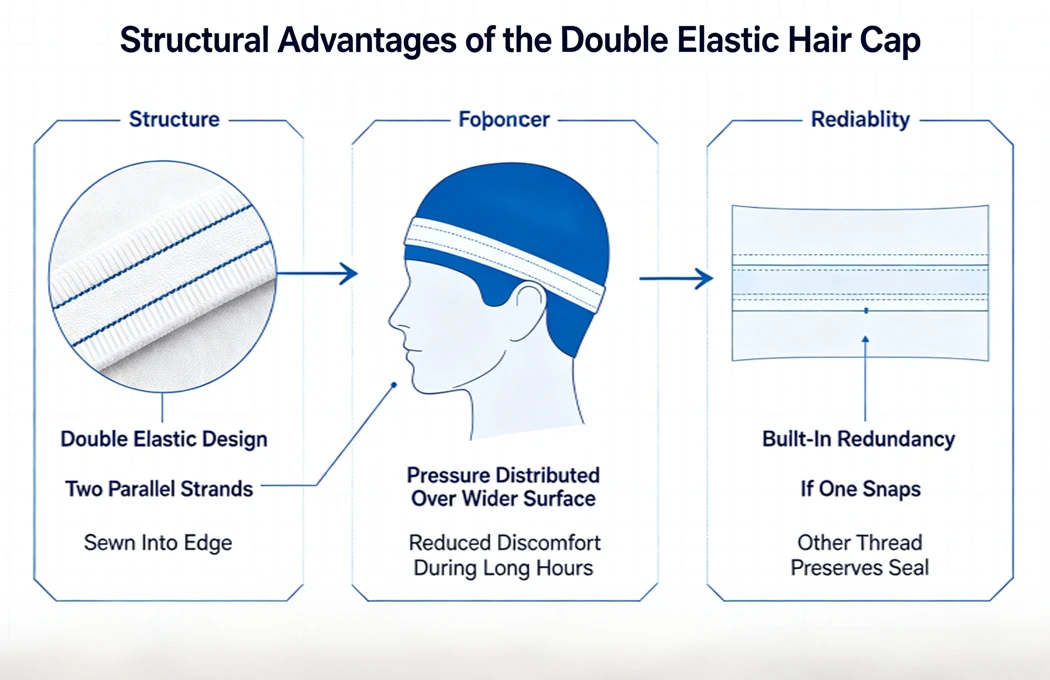
A double elastic hair cap incorporates two parallel strands of elastic material. These bands are sewn into the edge of the headcover simultaneously. This dual-band architecture significantly increases the product’s structural resilience.
The primary engineering advantage is pressure distribution. Two bands spread the tension over a wider surface area on the wearer’s skin. This structural upgrade dramatically reduces fatigue and discomfort during long working hours.
Furthermore, the dual-band system offers built-in redundancy. If one thread snaps under excessive force, the second thread maintains the barrier seal. This reliability makes it ideal for strict medical and cleanroom environments.
Technical Comparison of Disposable Cap Elastic Types
Evaluating disposable cap elastic types requires a close look at performance metrics. Procurement professionals must balance unit costs against structural reliability. The technical comparison table below highlights the core differences.
| Specification Feature | Single Elastic Design | Double Elastic Design |
|---|---|---|
| Tension Distribution | Concentrated on one line | Evenly spread across two lines |
| Breakage Risk | Moderate | Low (Redundant design) |
| Wearer Comfort | Suitable for short shifts | Excellent for extended wear |
| Manufacturing Cost | Highly economical | Marginally higher unit price |
| Secure Fit Level | Standard retention | High retention and stability |
| Best Application | General industry, visitors | Hospitals, strict cleanrooms |
Buyers should use this data to standardize their facility procurement lists. Cost savings on single-band models make sense for temporary visitors. Critical staff require the security of dual-band options.
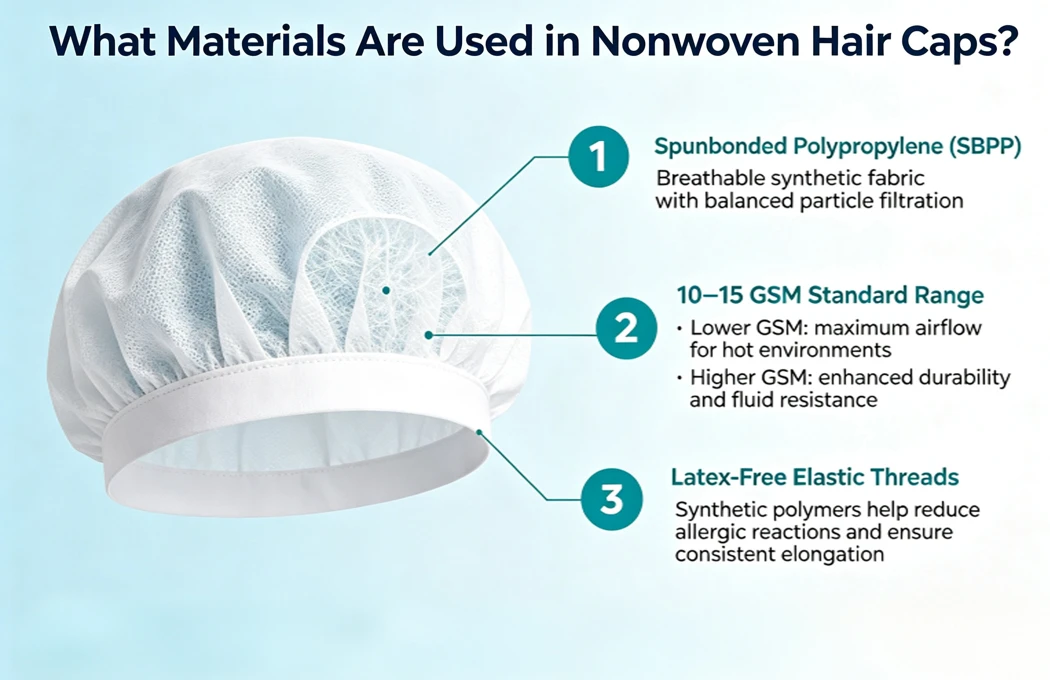
What Materials Are Used in Nonwoven Hair Caps?
The performance of an elastic bouffant cap depends heavily on its base material. Manufacturers predominantly use Spunbonded Polypropylene (SBPP). This synthetic fabric provides an optimal balance of breathability and particle filtration.
Standard production utilizes nonwoven fabric weighing between 10 to 15 grams per square meter (GSM). Lower GSM values offer maximum airflow for hot environments. Higher GSM values provide enhanced durability and better fluid resistance.
The elastic threads themselves are typically composed of latex-free synthetic polymers. This material choice is mandatory for medical compliance to prevent allergic reactions. High-quality synthetic rubber ensures consistent elongation and recovery rates.
Application Scenarios and Product Selection
Different industrial environments demand specific head protection solutions. Sourcing managers must evaluate dedicated head protection categories to match their exact needs. Selecting the wrong specification can compromise facility hygiene protocols.
Medical and Clinical Environments
Healthcare settings require maximum barrier integrity to prevent cross-contamination. Surgical teams and clinical staff wear headcovers for entire shifts. A secure fit is non-negotiable in these critical zones.
For these demanding applications, a white medical-grade disposable non-woven elastic hair cap is highly recommended. The double elastic structure prevents slippage during active procedures. White coloring helps infection control teams easily spot contamination.
Food Processing and Handling
Food safety regulations strictly mandate complete hair containment. Falling hair is a major hazard in food manufacturing facilities. Workers need headcovers that accommodate hairnets and secure all loose strands.
Food safety protocols often mandate colored options, such as a green food-grade disposable non-woven elastic hairnet. The green color allows for rapid visual compliance checks on the factory floor. Single elastics are often sufficient for these structured environments.
General Manufacturing and Laboratories
Standard industrial settings require basic particulate protection. Electronics assembly and basic laboratories prioritize cost-efficiency alongside standard compliance. Workers in these areas often prefer lightweight protective options.
General manufacturing facilities typically utilize a standard blue disposable nonwoven protective bouffant cap. The bouffant style accommodates varying hair volumes easily. The blue color hides industrial dust while maintaining a professional appearance.
Manufacturing Process and Quality Control
The production of an elastic bouffant cap relies on advanced automated machinery. Rolls of SBPP nonwoven fabric are fed into a folding and cutting machine. The elastic bands are simultaneously guided into the folding hem.
Modern factories use ultrasonic welding to seal the ends of the cap. This method eliminates the need for traditional sewing threads. Ultrasonic seals provide a stronger, cleaner bond that resists tearing.
Quality control is paramount in bulk manufacturing. Reliable suppliers implement strict testing protocols for every production batch. Procurement teams should understand these standard inspection workflows.
- Raw Material Audit: Verifying fabric GSM and latex-free elastic composition.
- Tension Testing: Stretching the finished cap to test elastic recovery.
- Weld Inspection: Checking ultrasonic seals for consistency and strength.
- Visual Assessment: Ensuring uniform color and absence of material defects.
- Packaging Verification: Confirming accurate counts in final vacuum packaging.
Strategic Procurement Considerations for B2B Buyers
Purchasing disposable protective products in bulk requires careful supplier evaluation. Buyers must ensure the manufacturer holds relevant ISO 13485 and CE certifications. Compliance documents guarantee consistent quality management systems.
Unit price differences between single and double elastic models are minimal. However, these small differences compound significantly across massive institutional orders. Procurement teams must calculate total cost of ownership carefully.
Customization is a key advantage of working directly with a manufacturer. Buyers can specify material weight, color, and packaging configurations. Original Equipment Manufacturer (OEM) services allow for customized branding on outer cartons.
Partnering with a Professional Manufacturer
Selecting a reliable factory ensures consistent product quality and supply chain stability. Buyers should look for manufacturers with over a decade of export experience. Automated production lines significantly reduce labor costs and human error.
Professional suppliers provide comprehensive OEM and ODM support for international clients. They offer flexible packaging solutions to optimize shipping container space. Strict in-house testing guarantees compliance with global hygiene standards.
Procurement teams are encouraged to request product samples before finalizing bulk orders. Testing the elastic tension on-site ensures the product meets facility requirements. Contact technical sales teams to discuss custom specifications and exact pricing.
Conclusion
Choosing between a single elastic hair cap and a double elastic model requires technical consideration. The single-band design offers a highly economical solution for basic, short-term usage. The dual-band architecture provides superior durability and comfort for extended wear.
Understanding disposable cap elastic types empowers buyers to optimize their procurement strategies. Matching the right nonwoven hair cap to the specific industry environment ensures safety compliance. Partnering with certified manufacturers guarantees reliable performance and supply chain security.
Frequently Asked Questions (FAQ)
1. What is the core difference between single and double elastic caps?
A single elastic model uses one thread for standard tension and cost efficiency. A double elastic model uses two parallel threads for better pressure distribution and enhanced durability.
2. Which elastic type is better for hospital use?
Hospitals generally prefer the double elastic design. It provides a more secure fit, prevents slippage during procedures, and ensures better comfort during long clinical shifts.
3. Are these disposable headcovers latex-free?
Yes, professional manufacturers use latex-free synthetic elastomers. This prevents allergic reactions among workers and ensures compliance with strict medical and food safety standards.
4. How does the elastic style impact the bulk unit price?
Double elastic models require slightly more raw material and complex manufacturing. Therefore, they carry a marginally higher unit cost compared to single elastic models.
5. Can buyers customize the nonwoven material weight?
Yes, working with a direct manufacturer allows buyers to specify the fabric weight. Standard options range from 10 GSM for breathability to 15+ GSM for higher fluid resistance.
6. What is the standard packaging for bulk orders?
Typically, caps are vacuum-packed or flat-packed in bags of 100 pieces. These bags are then loaded into master cartons holding 1,000 or 2,000 pieces to optimize shipping volume.