

Blog
KF94 vs Surgical Mask: Key Differences in Filtration, Fit & Use

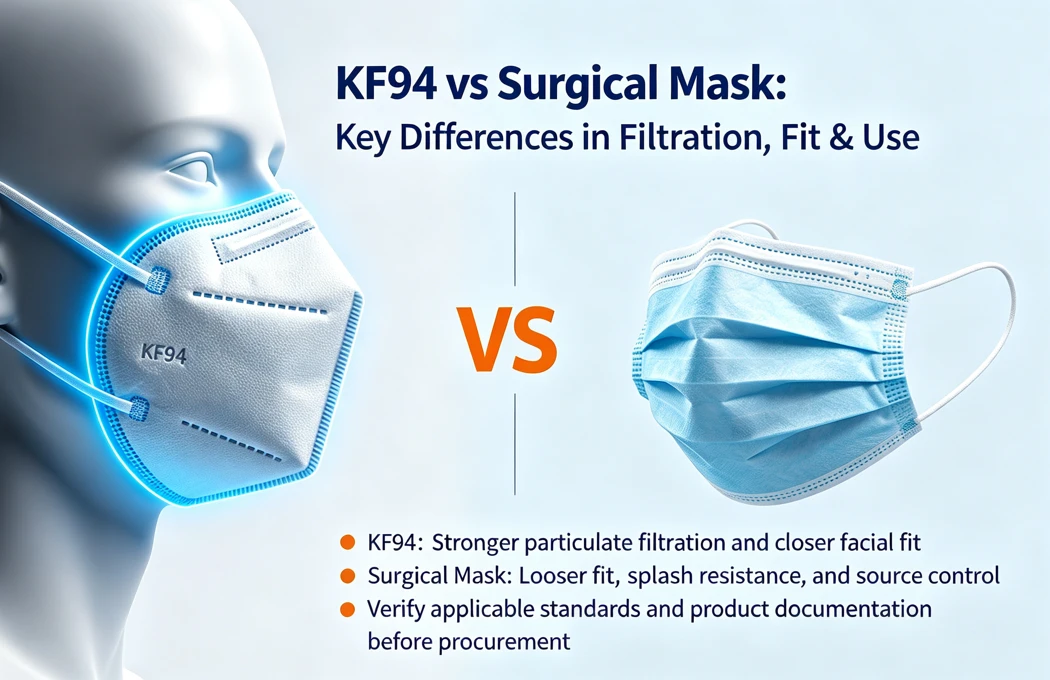
When comparing KF94 vs surgical masks, the key differences are not simply filtration percentage. The two mask types are designed around different performance requirements, including facial fit, particle filtration, fluid resistance, and intended use.
For PPE distributors, healthcare buyers, and procurement teams, understanding these differences can help determine which type of disposable face mask is appropriate for a specific application.
In simple terms, a KF94 mask is designed around particulate filtration and closer facial fit, while a disposable surgical mask is a loose-fitting medical face mask designed for source control and protection from splashes and droplets. The applicable standard and product documentation should always be verified before procurement.
What Is a KF94 Disposable Mask?
A KF94 disposable mask is a Korean respiratory protective mask classification. KF refers to the Korean “Korea Filter” designation, while 94 refers to the required filtration performance under the applicable Korean testing requirements.
The Korean Ministry of Food and Drug Safety describes KF94 masks as having filtration performance of at least 94% under its specified test conditions. Its public guidance distinguishes KF94 from other KF classifications and anti-droplet or surgical masks.
A typical KF94 mask uses a multilayer nonwoven construction and commonly has a three-dimensional, boat-shaped profile. This design creates space around the nose and mouth while helping the mask fit more closely to the face.
The filtration layer commonly includes meltblown nonwoven fabric, while spunbond polypropylene may be used for the outer and inner layers.
For example, Ruichen offers a White Disposable KF94 Protective Face Mask within its protective face masks product range.
For buyers, however, the product name alone is not enough. Test reports, applicable regulatory documentation, filtration results, and product labeling should be checked before placing a bulk order.
What Is a Disposable Surgical Mask?
A disposable surgical mask is a single-use medical face mask designed for healthcare applications and other environments where source control and protection from splashes or sprays are important.
Unlike a tight-fitting respirator, a conventional surgical mask does not create a complete seal around the face. Its performance therefore depends not only on filtration material but also on its design, fit, and the performance requirements of the applicable medical mask standard.
ASTM F2100, for example, specifies performance requirements and test methods for medical face mask materials. The current ASTM F2100-26 covers areas including bacterial filtration efficiency, differential pressure, sub-micron particulate filtration efficiency, resistance to synthetic blood penetration, flammability, and biocompatibility.
Disposable surgical masks commonly use a multilayer nonwoven structure. A typical configuration includes spunbond polypropylene outer and inner layers with a meltblown filtration layer between them.
Ruichen also supplies a Blue Disposable Nonwoven Medical Face Mask through its medical face mask product range.
KF94 Mask vs Surgical Mask: Key Differences
The most useful way to compare a KF94 mask vs surgical mask is to examine the performance characteristics that matter during procurement.
| Feature | KF94 Disposable Mask | Disposable Surgical Mask |
|---|---|---|
| Primary purpose | Particulate respiratory protection | Medical source control and barrier protection |
| Typical design | 3D / boat-shaped | Flat and pleated |
| Facial fit | Closer facial fit | Loose fit |
| Main filtration consideration | Particle filtration | Bacterial and particulate filtration requirements |
| Fluid protection | Depends on product specification | Medical mask standards may include fluid resistance requirements |
| Typical environment | Public, workplace and general respiratory protection | Healthcare, clinical and medical environments |
| Key procurement documents | Applicable Korean compliance and test documentation | Applicable medical mask standard and test documentation |
| Main buying consideration | Filtration + fit | Filtration + fluid resistance + medical requirements |
The table should not be interpreted as a universal performance ranking. A mask should be selected according to the exposure conditions, regulatory requirements, and intended application.
1. Filtration Performance
Filtration is one of the most important differences between KF94 and surgical masks, but the test methods are not necessarily identical.
For KF94 masks, the Korean classification specifies filtration performance under defined test conditions. The Korean MFDS identifies KF94 as a mask class with at least 94% filtration performance under its relevant testing conditions.
Medical face masks are evaluated using a broader group of performance tests. ASTM F2100 includes bacterial filtration efficiency, differential pressure, sub-micron particulate filtration efficiency, and resistance to synthetic blood penetration among its performance criteria.
This means buyers should avoid comparing two masks using a single percentage unless the testing method, test particle, airflow conditions, and applicable standard are the same.
Why Test Method Matters
A filtration percentage without its test method can be misleading.
When comparing suppliers, procurement teams should request:
- Applicable product standard
- Filtration test report
- Test method and conditions
- Differential pressure or breathing resistance data
- Fluid resistance results where applicable
- Product labeling and compliance documentation
This creates a more reliable technical comparison than looking only at a number printed on a product specification sheet.
2. Facial Fit and Seal
Facial fit is another major difference between KF94 masks and surgical masks.
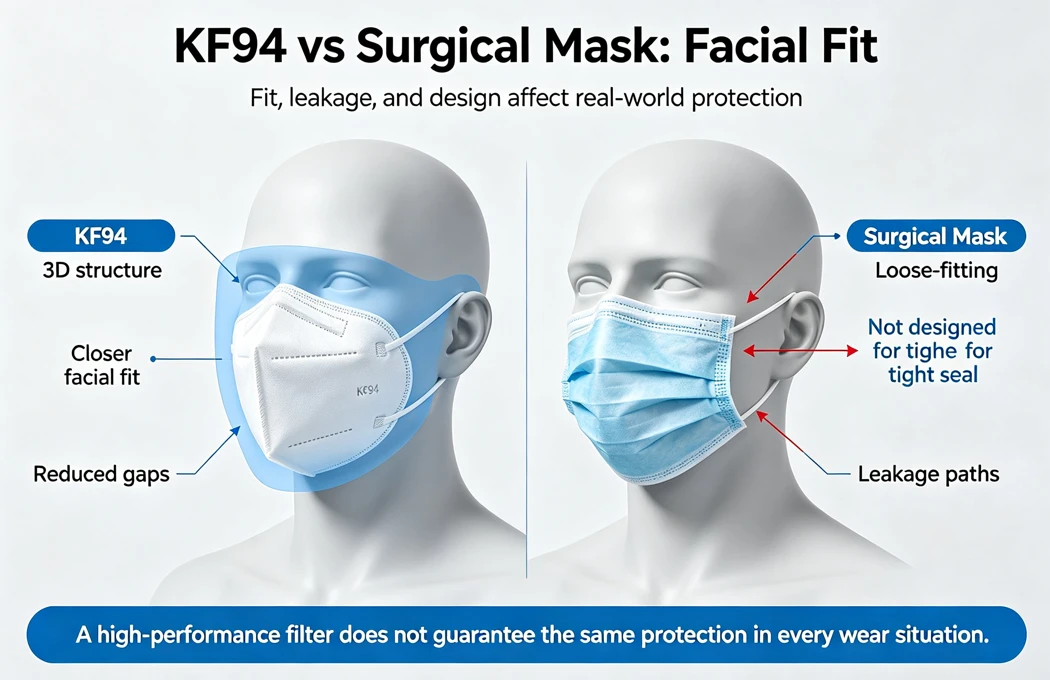
A KF94 mask typically uses a three-dimensional structure that sits closer to the face. The design can help reduce gaps around the nose and cheeks when the mask is correctly fitted.
A conventional surgical mask is generally loose-fitting. Its primary function is not to create the same type of facial seal associated with a tight-fitting respirator.
For this reason, buyers should consider both the filtration media and the physical design of the mask.
A high-performing filter material does not automatically mean the same level of protection in every wearing situation. Fit, leakage, wearing behavior, and product design can all affect real-world performance.
3. Materials and Layer Structure
Both KF94 masks and disposable surgical masks commonly use nonwoven polypropylene and meltblown filtration media.
Spunbond Polypropylene
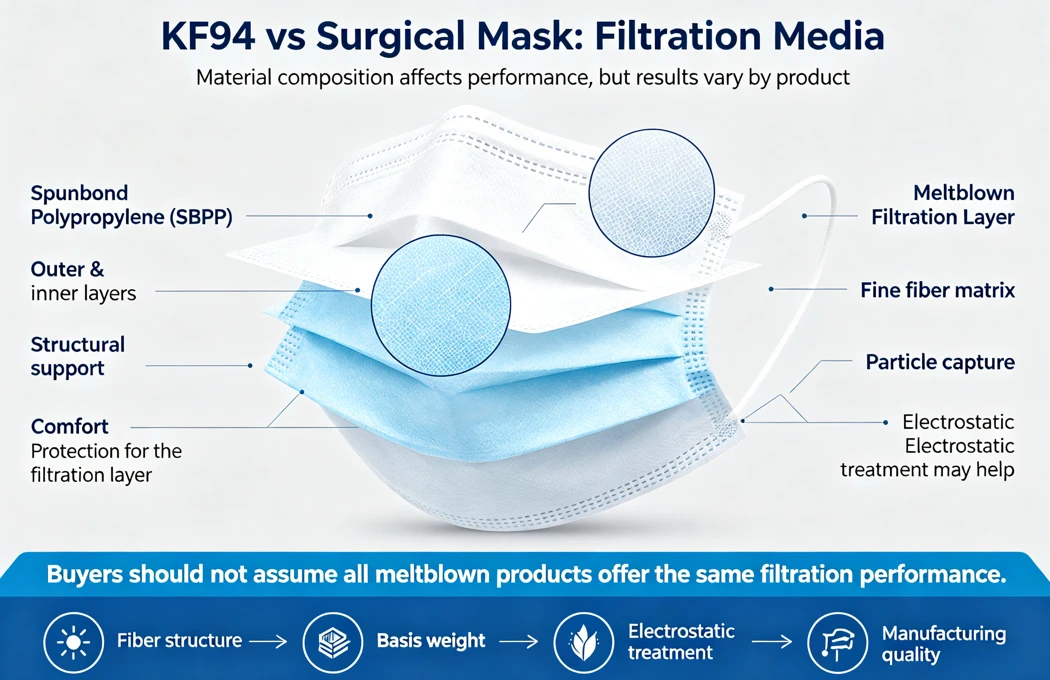
Spunbond polypropylene, often abbreviated as SBPP, can be used for the inner and outer layers.
These layers provide structural support, comfort, and protection for the filtration layer.
The exact material combination can vary by manufacturer and product specification.
Meltblown Filtration Layer
Meltblown nonwoven is commonly used as the main filtration layer in disposable face masks.
Its fine fiber structure creates a filtration matrix capable of capturing particles. Electrostatic treatment may also be used to improve filtration performance without requiring an excessively dense material.
However, buyers should not assume that every product using meltblown fabric has the same filtration performance. Fiber structure, basis weight, electrostatic treatment, manufacturing quality, and testing conditions can all affect the final result.
4. Fluid Resistance and Medical Use
Fluid resistance is particularly important when selecting masks for medical environments.
Medical face mask standards such as ASTM F2100 include resistance to penetration by synthetic blood as part of the performance evaluation. The standard is intended for medical face masks used in healthcare services such as surgery and patient care.
This is an important distinction for procurement teams.
A KF94 mask may be selected for particulate respiratory protection, but that does not automatically make it a substitute for a medical mask specified for a procedure involving fluid exposure.
Similarly, a surgical mask should not automatically be treated as a tight-fitting respiratory protective device.
The correct choice depends on the exposure scenario and the requirements specified by the healthcare facility or applicable regulation.
5. KF94 Mask vs Surgical Mask: Applications
KF94 Mask Applications
KF94 masks can be considered for applications where particulate filtration and a closer facial fit are important.
Common applications may include:
- Daily public use
- Offices and workplaces
- Public transportation
- Travel
- High-density indoor environments
- General workplace particulate protection
- Light industrial and non-hazardous dust environments
However, a KF94 mask should not automatically be treated as an industrial respirator for hazardous chemical, toxic particulate, or oxygen-deficient environments.
The required respiratory protection should be determined according to the actual hazard and applicable occupational safety requirements.
Surgical Mask Applications
Disposable surgical masks are commonly used in healthcare and other controlled environments where source control and barrier performance are important.
Applications can include:
- Hospitals
- Clinics
- Dental facilities
- Patient care
- Laboratories
- Food processing
- Clean environments
- General infection-control procedures
The exact application should be matched with the mask’s regulatory classification and performance documentation.
Which Mask Should a Buyer Choose?
There is no single choice that applies to every procurement scenario.
Instead, buyers should start with the intended application and required performance, then select the corresponding mask type.
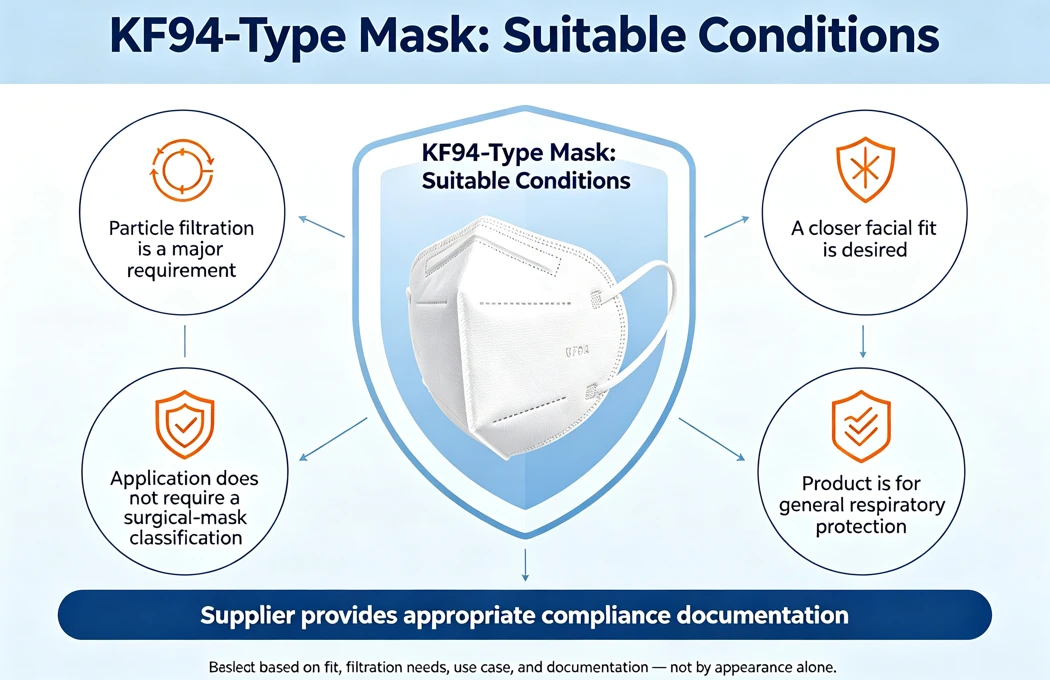
Choose a KF94-type mask when:
- Particle filtration is a major requirement
- A closer facial fit is desired
- The application does not require a medical surgical-mask classification
- The supplier can provide appropriate compliance documentation
- The product is intended for general respiratory protection rather than a specialized hazardous environment
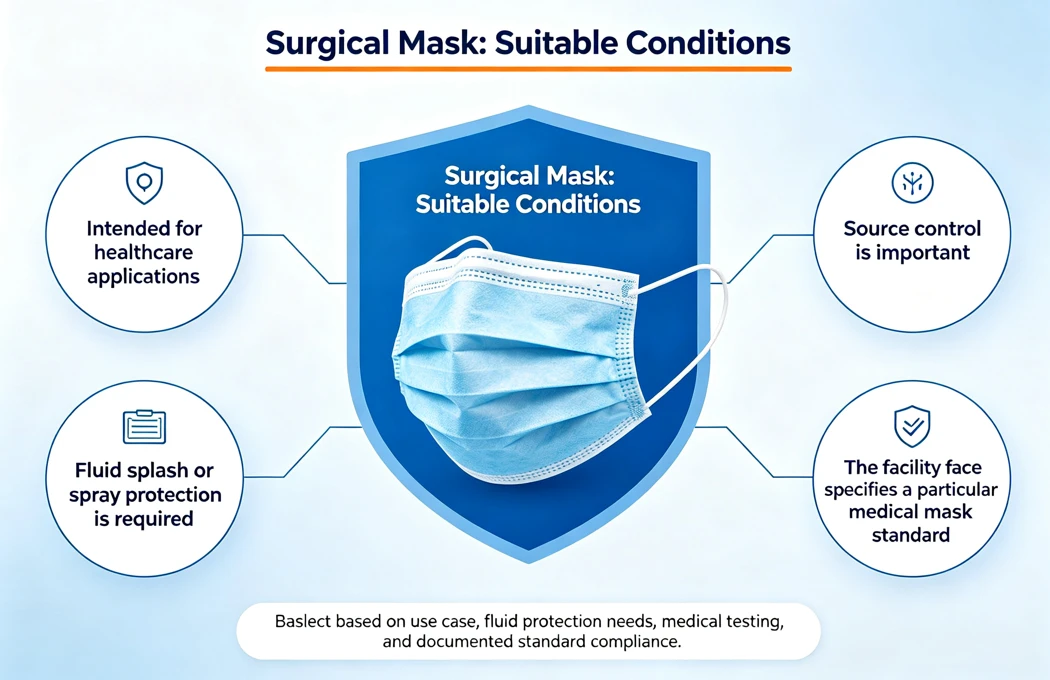
Consider a surgical mask when:
- The product is intended for healthcare applications
- Source control is important
- Fluid splash or spray protection is required
- The buyer requires medical face mask testing
- The facility specifies a particular medical mask standard
For B2B procurement, the supplier’s documentation is as important as the product description.
Before ordering, buyers should confirm the mask classification, applicable standard, filtration test results, fluid resistance where applicable, material structure, packaging, labeling, and regulatory documentation.
KF94 vs Surgical Mask: Procurement Checklist
For a faster supplier comparison, procurement teams can use the following checklist:
| Procurement Factor | What to Verify |
|---|---|
| Product type | KF94 or medical/surgical mask |
| Standard | Exact applicable standard |
| Filtration | Test method and reported result |
| Fit | 3D or flat-fold design |
| Materials | Spunbond, meltblown and other layers |
| Fluid resistance | Required for the intended application |
| Documentation | Test reports and compliance documents |
| Packaging | Individual and carton packaging |
| Customization | Color, branding, dimensions and packaging |
| MOQ | Supplier’s minimum order quantity |
| Samples | Pre-production sample availability |
| Manufacturing | Production capacity and quality control |
Conclusion
The difference between KF94 vs surgical masks is best understood through their intended use and performance requirements.
KF94 masks are associated with defined particulate filtration performance and a closer-fitting 3D design. Disposable surgical masks are medical face masks evaluated against requirements that can include bacterial filtration, differential pressure, particulate filtration, and resistance to synthetic blood penetration.
For PPE procurement, the right comparison is not simply “which mask has higher filtration.” Buyers should evaluate the standard, test method, facial fit, fluid resistance, application, documentation, and supplier capabilities together.
For manufacturers and distributors, these technical details also provide a practical framework for selecting products, preparing compliance documentation, and matching disposable face masks to different customer requirements.
FAQ: KF94 vs Surgical Mask
Is KF94 the same as a surgical mask?
No. KF94 is a Korean mask classification focused on defined filtration and performance requirements, while surgical masks are medical face masks designed for healthcare-related applications and evaluated against applicable medical mask requirements.
Is KF94 better for filtration than a surgical mask?
The answer depends on the test method and product specification. KF94 has a defined filtration requirement under the Korean classification, while medical face masks can be evaluated using multiple performance criteria. A direct comparison should use equivalent test methods rather than comparing percentages from different standards.
Can a KF94 mask be used in a hospital?
A KF94 mask may be used for certain general respiratory-protection situations, depending on the facility’s requirements. It should not automatically be considered a substitute for a medical or surgical mask where specific medical, fluid-resistance, or procedural requirements apply.
What is the main difference between KF94 and surgical masks?
The main differences are facial fit, filtration requirements, intended use, and regulatory classification. KF94 masks generally use a closer-fitting three-dimensional design, while conventional surgical masks are typically loose-fitting medical face masks.
Are KF94 masks made with meltblown fabric?
Many KF94 masks use meltblown nonwoven as part of their filtration structure. However, buyers should verify the actual material construction and test documentation for the specific product rather than assuming all products have an identical layer structure.
What should I check before buying KF94 masks in bulk?
Check the applicable standard, filtration test report, material structure, product labeling, packaging, MOQ, sample availability, and supplier documentation. For OEM procurement, also confirm customization options and production capacity.