
Blog
Short-Sleeved vs Long-Sleeved Isolation Gowns

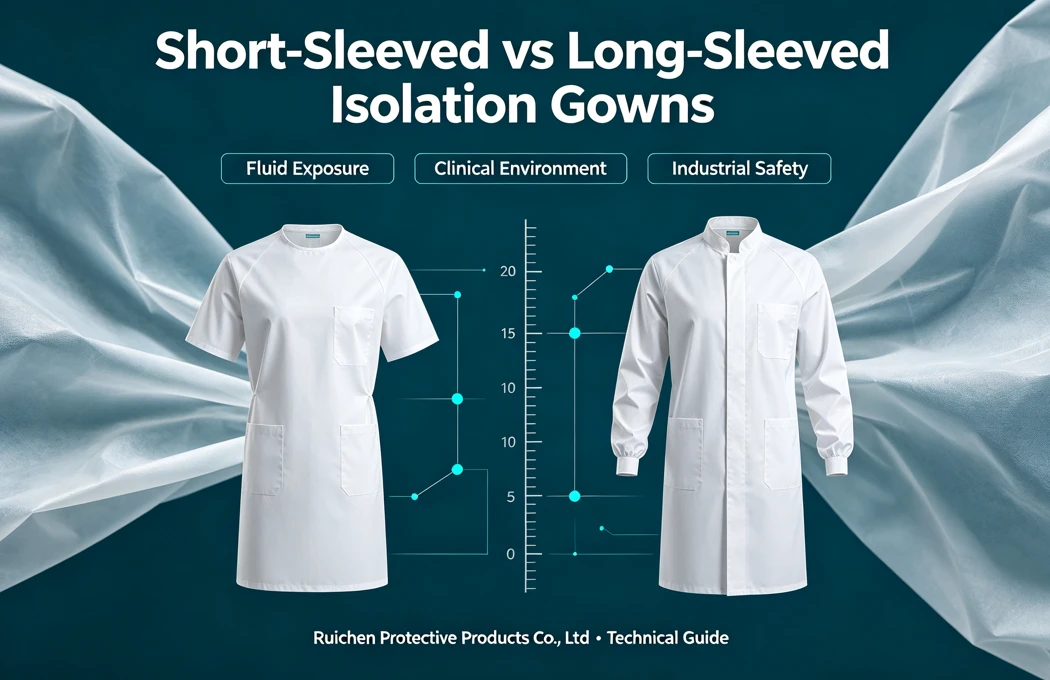
In the professional PPE (Personal Protective Equipment) manufacturing sector, the choice between a short-sleeved and a long-sleeved isolation gown is not merely a matter of comfort. It is a strategic decision influenced by infection control protocols, material science, and specific workplace safety requirements.
As a leading manufacturer based in Xiantao, Hubei, Ruichen Protective Products Co., Ltd has observed a shift in international procurement trends. While long-sleeved gowns remain the global standard for high-fluid exposure, short-sleeved variants are gaining traction in specific clinical and industrial environments. This guide analyzes the technical differences, material advantages, and application scenarios for both types.
The Technical Anatomy of Disposable Gown Sleeve Types
Before comparing the two, it is essential to understand the construction of the sleeves, as this dictates the barrier integrity of the garment.
1. Long-Sleeved Isolation Gowns
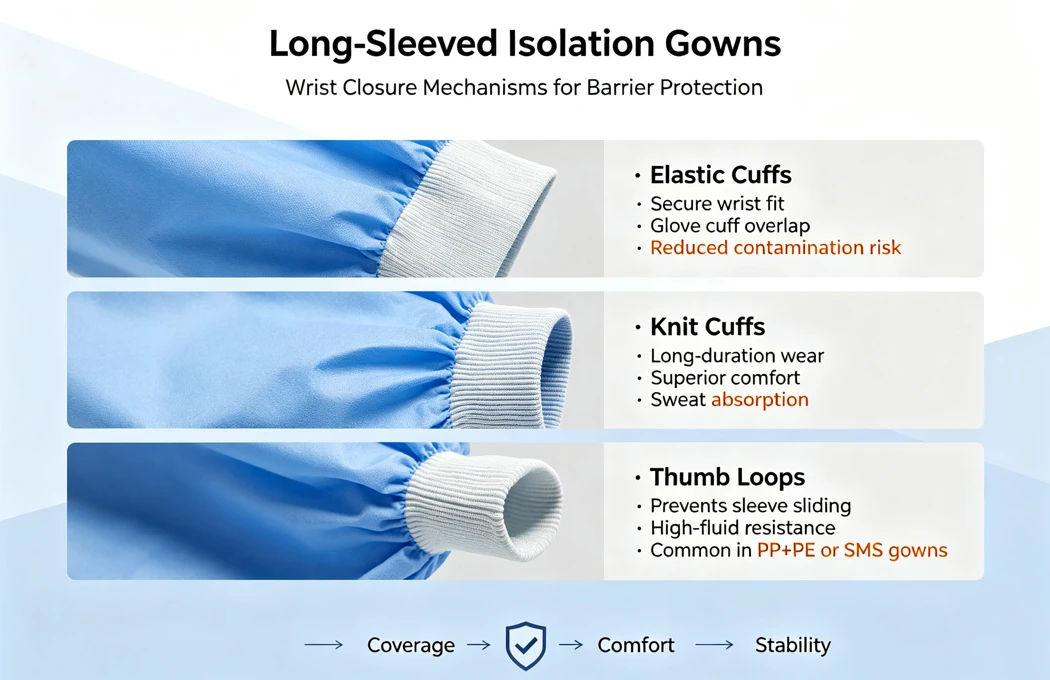
Long-sleeved gowns are designed for maximum coverage. They typically feature two types of closures at the wrist:
- Elastic Cuffs: Provide a secure fit around the wrist, preventing “sleeved-down” contamination and ensuring the glove cuff can overlap the gown sleeve.
- Knit Cuffs: Preferred for long-duration wear in laboratories or clinics, providing superior comfort and absorbing sweat.
- Thumb Loops: Often found in high-fluid resistance gowns (like PP+PE or SMS), these prevent the sleeves from sliding up when reaching or moving.
2. Short-Sleeved Isolation Gowns
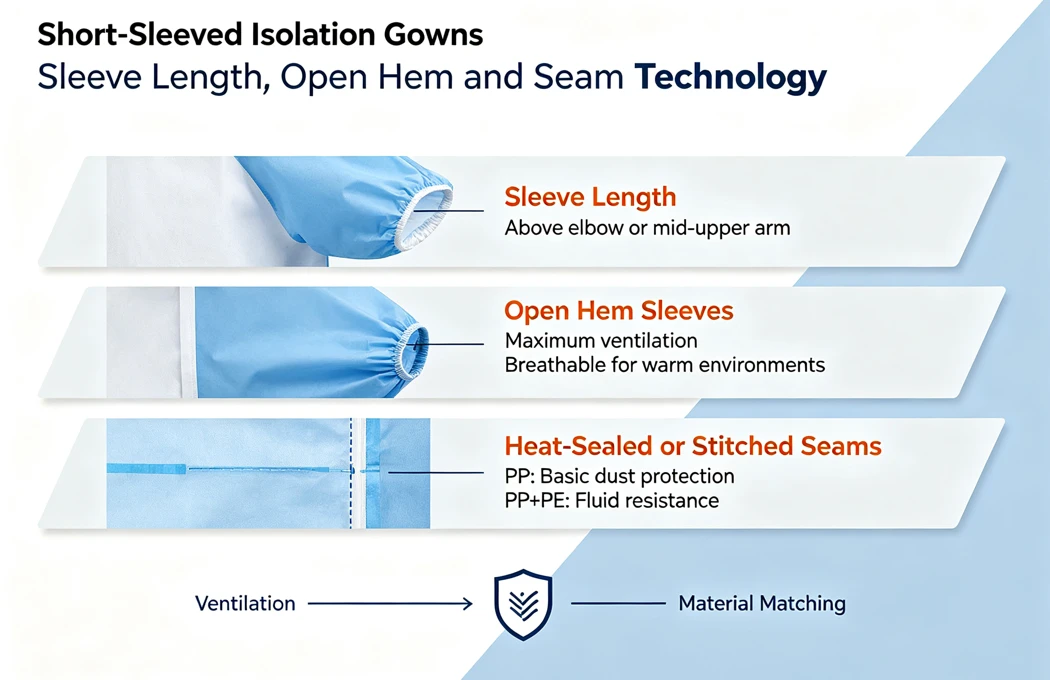
Short-sleeved gowns usually end above the elbow or at the mid-upper arm. They are often characterized by:
- Open Hem Sleeves: Allowing for maximum ventilation.
- Heat-Sealed or Stitched Seams: Manufacturers choose stitched seams for basic dust protection with PP gowns and heat-sealed seams for stronger fluid resistance with PP+PE gowns.
Short Sleeved vs Long Sleeved Isolation Gown: Key Comparison Factors
| Feature | Long-Sleeved Isolation Gown | Short-Sleeved Isolation Gown |
|---|---|---|
| Primary Protection | Full arm coverage (wrist to shoulder) | Torso and upper arm protection |
| Fluid Resistance | High (especially with PP+PE lamination) | Moderate (limited to covered areas) |
| Heat Dissipation | Moderate (can cause heat stress) | High (optimal for warm environments) |
| Hand Hygiene | Standard protocol (glove over cuff) | Supports “Bare Below the Elbows” (BBE) |
| Risk Environment | High-splatter, infectious wards | Low-risk wards, food prep, dental |
The “Bare Below the Elbows” (BBE) Policy and Short-Sleeved Gowns
One of the primary drivers for the use of short sleeve isolation gowns in healthcare settings is the “Bare Below the Elbows” (BBE) initiative, popularized by the NHS in the UK and healthcare systems in Australia.
The logic is centered on hand hygiene. Long sleeves, particularly the cuffs, are notorious for becoming colonized with pathogens (such as MRSA or VRE) through contact with patient environments. When a healthcare worker moves between patients, the contaminated cuff can act as a vector for cross-infection.
Short-sleeved gowns allow clinicians to:
- Wash their hands and forearms more effectively between procedures.
- Avoid the damp-cuff syndrome, where liquid wicks up the sleeve.
- Ensure that wristwatches and jewelry—which can harbor bacteria—remain outside the sleeves.
For facilities prioritizing rapid hand hygiene protocols in low-risk outpatient settings, the short-sleeved variant is often the preferred choice.
When to Choose Long-Sleeved Protection
Despite the hygiene benefits of short sleeves, long sleeve isolation gowns remain indispensable in environments where the risk of bloodborne pathogens or chemical splashes is present.
Fluid Barrier Performance
In procedures where fluid spray is expected, the forearm is a high-risk zone. A long-sleeved gown made of SMS (Spunbond-Meltblown-Spunbond) or PP+PE (Polypropylene with Polyethylene film) provides a continuous barrier. Without the sleeve, the skin is exposed to potentially infectious biological fluids.
AAMI Level Compliance
Most AAMI Level 1 and Level 2 ratings for isolation gowns assume full-body coverage, including the arms. If your facility must meet specific ANSI/AAMI PB70 standards for fluid impingement, long-sleeved gowns are typically the only compliant option.
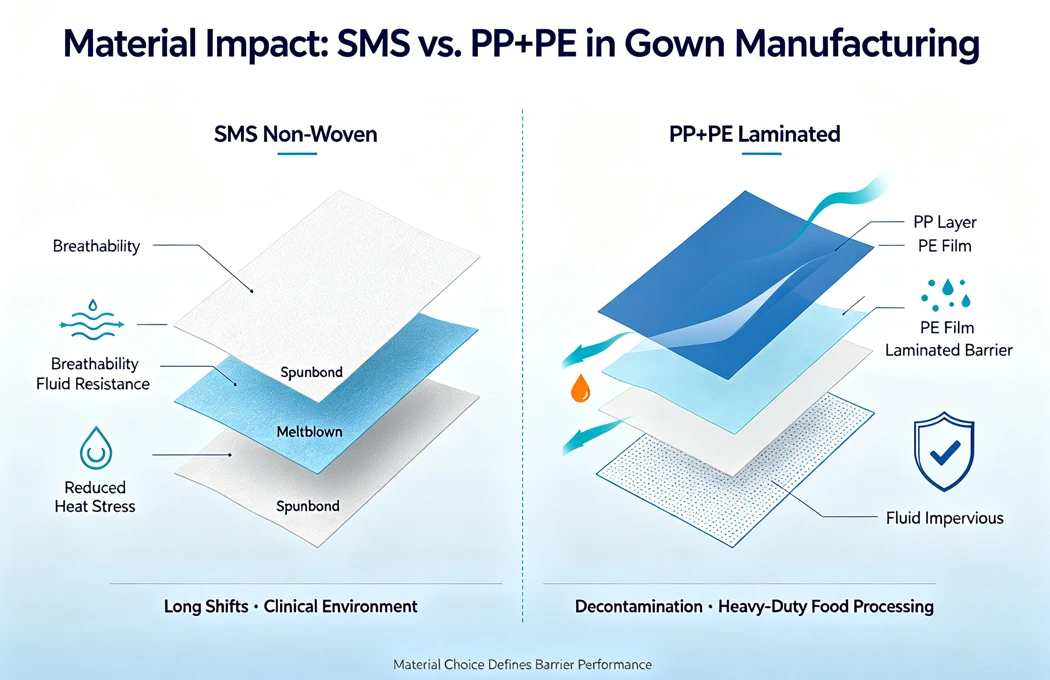
Material Impact: SMS vs. PP+PE in Gown Manufacturing
At Ruichen, we manufacture our own PE and CPE films, allowing us to customize the protection level of both sleeve types. The material choice is just as critical as the sleeve length.
- SMS Non-Woven: This 3-layer material offers excellent breathability and a high degree of fluid resistance. SMS fabric offers an excellent option for long-sleeved gowns used during extended shifts because it helps reduce heat stress while maintaining reliable barrier protection.
- Product Reference: Blue Disposable SMS Long Sleeve Isolation Gown
- PP+PE (Laminated): This material is completely impervious to fluids. We recommend PP+PE for both short and long-sleeved gowns used in decontamination or heavy-duty food processing.
- Product Reference: Blue Disposable PP+PE Short Sleeve Isolation Gown
Application Scenarios for Industrial and Medical Buyers
1. Hospital General Wards & Outpatient Clinics
For routine patient check-ups where there is minimal risk of fluid spray, a short vs long sleeve protective gown debate usually leans toward short sleeves for ease of movement and better forearm hygiene.
2. Dental Practices
Dental hygienists often prefer short-sleeved gowns combined with long gloves or bare forearms that can be easily sanitized, as dental procedures involve significant aerosol generation but localized splatter.
- Product Reference: Blue Disposable SMS Short Sleeve Isolation Gown
3. Food Processing & Industrial Decoration
In food production, disposable gown sleeve types are chosen based on the machinery being used. Short sleeves are often safer around rotating equipment to prevent sleeve entanglement, whereas long sleeves are used in cold-storage environments for slight thermal protection and hygiene.
- Product Reference: Blue Disposable PP+PE Long Sleeve Isolation Gown
Procurement Guide: Evaluating Your Supplier
As an experienced exporter with over 10 years in the PPE industry, Hubei Ruichen Protective Products Co., Ltd recommends that procurement managers evaluate the following when ordering isolation gowns in bulk:
- Fabric Weight (GSM): Ensure the GSM (grams per square meter) is appropriate for the intended use. For visitors, manufacturers can use lightweight materials ranging from 20–25 gsm. Clinical isolation typically requires heavier materials in the 35–45 gsm range.
- Seam Integrity: For long-sleeved gowns, the junction between the sleeve and the body is a common failure point. Look for reinforced stitching.
- Certification Compliance: Always verify CE, ISO9001, and ISO13485 certifications. These standards help manufacturers produce gowns under a strict quality management system.
- In-House Film Production: Suppliers who produce their own PE/CPE films (like Ruichen) offer better cost control and more consistent material quality than those who outsource raw materials.
Conclusion
Choosing between short-sleeved and long-sleeved isolation gowns requires a balance of infection control theory and practical workplace safety. While long sleeves offer the ultimate barrier for high-risk clinical settings, short sleeves provide unique advantages in hand hygiene and worker comfort for low-risk or high-temperature environments.
For a comprehensive range of body protection solutions tailored to your specific industry standards, explore our full category:
Ruichen Body Protection – Isolation Gowns
FAQ
1. Are short-sleeved isolation gowns considered “medical grade”?
Yes, they can be. “Medical grade” refers to the quality of the material and the manufacturing environment (ISO13485). However, their use is restricted to specific low-risk clinical applications where full-arm fluid protection is not a regulatory requirement.
2. Can I use short-sleeved gowns in a laboratory?
It depends on the Bio-Safety Level (BSL). For BSL-1 where chemicals and pathogens are not an aerosol/splatter risk, they may be used. For BSL-2 and above, long-sleeved gowns with elastic or knit cuffs are mandatory to ensure no skin exposure.
3. Why are SMS gowns more expensive than PP gowns?
SMS (Spunbond-Meltblown-Spunbond) includes a meltblown layer that acts as a bacterial and fluid filter, whereas standard PP (Spunbonded Polypropylene) is mainly for dust and light particles. SMS provides a significantly higher level of protection.
4. Does Ruichen offer OEM/ODM for custom sleeve lengths?
Yes. As a direct manufacturer, we can customize sleeve lengths, cuff types (elastic vs. knit), and material weights to meet specific regional healthcare standards or industrial needs.
5. Which sleeve type is better for heat stress prevention?
Short-sleeved gowns are significantly better for heat dissipation. If long sleeves are required for safety, choosing a high-breathability SMS material can help mitigate heat stress compared to a non-breathable PP+PE laminated gown.