

Blog
5-Ply vs 3-Ply Masks: Which Is Better?

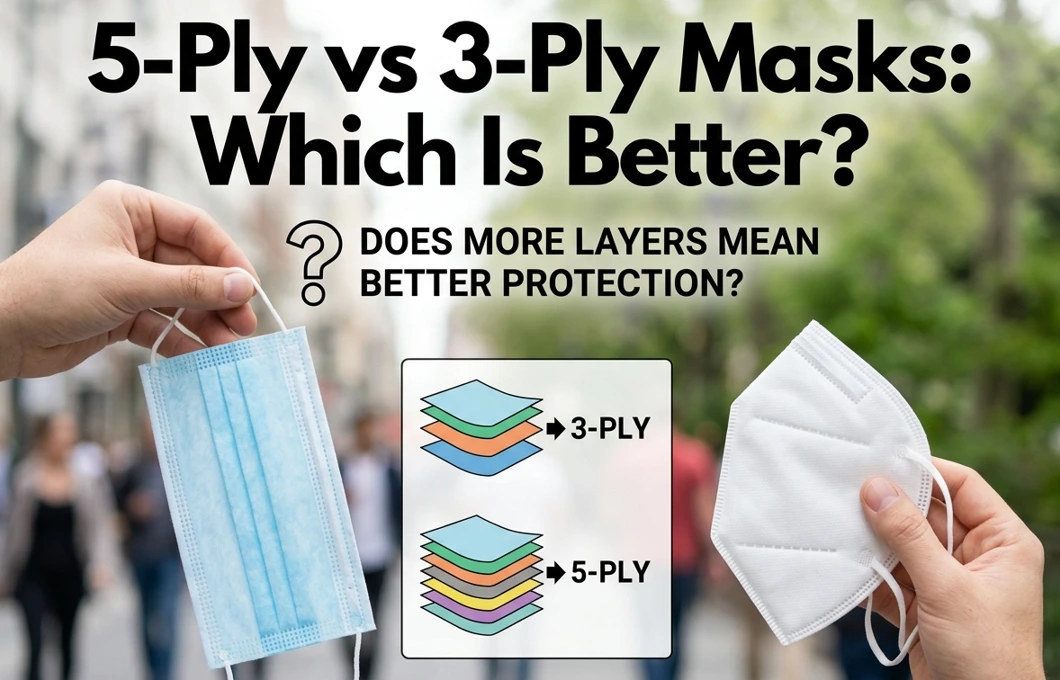
When comparing disposable face masks, the difference between 3-ply and 5-ply masks seems straightforward. One uses three layers of material, while the other uses five. The harder question is whether those extra layers actually make a mask more effective.
The short answer is: not necessarily. A 5-ply mask can have a more complex structure and may include additional functional layers, but the number of layers alone does not determine filtration performance. The materials used in those layers and the way the mask is constructed matter just as much.
3-Ply vs 5-Ply Mask Difference
The main difference is the number and arrangement of material layers.
A typical 3-ply disposable mask uses an outer nonwoven layer, a middle filtration layer, and an inner layer designed for contact with the face. The middle layer is often the most important part of the structure because it can provide the primary filtration function.
A 5-ply mask adds two more layers to that basic structure. Depending on the design, these layers may provide additional filtration media, support the mask structure, or serve another specific function.
| Feature | 3-Ply Mask | 5-Ply Mask |
|---|---|---|
| Number of layers | 3 | 5 |
| Layer structure | Relatively simple | More complex |
| Filter media | May include a dedicated filter layer | May include one or more functional filter layers |
| Thickness | Usually lighter | Usually thicker |
| Breathability | Depends on materials | Depends on materials and layer resistance |
| Structure | Flexible and lightweight | Can feel more substantial |
| Filtration performance | Depends on filter media | Depends on filter media |
| Suitable applications | Depends on product specification | Depends on product specification |
The important point is that three layers do not mean poor filtration, and five layers do not automatically mean better filtration.
Is 5 Ply Mask Better Than 3 Ply?
A 5-ply mask can be better than a 3-ply mask for a particular application, but it is not correct to say that every 5-ply mask is better.
Why?
Because filtration comes from the properties of the filtration material, not simply from adding more layers.For example, a 3-ply mask with an effective meltblown filtration layer may perform differently from a 5-ply mask made with several ordinary nonwoven layers. If the additional layers do not provide meaningful filtration or another useful function, simply increasing the layer count does not automatically improve the finished mask.
This is why the right comparison is not:
3 layers vs. 5 layers
It is:
What materials are used in each layer, and what does each layer do?
That distinction makes the comparison much more useful.
How Do the Extra Layers Affect a 5-Ply Mask?
The two additional layers in a 5-ply mask can change the physical structure of the product.
A manufacturer may use them to add another filtration layer, create a specific material combination, or increase the structure of the mask. The exact configuration varies by product.
Filtration
Filtration is the main reason people often associate more layers with better protection.
A multilayer structure can provide more opportunities to use filtration media. However, the actual result depends on the material, fiber structure, filtration mechanism, and finished-mask design.A mask should therefore be evaluated using its tested filtration performance, where applicable, rather than its ply count alone.
Thickness
A 5-ply mask will generally contain more material than a comparable 3-ply mask, so it may feel thicker.
That can make the mask feel more substantial, but thickness itself is not a measurement of filtration efficiency. A thicker mask can also create greater resistance to airflow if the materials are not selected carefully.
Breathability
This is where adding layers can involve a trade-off.Each additional layer can affect airflow through the mask. A well-designed 5-ply mask needs to balance filtration requirements with acceptable breathability.For that reason, a mask with more layers is not automatically more comfortable. Material type and layer construction have a direct influence on how the mask feels during use.
5 Layer Face Mask Benefits
The potential benefits of a 5-layer construction come from its layer arrangement, rather than the number five itself.
A 5-ply design gives manufacturers more flexibility when combining different materials. For example, different layers can be assigned different functions instead of asking one material to perform several jobs.
Common potential benefits include:
- More flexibility in material combinations
- Additional space for filtration media
- A more structured mask construction
- Different combinations of filtration and breathability
- Greater control over the physical properties of the finished mask
These benefits depend on the actual product design. Adding two layers of similar material does not necessarily provide the same result as adding specifically designed functional layers.
Does a 5-Ply Mask Filter Better Than a 3-Ply Mask?
Not by definition.
This is probably the most important point in the entire 5-ply vs 3-ply mask comparison.
A mask’s filtration performance depends on factors such as:
- Type of filtration media
- Fiber structure
- Layer density
- Airflow resistance
- Mask construction
- Fit around the face
- Applicable testing requirements
The middle filtration layer in a disposable mask can be particularly important. Meltblown nonwoven is commonly used as filtration media because its fine fiber structure can support particle and bacterial filtration applications.
However, simply knowing that a mask contains meltblown material still does not provide a complete performance assessment. The finished product and its tested specifications matter.
So if a supplier describes a product as “5-ply,” ask what those five layers actually contain.
That question can reveal much more than the ply number itself.
Which Mask Is Better for Different Requirements?
There is no single best ply mask for protection for every application.If the main requirement is a lightweight disposable mask with a relatively simple structure, a 3-ply design may be sufficient when its tested specifications meet the intended use.A 5-ply design may be considered when a more complex material structure is required. It can provide additional flexibility for combining filtration or structural layers.
The comparison can be simplified like this:
| Requirement | What to Consider |
|---|---|
| Basic disposable use | 3-ply construction may be sufficient |
| More complex layered structure | 5-ply may provide more design flexibility |
| Filtration | Check filter media and tested performance |
| Breathability | Check airflow resistance or relevant test data |
| Comfort | Consider thickness, weight and materials |
| Fit | Check mask dimensions, nose wire and edge coverage |
| Protection requirements | Match the mask to the intended application and standard |
The key is to compare performance specifications, not just layer counts.
3-Ply or 5-Ply: What Should You Choose?
If you are deciding between a 3-ply and 5-ply disposable mask, start with the intended use.
For a simple comparison, consider these questions:
- What is the mask being used for?
Define the application before comparing the construction. - What is inside each layer?
Check whether the mask uses meltblown or another dedicated filtration material. - What filtration performance has been tested?
Look for actual product test data when filtration performance is important. - How breathable is the mask?
More material can affect airflow resistance. - How does the mask fit?
Nose wires, dimensions, ear loops, and overall shape can affect fit.
Once these points are clear, the 3-ply versus 5-ply decision becomes much easier.For disposable mask buyers, this is a more practical approach than assuming that five layers must provide twice the protection of three layers. Ply count describes construction; it does not replace performance data.
Medical Face Masks and Protective Face Masks
The same principle applies when comparing different disposable mask categories.For healthcare-related applications, buyers can review Medical Face Masks based on their intended use and applicable product requirements. For other protective applications, Protective Face Masks provide another category to consider.The important thing is to match the mask to the required application rather than choosing solely because the product has three or five layers.A 5-ply construction can be useful, but more layers are not a substitute for appropriate materials, tested performance, and proper fit.
Conclusion
The 5 ply vs 3 ply mask difference mainly comes down to construction.A 3-ply mask uses a simpler three-layer structure, while a 5-ply mask provides additional layers that can be used for filtration, structure, or other functions. That gives the 5-ply design more room for material combinations, but it does not automatically make it more effective.If you are comparing two masks, look at the filter media, tested filtration performance, breathability, thickness, and fit. Those details tell you far more than the number of layers alone.In other words, a 5-ply mask can be the right choice for some applications, while a 3-ply mask can be entirely suitable for others. The better option depends on what the mask is designed to do and whether its verified specifications match that requirement.
FAQ
Is 5 ply mask better than 3 ply?
Not automatically. A 5-ply mask has more layers, but its filtration performance depends on the materials and construction of those layers.
What is the 3 ply vs 5 ply mask difference?
A 3-ply mask contains three material layers, while a 5-ply mask contains five. The additional layers can provide more flexibility in filtration and structural design.
Do 5-ply masks provide better filtration?
They can, depending on the filtration media and construction. However, ply count alone does not establish filtration efficiency.
What are the benefits of a 5 layer face mask?
Potential benefits include greater flexibility in material combinations, additional filtration media, and a more structured construction. The actual benefits depend on the product design.
Is a 3-ply mask enough for protection?
It can be suitable for applications where its materials and tested performance meet the required specifications. The number of layers alone does not determine suitability.
Does a 5-ply mask have to be thicker?
Generally, adding two layers adds material and can increase thickness, but the final thickness depends on the materials and construction used.
Are 5-ply masks harder to breathe through?
Not necessarily. Breathability depends on the resistance of the materials and the complete mask structure. Additional layers can affect airflow, but the result varies between products.
What should I check besides the ply count?
Check the filtration media, tested performance, breathability, mask dimensions, fit, nose wire, ear loops, and intended application.