

Blog
Medical Mask vs Respirator: Differences Explained

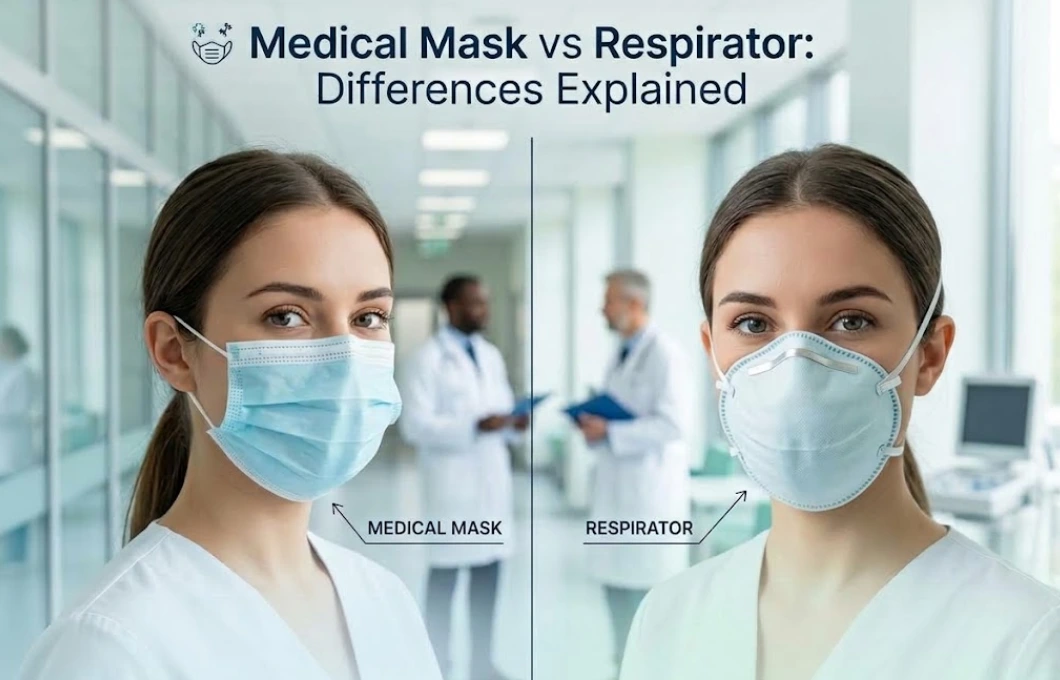
A medical mask and a respirator may look similar at a glance, but they serve different protection purposes. The main difference is how they fit, what they are designed to filter, and whether they rely on a close face seal.A medical mask generally covers the nose and mouth and helps reduce exposure to droplets, splashes, and larger airborne particles. It can also help limit the spread of respiratory secretions from the wearer.A respirator takes protection further. Models such as N95 respirators are designed to filter very small airborne particles and form a closer seal around the face when properly fitted.
That difference matters when people compare a medical mask vs respirator for healthcare, laboratory, pharmaceutical, cleanroom, or other controlled environments.
What Is the Difference Between a Medical Mask and a Respirator?
The simplest way to understand the difference between medical mask and respirator is to look at their design purpose.
A medical mask is usually loose-fitting. Small gaps can remain between the mask and the wearer’s face. Its primary role is often source control and protection against droplets or splashes rather than creating a sealed breathing zone.A respirator is designed to fit more closely around the face. Its performance depends on both filtration and the quality of the face seal.
| Feature | Medical Mask | Respirator |
|---|---|---|
| Primary design | Droplet and splash protection, source control | Particle filtration and respiratory protection |
| Face fit | Generally loose-fitting | Designed for a closer facial seal |
| Air leakage around edges | More likely | Reduced when properly fitted |
| Particle filtration | Depends on mask design and applicable standard | Designed for specified filtration performance |
| Fit testing | Generally not the same requirement as tight-fitting respirators | May be required for workplace use |
| Typical examples | Surgical or medical masks | N95 and other particulate respirators |
| Main consideration | Mask construction and intended use | Filtration, fit, seal, and applicable standard |
The distinction is important because filtration material alone does not determine how much protection a person receives.If air can easily move around the edges of a face covering, some inhaled air may bypass the filter material.
Medical Mask vs Respirator Protection
The difference in medical mask vs respirator protection comes down to more than the filter itself.
Medical masks can help protect the wearer from droplets and splashes, depending on their construction and intended standard. They can also reduce the amount of respiratory material released by the wearer.However, a typical medical mask does not form the same type of facial seal as a tight-fitting respirator.Respirators are designed around a different concept. The filter removes particles from air that passes through the filtering material, while the facepiece is intended to limit unfiltered air entering around the edges.
For that reason, fit becomes an important part of respirator performance.A respirator that has a high-performing filter but does not fit the wearer’s face properly may not provide the expected level of protection.
Filtration Is Only Part of the Equation
It is easy to focus on filtration numbers when comparing masks. In real use, several factors interact:
- Filter construction
- Particle size and type
- Face fit
- Leakage around the edges
- Wearing time
- Mask condition
- Proper donning
- Applicable testing standard
- Intended work environment
This is why a medical mask and a respirator should not be treated as interchangeable products.
Surgical Mask vs N95: Are They the Same?
The surgical mask vs N95 comparison is one of the most common questions in respiratory protection.
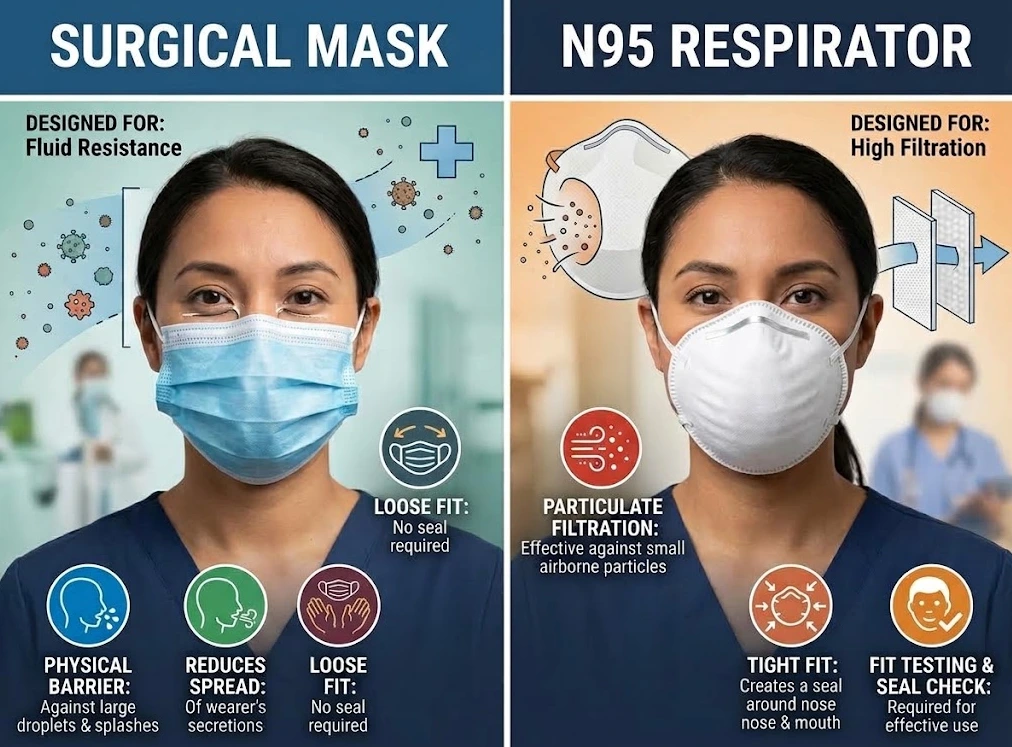
They are designed differently.A surgical or medical mask generally has a loose fit. Its design can provide a physical barrier against droplets and splashes and can reduce the spread of respiratory secretions.An N95 respirator is a particulate respirator designed to filter airborne particles and fit closely to the wearer’s face when correctly selected and worn.
The two products therefore address different protection needs.An N95 respirator also requires attention to fit. Facial hair, incorrect positioning, movement, or an unsuitable size can affect the seal.For workplace applications, organizations may also have additional requirements for respirator selection, fit testing, training, and use.
Why the Fit Matters
Imagine two filters with similar laboratory performance.One sits loosely over the face. The other forms a seal around the nose, cheeks, and chin.The amount of protection experienced by the wearer can differ because air follows the path of least resistance.
This is one reason respirator protection cannot be judged only by the filter material.A medical mask may still be the appropriate option for situations where droplet control, splash resistance, or source control is the primary concern.A respirator becomes more relevant when the work environment requires respiratory protection against airborne particles and the applicable requirements call for a properly fitted respirator.
When to Use a Respirator
The question of when to use respirator depends on the hazard, workplace requirements, exposure route, and applicable regulations.
A respirator may be appropriate when workers need protection from airborne particles that could pass through the gaps of a loose-fitting face covering.Healthcare, laboratory, pharmaceutical, industrial, and other controlled environments can have different respiratory protection requirements.
Before selecting a respirator, consider:
- Identify the hazard.
Determine whether the concern involves droplets, airborne particles, aerosols, gases, vapors, or another hazard. - Understand the required protection.
Different hazards call for different types of respiratory protection. - Check the applicable standard.
The required certification or performance classification depends on the country, workplace, and intended application. - Consider facial fit.
Tight-fitting respirators depend on an effective seal. - Follow workplace procedures.
Employers may have requirements for fit testing, training, inspection, replacement, and storage. - Check the manufacturer’s instructions.
Product limitations and intended applications should always be reviewed before use.
This process is more reliable than choosing a mask based only on appearance or a familiar product name.
Where Medical Masks Are Commonly Used
Medical masks are widely used in healthcare and other environments where source control, droplet protection, or splash protection is relevant.
Common applications include:
- Hospitals and clinics
- Dental practices
- Medical laboratories
- Pharmaceutical facilities
- Food processing
- Personal care and beauty services
- Clean and controlled production areas
- General hygiene applications
The exact requirements vary by application.For example, a medical mask used in a clinical environment may need different performance characteristics from a disposable mask intended for general hygiene or food-processing use.
Material construction also matters.Common disposable medical mask structures use layers of nonwoven materials, with the middle filtration layer providing an important part of the mask’s filtering function.The outer and inner layers can serve different roles related to protection, comfort, and handling.
Choosing a Medical Mask for Different Applications
For buyers sourcing disposable medical masks, the product specification should match the intended environment.
Important factors can include:
- Mask type
- Number of layers
- Filter material
- Bacterial filtration performance where applicable
- Fluid resistance where required
- Breathability
- Nose and ear-loop construction
- Size and fit
- Packaging
- Applicable certification or testing documentation
A medical mask supplier should also be able to provide clear product specifications rather than relying on broad claims such as “high protection.”
For standard disposable medical face mask requirements, see the Medical Face Mask category.The category can help buyers compare available medical mask products according to their intended use and product specifications.
Protective Face Masks for Industrial and Controlled Environments
Not every disposable face covering has the same purpose.Some applications require a basic disposable medical mask. Others may involve dust control, cleanroom procedures, industrial production, or additional protection requirements.
The product should therefore be evaluated according to its material, construction, filtration characteristics, intended application, and applicable standard.For buyers looking at broader disposable protective mask options, the Protective Face Masks category provides another product group to consider.The important point is to match the product with the actual hazard rather than assuming that every face mask provides the same type of respiratory protection.
A Practical Way to Compare Medical Masks and Respirators
For procurement teams, the comparison can be made fairly quickly.
| Question | Medical Mask | Respirator |
|---|---|---|
| Is source control important? | Often suitable | Can also provide source control depending on design |
| Is splash protection required? | Some medical masks are designed for this | Depends on respirator design |
| Is close facial sealing required? | Generally no | Yes for tight-fitting models |
| Is airborne particle protection required? | May not provide the same protection approach | Specifically designed for particulate respiratory protection |
| Is fit testing relevant? | Generally not in the same way | Often relevant for tight-fitting workplace respirators |
| Is the product standard important? | Yes | Yes, and the required respirator classification matters |
| Is workplace respiratory protection involved? | Not necessarily | Often requires additional procedures |
The right choice depends on the hazard and the purpose of the PPE.A medical mask is not simply a lower-cost respirator. The two products have different design objectives.Likewise, a respirator should not automatically replace a medical mask when splash protection or source-control requirements are the primary concern.
Medical Mask vs Respirator: The Practical Difference
The easiest way to remember the difference is this:
A medical mask is generally designed around barrier protection and source control, while a respirator is designed around respiratory protection through filtration and, for tight-fitting models, a close facial seal.
That does not make one universally better than the other.A healthcare worker dealing with droplets or splashes may have a different PPE requirement from a worker exposed to airborne particles.
The same logic applies to procurement.Instead of asking, “Which mask is better?” it is usually more useful to ask:
“What hazard does this product need to address, and what standard applies to that application?”That question leads to a much more practical PPE decision.
Conclusion
The difference between a medical mask and a respirator is mainly related to design purpose, filtration, fit, and the type of exposure they are intended to address.Medical masks generally provide loose-fitting barrier protection and can support source control and protection from droplets or splashes, depending on their design.Respirators are designed for respiratory protection against specified airborne hazards. Tight-fitting models depend on a proper facial seal, so fit and correct use become part of their performance.For healthcare facilities, laboratories, manufacturers, distributors, and other PPE buyers, the safest approach is to match the product specification with the actual application and applicable standard.The product name alone does not tell the whole story.
FAQ
Is a medical mask the same as a respirator?
No. A medical mask generally uses a loose-fitting design for barrier protection, droplet control, splash protection, or source control. A respirator is designed for respiratory protection and may form a closer seal around the face.
What is the difference between a medical mask and a respirator?
The main differences involve fit, filtration design, intended use, and protection requirements. Medical masks generally do not create the same facial seal as tight-fitting respirators.
Is an N95 a medical mask?
An N95 is a type of particulate respirator. Some N95 respirators may have healthcare applications, but the term N95 itself refers to a respirator classification rather than simply a general medical mask.
What is the difference between a surgical mask and an N95?
A surgical mask generally has a loose fit and is designed for barrier and source-control functions. An N95 respirator is designed to filter airborne particles and fit closely to the face when properly worn.
When should you use a respirator?
A respirator may be appropriate when the work environment involves airborne particle hazards and the applicable workplace or regulatory requirements call for respiratory protection. The correct type depends on the specific hazard.
Do medical masks protect against airborne particles?
Medical masks can filter particles to some extent, depending on their construction and applicable standard. However, they generally do not provide the same type of close facial seal as a tight-fitting respirator.
Does a respirator always provide better protection than a medical mask?
Not necessarily for every situation. The appropriate PPE depends on the hazard. A medical mask may be suitable when droplet, splash, or source-control functions are the main concern, while a respirator is designed for specified respiratory hazards.
What should buyers check when sourcing medical face masks?
Buyers should review material construction, dimensions, filtration-related performance, applicable standards, documentation, packaging, customization options, quality control, and the intended application before placing a bulk order.