

Blog
N95 vs KN95 Masks: Key Differences

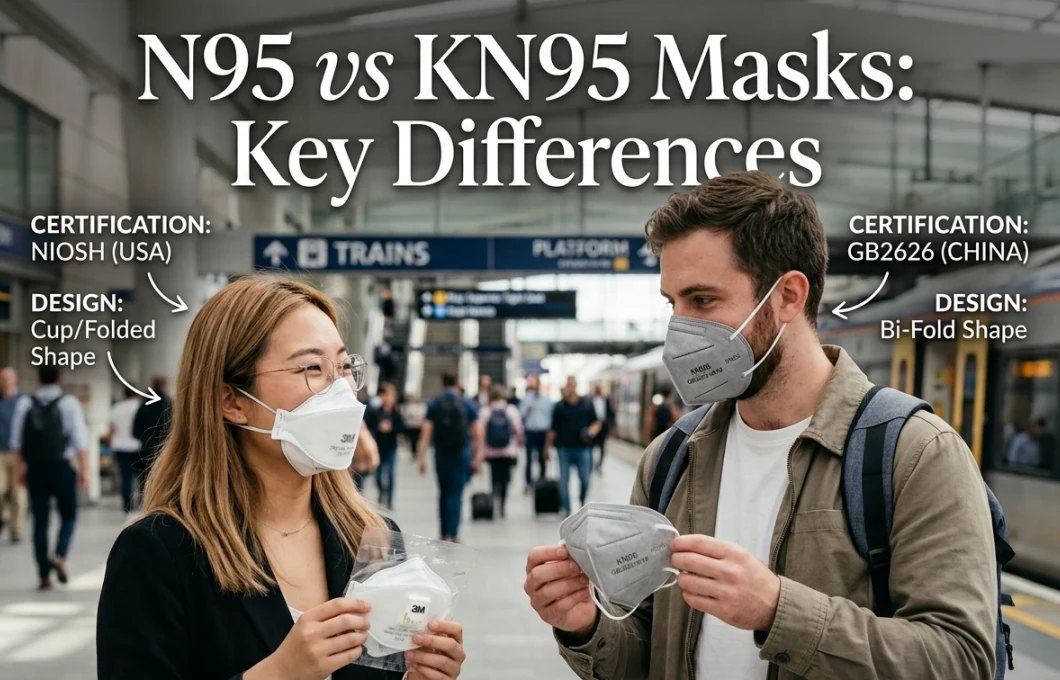
N95 and KN95 respirators look similar, and both are designed to filter at least 95% of airborne particles under their respective certification standards. The main difference is not the number on the mask. It is the standard behind that number, along with the product’s fit, testing requirements, and acceptance in the intended market.
An N95 respirator must receive approval from the U.S. National Institute for Occupational Safety and Health (NIOSH). A KN95 respirator follows China’s applicable GB 2626 standard. Although their filtration requirements are comparable, the two classifications are not interchangeable certifications.
For healthcare facilities, industrial workplaces, and PPE distributors, the distinction matters. A respirator must meet the applicable requirements for its intended use, and its design must provide a suitable facial seal for the wearer.
N95 vs KN95: A Quick Comparison
| Feature | N95 Respirator | KN95 Respirator |
|---|---|---|
| Applicable standard | U.S. 42 CFR Part 84 | China’s applicable GB 2626 standard |
| Approval or compliance system | NIOSH approval | Chinese standard compliance |
| Required filtration efficiency | At least 95% under the applicable test | At least 95% under the applicable test |
| Typical fastening | Headbands | Headbands or ear loops, depending on design |
| Fit requirements | Workplace use may require fit testing under OSHA rules | Fit depends on design and wearer; workplace requirements still apply |
| Common market association | United States | China and international markets |
| Interchangeable certification | No | No |
The table highlights the broad differences, but it does not mean every respirator within either category has the same shape, comfort level, or real-world performance. Model-specific documentation and fit matter.
What Do N95 and KN95 Certification Standards Actually Mean?
The letters and numbers identify different respiratory protection classifications. Both are intended to filter airborne particles, but each belongs to its own regulatory framework.
N95: A U.S. NIOSH-Approved Respirator
N95 is a respirator classification under U.S. regulations. NIOSH evaluates respirators against the requirements in 42 CFR Part 84 before granting approval.The designation indicates a minimum filtration efficiency of 95% under the prescribed test conditions for non-oil-based particles. It does not mean that a mask blocks every particle or provides the same protection in every situation.
A genuine NIOSH-approved respirator should carry the required approval markings. Buyers can also check the model against the NIOSH Certified Equipment List.For organizations supplying U.S. workplaces, this approval is particularly important when a purchasing specification calls for NIOSH-approved N95 respirators.
KN95: A Chinese Respirator Classification
KN95 respirators follow China’s GB 2626 standard, which covers respiratory protective equipment for protection against particulate matter. The applicable edition and product markings should be checked when evaluating a particular model.
Like N95 respirators, compliant KN95 models must meet a minimum filtration efficiency of 95% under their prescribed test conditions. However, compliance with a Chinese standard does not automatically establish NIOSH approval.
This distinction matters when a distributor exports products to different countries. A respirator may meet one market’s requirements without satisfying the documentation or approval requirements of another.Buyers should verify the product’s stated standard, manufacturer information, test documentation, and any additional regulatory requirements for the destination market.
How Do Filtration Performance and Testing Differ?
The phrase “95% filtration” is useful, but it needs context. Filtration efficiency measures how effectively the filter material captures particles under specified laboratory conditions. It does not describe every aspect of respiratory protection.
Two respirators can achieve similar filtration results while differing in breathing resistance, construction, fit, or performance during actual use.
Filtration Efficiency Is Only One Part of Protection
N95 and KN95 classifications both specify at least 95% filtration efficiency under their respective test methods. Their test protocols are similar in purpose, but the standards should not be treated as identical.The result also depends on the prescribed test conditions. Particle characteristics, airflow, conditioning, and other parameters can influence how a respirator performs during testing.
For this reason, a claim that a KN95 is “the same as an N95” based only on the 95% figure is incomplete. The figure describes one performance requirement, not the entire approval system.
Breathing Resistance and Construction
Respirators must balance filtration with the effort needed to breathe through the filter material. Standards specify performance limits for breathing resistance, but actual comfort also depends on the respirator’s design and the wearer.
Common design considerations include:
- Filter media and the number of material layers.
- Nose clip shape and adjustment.
- Headband or ear-loop tension.
- Facepiece shape and available sizes.
- Structural support that helps the respirator maintain its shape.
These details matter to manufacturers and distributors because small design changes can affect fit, comfort, and product consistency. Buyers comparing models should review test reports and product specifications rather than assuming all products carrying the same classification perform identically.
Does N95 vs KN95 Fit Differ in Practice?
Fit is one of the most important differences to consider when comparing N95 and KN95 respirators. A high-performing filter cannot deliver its intended level of protection if air leaks around the edges of the facepiece.
N95 models commonly use two headbands that secure the respirator around the head. KN95 designs vary more widely and may use headbands or ear loops. These are common design patterns, not rules that apply to every model.
A headband design may provide more consistent tension for some wearers. An ear-loop design may be easier to put on and remove. Neither design guarantees a better seal for every face shape.
What Affects Respirator Fit?
Several factors can influence how well a respirator seals:
- Face shape and size: The nose bridge, cheek contours, and chin affect contact with the facepiece.
- Strap tension: Loose or uneven straps can create gaps.
- Nose clip adjustment: An improperly shaped nose clip may allow air to escape near the nose.
- Facial hair: Hair crossing the sealing surface can interfere with a tight seal.
- Movement: Talking, bending, and turning the head may change the seal.
Wearers should follow the manufacturer’s instructions and perform a user seal check each time they put on a respirator. A seal check helps identify obvious leakage, but it does not replace a formal fit test.
Under U.S. OSHA respiratory protection rules, workers required to use tight-fitting respirators must pass an appropriate fit test. The test applies to the specific make, model, style, and size they will wear. These workplace requirements should not be confused with NIOSH’s product approval process.
For distributors serving industrial or healthcare customers, fit guidance and model availability are therefore practical considerations, not minor details.
Which Is Better for Healthcare, Industry, and Everyday Use?
The answer to “N95 vs KN95 which is better” depends on the application, the destination market, and whether the respirator fits the intended wearer.
Neither classification is universally better in every situation.
Healthcare Environments
Healthcare organizations should follow their respiratory protection programs and applicable infection prevention policies. In the United States, workplaces that specify NIOSH-approved N95 respirators should verify the approval of the exact model.
Some clinical procedures or applications may require additional product characteristics or a specific medical-device status. A standard N95 respirator should not automatically be described as a surgical N95 respirator.
A KN95 may meet its own applicable standard, but that alone does not make it an approved substitute where a U.S. workplace specifically requires a NIOSH-approved respirator.
Industrial Workplaces
Industrial buyers should start with the hazard assessment and the applicable respiratory protection requirements. Dust, particulate contaminants, workplace exposure levels, and other hazards may call for different protective equipment.
The N95 classification indicates that the respirator is not resistant to oil-based particles under the NIOSH classification system. It should not be assumed suitable for every industrial contaminant.
Employers should select equipment based on the hazard, the manufacturer’s instructions, and applicable regulations. They must also consider fit testing, training, maintenance, and other elements of the respiratory protection program where required.
General Public Use
For members of the public, comfort and fit often influence whether a respirator can be worn consistently. A model that feels comfortable but leaves gaps may perform worse in practice than a properly fitted alternative.
Buyers should look for clear manufacturer information, genuine certification or compliance markings, and an appropriate design. Avoid relying on appearance alone: two respirators may look nearly identical but have different documentation or performance.
How Can Buyers Verify Respirator Quality?
Counterfeit products and unsupported certification claims can make product evaluation difficult. This is particularly important for importers, distributors, and organizations purchasing respirators in volume.
A sensible verification process begins with the product itself and continues through the supplier’s documentation.
- Identify the required standard. Confirm whether the destination market or customer specification calls for NIOSH-approved N95 respirators or KN95 respirators compliant with the applicable GB 2626 edition.
- Check product markings. Review the model, manufacturer identification, classification, and required approval or compliance information.
- Verify the documentation. For N95 products, check the exact model against the official NIOSH listing. For KN95 products, review applicable conformity documents and test reports.
- Review the physical construction. Inspect seams, straps, nose clips, and facepiece consistency across samples or production batches.
- Confirm traceability. Ask how the supplier identifies production batches and handles quality records, complaints, and nonconforming products.
- Evaluate fit and intended use. Ensure the model suits the wearer and the application, and follow any required fit-testing procedures.
A supplier’s certificate or test report should be relevant to the exact product being offered. Documentation for a similar model is not enough to establish that the product in hand meets the same requirements.
For B2B buyers, it is also sensible to agree on product specifications, labeling, packaging, inspection criteria, and required export documents before placing a large order.
Conclusion
N95 and KN95 respirators share a similar filtration target, but they belong to different standards and approval systems. N95 refers to a NIOSH-approved classification in the United States, while KN95 refers to a classification under China’s applicable GB 2626 standard.
The most useful comparison goes beyond the label. Filtration test results, facepiece design, breathing resistance, fit, documentation, and destination-market requirements all affect whether a particular respirator is appropriate.
For workplace use, follow the relevant respiratory protection program and regulatory requirements. For procurement, verify the exact model and its documentation instead of treating the two classifications as interchangeable.
FAQ
What is the main difference between N95 and KN95?
The main difference is the standard and approval system. N95 respirators require NIOSH approval under U.S. regulations, while KN95 respirators follow China’s applicable GB 2626 standard. Both specify at least 95% filtration efficiency under their respective test conditions.
Is KN95 as effective as N95?
A compliant KN95 and a genuine NIOSH-approved N95 have comparable minimum filtration targets. However, the labels alone do not prove that two specific products have identical performance, fit, or regulatory status.
N95 vs KN95: Which is better?
Neither is universally better. The right choice depends on the required standard, workplace or personal application, product authenticity, and fit. If a U.S. workplace requires a NIOSH-approved N95, a KN95 should not be assumed to satisfy that requirement.
Does an N95 fit better than a KN95?
Not in every case. N95 respirators commonly use headbands, while KN95 models may use headbands or ear loops. The actual seal depends on the design, size, strap tension, and the wearer’s facial features.
Can KN95 respirators be used in U.S. workplaces?
That depends on the workplace requirements and applicable regulations. A KN95 marking does not establish NIOSH approval. Employers should follow their respiratory protection program and verify that the selected respirator meets the requirements for the intended use.
How can I verify whether an N95 respirator is genuine?
Check the required markings and search the exact manufacturer and model in the official NIOSH Certified Equipment List. A matching listing is an important verification step, but the physical product should also match the approved model and configuration.
Do N95 and KN95 respirators protect against oil-based particles?
A standard N95 classification does not indicate resistance to oil-based particles. Buyers working with oil aerosols or other specific hazards should assess the hazard and select a respirator classification appropriate to the exposure.
What should importers check when sourcing KN95 respirators?
Importers should verify the applicable GB 2626 edition, manufacturer details, test documentation, product markings, batch traceability, and destination-market requirements. They should also agree on specifications and inspection criteria before bulk production or shipment.