

Blog
What Is a Disposable Face Mask?

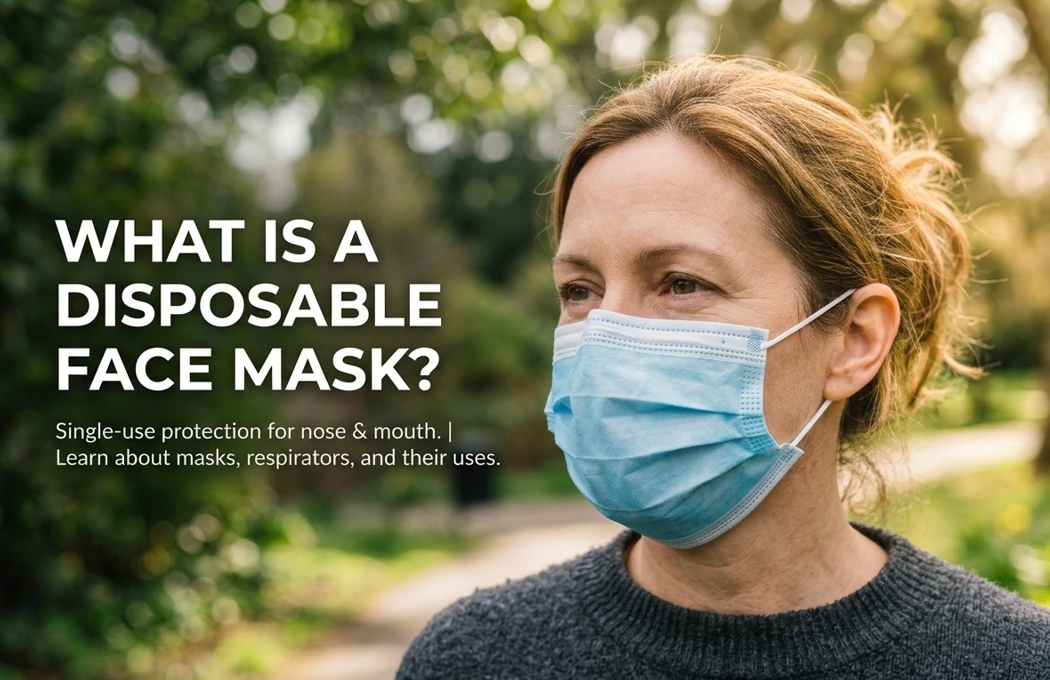
A disposable face mask covers the nose and mouth and usually serves as a single-use protective covering.Depending on its design, the mask can help reduce exposure to droplets, airborne particles, dust, or environmental contamination.The term sounds simple, but it covers several different products.For example, a 3-ply medical mask does not work in exactly the same way as a KN95 or FFP2 respirator. All three cover the face, yet their construction, fit, testing requirements, and intended uses differ.That distinction helps explain what a disposable face mask actually does.
What Is a Disposable Face Mask Made Of?
Most disposable face masks use several layers of nonwoven material rather than conventional woven fabric.A common 3-ply design combines an outer layer, a filtration layer, and an inner layer. Manufacturers often use polypropylene because it can form lightweight nonwoven structures.
| Mask layer | Common material | Typical function |
|---|---|---|
| Outer layer | Spunbond polypropylene | Forms the outer surface |
| Middle layer | Meltblown polypropylene | Provides the main filtration layer |
| Inner layer | Spunbond polypropylene | Faces the wearer |
The middle layer deserves particular attention.Manufacturers commonly use meltblown polypropylene for filtration because its fine fiber structure can capture particles as air moves through the material.However, the filtration layer does not work alone.The nose clip, ear loops, dimensions, shape, and overall construction can also affect how the mask sits on the face.For a broader look at disposable face protection products, visit the face protection category.
How Does a Disposable Face Mask Work?
A disposable mask relies on three basic factors: coverage, filtration, and fit.The material handles much of the filtration function. In many nonwoven masks, meltblown polypropylene creates a fine fiber layer that captures particles during airflow.Fit presents a different issue.A loose-fitting medical mask normally leaves some space around the edges. By contrast, a filtering facepiece respirator aims for a much closer facial fit.As a result, these products serve different purposes even when they look similar.For this reason, layer count alone cannot describe mask performance.The material structure, applicable standard, filtration characteristics, and intended application all contribute to the final product.
Types of Disposable Masks
Several types of disposable masks appear in healthcare, laboratories, workplaces, and everyday environments.Although they may look similar, their designs address different requirements.
| Type | General design | Typical fit | Common application |
|---|---|---|---|
| 3-ply medical mask | Multi-layer nonwoven mask | Loose-fitting | Medical and general hygiene applications |
| Surgical mask | Medical mask for procedural use | Loose-fitting | Healthcare procedures |
| KN95 respirator | Filtering facepiece | Close-fitting | Airborne particle protection |
| FFP2 respirator | Filtering facepiece | Close-fitting | Airborne particle protection |
| FFP3 respirator | Filtering facepiece | Close-fitting | Higher filtration classification within EN 149 |
The table does not represent one simple protection ranking.Instead, each category follows its own design principles and applicable requirements.
3-Ply Disposable Face Mask
The 3-ply disposable mask remains one of the most familiar designs.It usually combines a rectangular mask body, ear loops, and a flexible nose piece. The manufacturer bonds several nonwoven layers together to form the mask body.Typically, the outer and inner layers provide the basic structure. Meanwhile, the middle layer handles much of the filtration function.People commonly use these masks in healthcare, laboratories, food processing, clean environments, and general hygiene settings.
Surgical Mask
A surgical mask belongs to the broader medical face mask category.Healthcare professionals commonly use surgical masks during medical and procedural activities. Their loose fit distinguishes them from close-fitting filtering respirators.Medical masks can follow different specifications and standards depending on their intended application and market.For example, EN 14683 covers requirements for medical face masks in applicable markets.You can also explore the medical face mask category to see different disposable mask configurations.
KN95 Respirator
KN95 refers to a filtering facepiece classification associated with the Chinese GB 2626 standard.Unlike a typical loose-fitting medical mask, a KN95 respirator uses a design intended to fit more closely around the face.The filtration material forms an important part of this respiratory protection system.The number “95” describes a filtration classification within the relevant standard. It does not mean that every real-world situation produces exactly 95% protection.Instead, users need to consider the complete product, its fit, testing, and conditions of use.
FFP2 and FFP3 Respirators
FFP2 and FFP3 belong to the filtering facepiece respirator classifications under EN 149.These respirators combine filtration material with a close-fitting design.Within this classification system, FFP3 has a higher filtration classification than FFP2.Still, that difference does not make either respirator equivalent to a surgical mask.The two product groups address different protection requirements.
Disposable Mask Uses in Different Environments
The phrase disposable mask uses covers a surprisingly wide range of situations.A disposable mask may appear in a hospital, laboratory, food-processing facility, cleanroom, factory, or everyday environment.However, the reason for wearing it can change considerably from one setting to another.
Healthcare
Medical and surgical masks commonly appear in healthcare settings.They create a physical barrier between the wearer’s nose and mouth and the surrounding environment. Depending on the product, some medical masks also address fluid splash exposure.Hospitals, clinics, dental practices, and laboratories may use different types of medical face masks.The specific requirements depend on the procedure, product classification, and applicable regulations.
Laboratories
Laboratories can use disposable masks for several different purposes.For example, personnel may wear masks as part of general hygiene or contamination-control practices.However, some laboratory activities involve airborne hazards that require specialized respiratory protection.Therefore, a basic disposable medical mask should not automatically replace a respirator when the work environment calls for respiratory protection.
Food Processing
Food-processing facilities often include disposable masks within broader hygiene procedures.In this environment, the mask may help control contamination from personnel rather than protect workers from hazardous airborne particles.That difference matters.A product can look almost identical while serving a completely different purpose.
Cleanrooms
Cleanrooms may use disposable face coverings as part of their contamination-control practices.Pharmaceutical production, electronics manufacturing, and other controlled environments can have different cleanliness requirements.Consequently, the mask forms only one part of the overall cleanroom protection system.Other clothing, procedures, air controls, and hygiene measures can also contribute to contamination control.
General Daily Use
Some disposable masks serve general everyday purposes.Their lightweight construction makes them convenient for short-term use.However, users should not automatically treat a general disposable mask as an industrial respirator.The product’s intended application and stated performance determine how it should be understood.
Surgical Mask vs Face Mask: What Is the Difference?
“Face mask” describes a broad product category.A surgical mask represents one specific type within that category. By contrast, the broader term can include medical masks, respirators, dust masks, and other face coverings.That is why the question surgical mask vs face mask can cause confusion.
| Feature | Surgical/medical mask | Filtering respirator |
|---|---|---|
| Fit | Generally loose-fitting | Designed for close facial fit |
| Main design | Multi-layer medical mask | Filtering facepiece |
| Face seal | Limited | Designed for a closer seal |
| Typical examples | Surgical mask, medical mask | KN95, FFP2, FFP3 |
| Main focus | Barrier and procedural use | Airborne particle filtration |
| Standard | Depends on product and market | Depends on respirator classification |
Both products can use disposable materials.Even so, they do not perform the same role.A surgical mask generally focuses on barrier and procedural applications. A filtering respirator, on the other hand, focuses on respiratory protection against airborne particles.The difference becomes particularly important when people use the terms “mask” and “respirator” interchangeably.
What Does the Filtration Layer Do?
The filtration layer forms an important part of many disposable nonwoven masks.Manufacturers commonly use meltblown polypropylene for this layer.The material contains very fine fibers that create a dense filtration structure. As air moves through the material, different physical mechanisms can contribute to particle capture.
These mechanisms include:
- Physical interception
- Inertial effects
- Diffusion
- Electrostatic attraction
The exact filtration behavior depends on the material, fiber structure, manufacturing process, and test conditions.Therefore, adding another layer does not automatically produce the same filtration performance.The type of fiber, the way manufacturers process the material, and the finished mask design all matter.
How Are Disposable Face Masks Manufactured?
Although a disposable face mask looks simple, manufacturers normally complete several production steps.
A typical nonwoven mask process may follow this sequence:
- Prepare the nonwoven materials
- Combine the required layers
- Cut the mask material
- Form the mask body
- Install the nose clip
- Attach the ear loops
- Bond the components
- Inspect the finished mask
- Package the product
The exact process varies with the mask design and production equipment.During quality inspection, teams may check dimensions, appearance, bonding strength, ear-loop attachment, nose clip position, and other specifications.Medical products may also require additional testing and documentation under their applicable standards.
How Long Can a Disposable Face Mask Be Used?
Most disposable masks are intended for limited use rather than indefinite reuse.The appropriate replacement time depends on the product instructions and the environment.Several conditions can affect when a mask needs replacement:
- Moisture
- Visible contamination
- Physical damage
- Breathing resistance
- Duration of use
- Manufacturer instructions
- Workplace or healthcare procedures
For example, a damaged or heavily contaminated mask may require earlier replacement.Likewise, moisture can change the condition of the mask material.For single-use products, washing or repeatedly reusing the mask can also alter its original properties.
Disposable Face Masks at a Glance
The easiest way to understand the category is to compare the basic product characteristics.
| Product | Disposable | Loose-fitting | Close-fitting respirator | Typical focus |
|---|---|---|---|---|
| 3-ply medical mask | Yes | Yes | No | Barrier and hygiene |
| Surgical mask | Usually | Yes | No | Medical procedures |
| KN95 | Usually | No | Yes | Particle filtration |
| FFP2 | Usually | No | Yes | Particle filtration |
| FFP3 | Usually | No | Yes | Higher filtration classification |
These descriptions provide a general overview rather than a substitute for product documentation.Specific products can differ in construction, certification, labeling, and intended application.For additional face protection products, you can explore the protective face masks category.
Conclusion
A disposable face mask is not simply a piece of material placed over the nose and mouth.Its characteristics come from the materials, layer structure, filtration technology, fit, and intended application.The term also covers several different product categories.A 3-ply medical mask differs from a KN95 respirator. Likewise, an FFP2 respirator serves a different role from a surgical mask.Understanding these differences makes the terminology much easier to follow.The most useful question is not simply how many layers a mask contains.Instead, look at what type of mask it is, which standard applies, how it fits, and what purpose the manufacturer designed it to serve.That distinction helps explain the role of disposable face masks across healthcare, laboratories, food processing, cleanrooms, workplaces, and everyday environments.
FAQ
What is a disposable face mask?
A disposable face mask covers the nose and mouth and normally serves as a single-use protective covering. Different designs address medical, hygiene, or respiratory protection needs.
What are the types of disposable masks?
Common types include 3-ply medical masks, surgical masks, KN95 respirators, FFP2 respirators, and FFP3 respirators. Their materials, fit, standards, and intended applications differ.
What are disposable masks used for?
Disposable mask uses include healthcare, laboratory work, food processing, clean environments, industrial workplaces, and general hygiene. The specific purpose depends on the mask design and application.
Is a surgical mask the same as a disposable face mask?
A surgical mask is one type of disposable face mask. However, the broader term can also describe other medical masks and filtering respirators.
What is the difference between a surgical mask and a respirator?
A surgical mask generally uses a loose-fitting design for medical or procedural applications. A respirator fits more closely against the face and targets airborne particle filtration.
What is a 3-ply disposable mask?
A 3-ply disposable mask normally contains three layers of nonwoven material. A common structure uses spunbond polypropylene for the outer and inner layers and meltblown polypropylene in the middle.
What is the difference between KN95 and FFP2?
KN95 and FFP2 belong to different standards and certification systems. KN95 connects with GB 2626, while FFP2 belongs to the EN 149 classification system.
Are disposable face masks made from polypropylene?
Many disposable nonwoven masks use polypropylene. Manufacturers commonly use spunbond polypropylene for structural layers and meltblown polypropylene for filtration.
Can disposable face masks be reused?
Many disposable masks are designed for single use. Follow the manufacturer’s instructions and the procedures that apply to the environment where the mask is used.
Does a thicker disposable mask provide better protection?
Not necessarily. Thickness and layer count alone do not determine filtration performance. Material structure, filtration technology, fit, testing, and the applicable standard also matter.
Can a surgical mask filter airborne particles?
Surgical masks can provide a barrier against droplets and some particles, but they do not function in the same way as close-fitting filtering respirators. Their performance depends on the specific product and applicable requirements.
Why do disposable masks have a nose clip?
A nose clip helps shape the upper edge of the mask around the nose. This can improve the fit and reduce gaps around that area.
How are disposable face masks manufactured?
Manufacturers typically prepare the nonwoven materials, combine the layers, form the mask body, attach the nose clip and ear loops, bond the components, and inspect the finished product.
Why do disposable masks use meltblown material?
Meltblown material contains fine fibers that create a filtration structure. Manufacturers commonly use it as the middle filtration layer in multi-layer disposable masks.