
Blog
What Is Spunbond Polypropylene Used For?

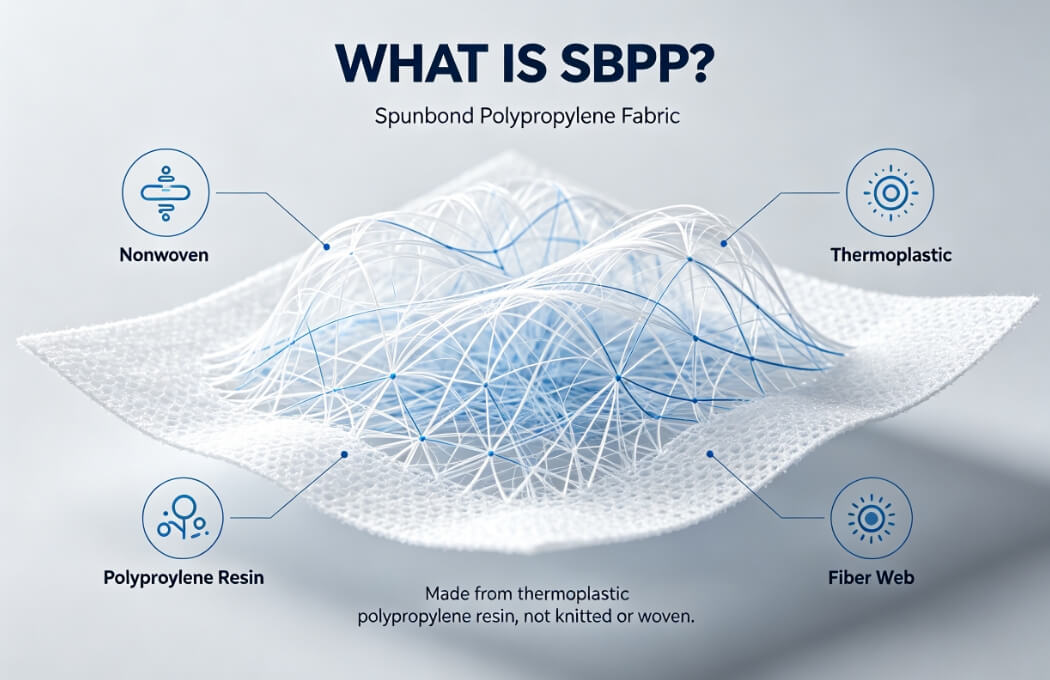
Spunbond polypropylene fabric (often abbreviated as SBPP) is a type of nonwoven textile. It is manufactured from thermoplastic polypropylene resin. Unlike traditional woven fabrics, nonwoven materials are not knitted or woven together.
Instead, the manufacturing process relies on thermal and mechanical bonding. The polymer is melted, extruded into continuous filaments, and laid down on a moving conveyor belt. These filaments are then bonded together using heated calender rolls.
The resulting fabric features a web-like structure. This unique structure provides a balance of tensile strength, breathability, and cost-effectiveness. Manufacturers typically consider this material ideal for single-use products.
What Is Spunbond Polypropylene Fabric?
Spunbond polypropylene fabric (often abbreviated as SBPP) is a type of nonwoven textile. It is manufactured from thermoplastic polypropylene resin. Unlike traditional woven fabrics, nonwoven materials are not knitted or woven together.
Instead, the manufacturing process relies on thermal and mechanical bonding. The polymer is melted, extruded into continuous filaments, and laid down on a moving conveyor belt. These filaments are then bonded together using heated calender rolls.
The resulting fabric features a web-like structure. This unique structure provides a balance of tensile strength, breathability, and cost-effectiveness. Manufacturers typically consider this material ideal for single-use products.
Key Characteristics of Spunbond Polypropylene
Understanding the physical properties of SBPP helps clarify its wide range of applications. PPE distributors commonly consider the following technical characteristics.
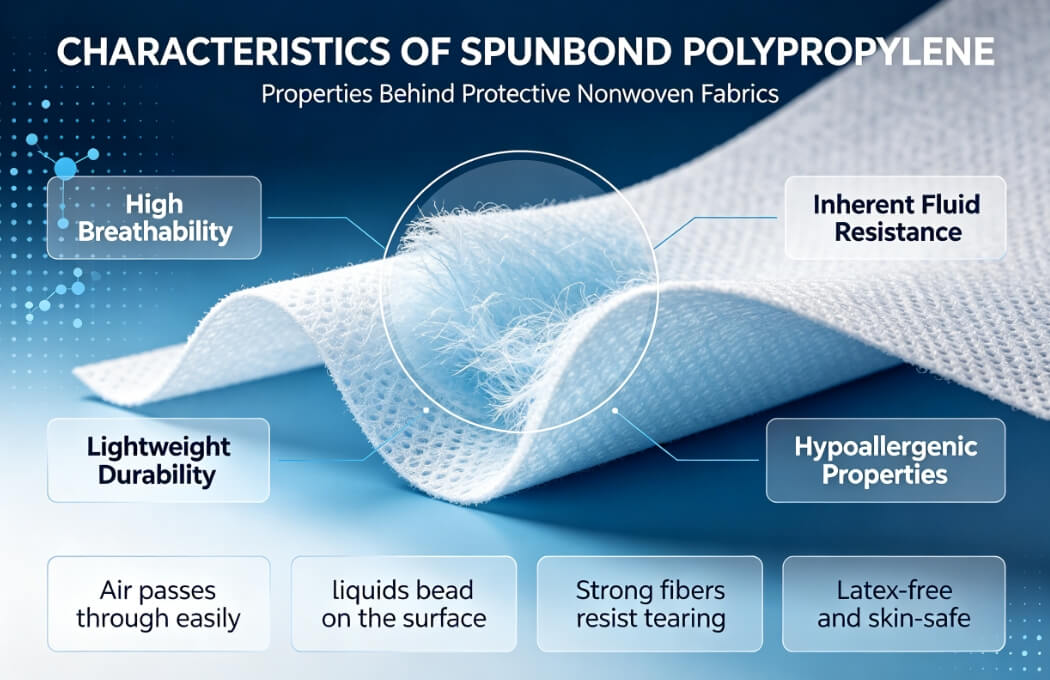
High Breathability
The web-like structure of spunbond fabric allows air to pass through easily. This prevents heat buildup during extended wear. Breathability is critical for healthcare workers wearing protective clothing for long shifts.
Inherent Fluid Resistance
Polypropylene is naturally hydrophobic. This means the fibers naturally repel water and water-based liquids. While standard spunbond fabric is not entirely waterproof, it offers excellent light fluid resistance.
Lightweight Durability
Spunbond PP provides significant tensile strength relative to its weight. It resists tearing and stretching during normal use. This makes it suitable for manufacturing durable yet lightweight isolation gowns and coveralls.
Hypoallergenic Properties
Medical-grade polypropylene is non-toxic and skin-friendly. It does not contain latex or fiberglass. This reduces the risk of allergic reactions when the fabric comes into direct contact with the skin.
What Is Spunbond Polypropylene Fabric Used For in Healthcare?
The medical sector is the largest consumer of spunbond polypropylene fabric. Infection prevention protocols require reliable, single-use barriers to maintain hygiene.
Disposable Isolation Gowns
Standard isolation gowns rely heavily on SBPP. These gowns provide basic barrier protection for visitors and healthcare workers. They are ideal for minimal-risk environments, such as basic patient care and standard clinical settings.
Medical Face Masks
A standard surgical mask consists of multiple layers. The outer and inner layers are almost always made of spunbond polypropylene. The outer layer repels airborne droplets, while the inner layer absorbs moisture from the wearer’s breath.
Protective Head Covers
Bouffant caps and surgical hoods are manufactured using lightweight spunbond fabric. These products prevent hair and skin particles from contaminating sterile environments. The breathability of SBPP ensures wearer comfort in warm operating rooms.
Disposable Shoe and Boot Covers
Shoe covers prevent the tracking of contaminants across different hospital zones. Heavy-duty spunbond polypropylene provides enough durability to withstand walking friction. It also offers a basic barrier against dry dirt and light floor moisture.
Industrial and Cleanroom Applications
Beyond healthcare, spunbond polypropylene is widely used in industrial safety scenarios. Facility managers often procure SBPP products for daily workplace protection.
Laboratory Coats
Disposable lab coats made of SBPP protect user clothing from dust, dirt, and non-hazardous materials. They are frequently used in educational laboratories, food processing facilities, and light manufacturing environments.
General Maintenance Coveralls
Workers in painting, cleaning, and general maintenance require basic particulate protection. Single-layer spunbond coveralls offer an affordable solution. They protect against dry dust while keeping the worker cool.
Food Processing Uniforms
Food safety regulations require workers to wear hairnets, beard covers, and protective aprons. Spunbond polypropylene is the industry standard for these items. It prevents cross-contamination without introducing lint into the production line.
Material Upgrades: Combining Spunbond PP with Other Layers
While standard spunbond PP is highly versatile, certain environments require enhanced protection. Manufacturers often combine SBPP with other materials to meet strict safety standards.
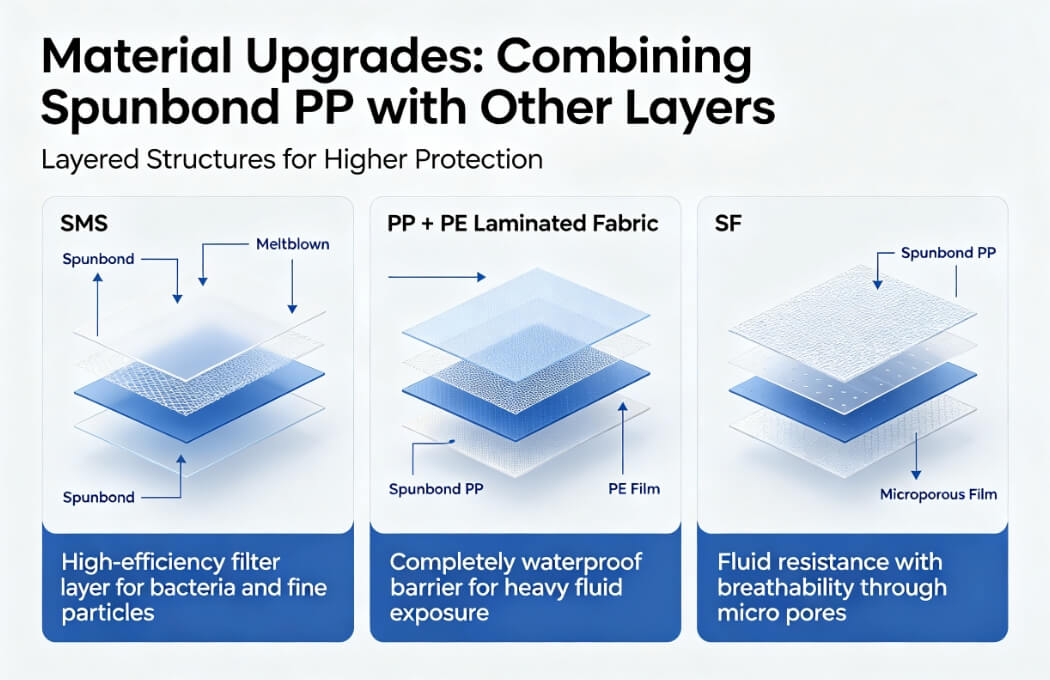
SMS (Spunbond-Meltblown-Spunbond)
When a meltblown layer is sandwiched between two spunbond layers, the result is SMS fabric. The meltblown layer acts as a high-efficiency filter for bacteria and fine particles. SMS is widely used for surgical gowns and advanced isolation gowns.
PP + PE Laminated Fabric
For environments with heavy fluid exposure, spunbond PP is laminated with a polyethylene (PE) film. This creates a completely waterproof barrier. PP+PE fabric is essential for chemotherapy gowns and strict infection control situations.
SF (Spunbond + Microporous Film)
Microporous film laminated on spunbond PP offers high fluid resistance while maintaining breathability. The microscopic pores allow water vapor to escape but block liquid molecules. This material is used in high-level biohazard coveralls.
Nonwoven Material Comparison
To assist procurement teams, the table below compares common nonwoven materials used in disposable PPE.
| Material Type | Structure | Breathability | Fluid Resistance | Primary Use Case |
|---|---|---|---|---|
| Spunbond PP | Single-layer web | Excellent | Low to Medium | Basic isolation gowns, hairnets |
| SMS | 3-layer composite | Good | Medium to High | Surgical gowns, fluid-resistant PPE |
| PP + PE | Film laminated | Low | Complete Waterproofing | Heavy fluid environments |
| Spunlace | Water-entangled | Excellent | Low | Wound dressings, surgical drapes |
How to Choose the Right Spunbond Fabric Weight (GSM)?
When ordering disposable protective products, buyers must specify the fabric weight. This is measured in grams per square meter (GSM).
10 GSM to 20 GSM
This ultra-lightweight category is highly breathable but offers minimal physical strength. It is primarily used for bouffant caps, beard covers, and the inner layers of face masks.
20 GSM to 40 GSM
This is the standard weight for basic protective apparel. Most Level 1 isolation gowns and disposable lab coats utilize 25 to 40 GSM spunbond fabric. It provides a reliable balance of comfort and structural integrity.
40 GSM to 60+ GSM
Heavier spunbond fabrics are used for high-durability requirements. Disposable bed sheets, stretcher covers, and heavy-duty industrial coveralls utilize 40+ GSM fabric. This weight resists tearing during strenuous physical movement.
Procurement Considerations for Global Buyers
International procurement teams often require specific documentation when purchasing nonwoven products. Evaluating the manufacturing source is critical for quality assurance.
Quality Management Systems
Reliable manufacturers operate under strict ISO 13485 and ISO 9001 certifications. These frameworks ensure consistent fabric tension, uniform GSM distribution, and clean production environments.
Material Traceability
Buyers should verify that the manufacturer uses high-grade, virgin polypropylene resin. Recycled resins can compromise fabric strength and introduce unwanted chemical impurities. Traceability is vital for medical compliance.
In-House Extrusion Capabilities
Manufacturers that produce their own PE or CPE films offer better quality control. They can efficiently laminate base spunbond fabrics to create advanced barrier materials. This vertical integration often results in more competitive pricing for bulk orders.
Conclusion
Understanding what spunbond polypropylene fabric is used for helps buyers make informed procurement decisions. From hospital isolation gowns to industrial coveralls, SBPP provides a critical layer of defense. Its unique combination of breathability, light fluid resistance, and cost efficiency makes it irreplaceable in the PPE industry.
When sourcing nonwoven protective products, evaluating the manufacturer’s technical capability is essential. Buyers must align the fabric’s GSM, structural properties, and material combinations with their specific application requirements. By doing so, they ensure safety, compliance, and optimal supply chain performance.
FAQ
1. Is spunbond polypropylene fabric waterproof?
Standard spunbond PP is water-resistant, meaning it repels light splashes. However, it is not entirely waterproof under pressure. For complete waterproof protection, the fabric must be laminated with a PE (Polyethylene) film.
2. What is the difference between spunbond and meltblown fabric?
Spunbond fabric provides structural strength and breathability. Meltblown fabric provides high-density filtration for microscopic particles. They are often combined to create SMS fabric for medical applications.
3. Is spunbond polypropylene safe for direct skin contact?
Yes. Medical-grade spunbond PP is hypoallergenic, latex-free, and non-toxic. It is safely used as the inner layer of face masks and hygiene products that touch the skin.
4. Can spunbond polypropylene protective clothing be washed?
No. Spunbond polypropylene is engineered for single-use applications. Washing the fabric destroys its mechanical bonds and compromises its protective barrier properties. It should be disposed of according to local safety regulations.
5. What does GSM mean in protective clothing?
GSM stands for grams per square meter. It measures the density and weight of the fabric. A higher GSM indicates a thicker, more durable material, while a lower GSM indicates a lighter, more breathable fabric.