
Blog
Disposable Coverall with Hood vs Without Hood: What Is the Difference?

When choosing disposable protective clothing, buyers often need to decide between a disposable coverall with hood and a coverall without hood.
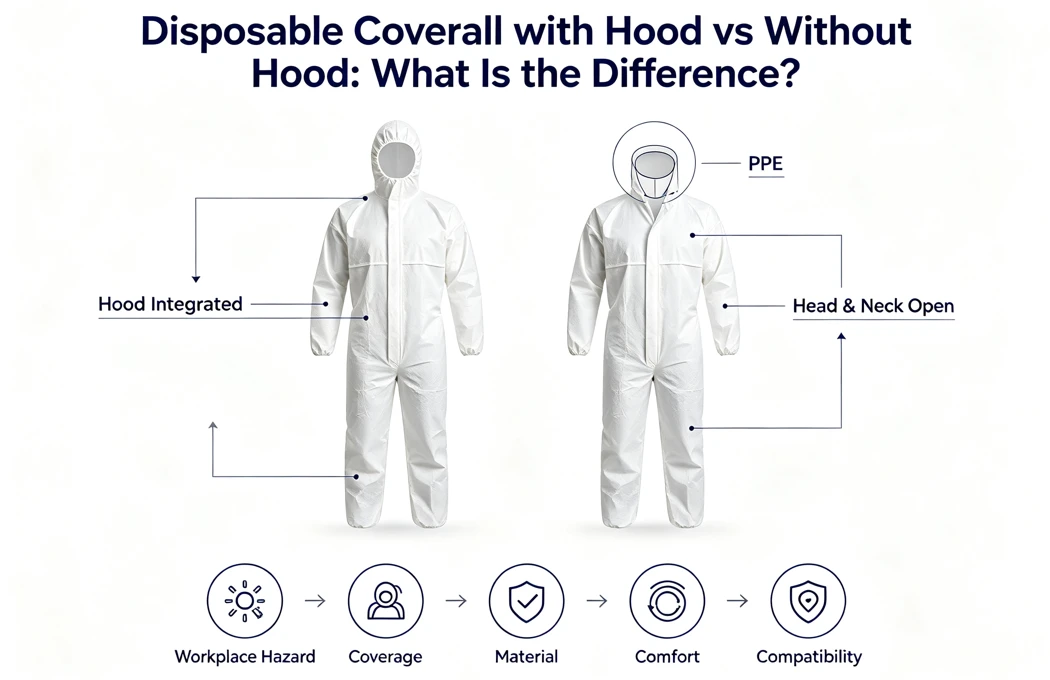
The main difference is head and neck coverage. A hooded coverall integrates the hood into the garment, while a non-hooded coverall leaves the head and neck open for separate PPE.
However, the better choice depends on the workplace hazard, required coverage, material, comfort, and compatibility with other protective equipment.
What Is a Disposable Coverall With Hood?
A disposable coverall with hood is a one-piece protective garment that covers the body while extending protection to the head and neck.
Common features include:
- Integrated hood
- Elastic face opening
- Elastic cuffs
- Elastic ankles
- Zipper closure
- Zipper flap
The integrated hood can reduce the gap between body protection and separate head protection. This makes the design useful when greater head and neck coverage is required.
However, a hood does not determine the overall protection level of the garment. Material, seams, closures, fit, and garment construction also affect performance.
What Is a Disposable Coverall Without Hood?
A disposable coverall without hood protects the torso, arms, and legs while leaving the head and neck available for separate PPE.
Depending on the application, workers can combine a non-hooded coverall with:
- Bouffant caps
- Hair covers
- Respirators
- Face shields
- Safety helmets
- Hard hats
This design provides greater flexibility when different types of head protection are required for different tasks.
Coverall With Hood vs Without Hood: Key Differences
| Feature | Coverall With Hood | Coverall Without Hood |
|---|---|---|
| Head coverage | Integrated | Separate PPE required |
| Neck coverage | Greater integrated coverage | Open collar area |
| PPE flexibility | Hood must work with other PPE | More flexible headgear options |
| Comfort | Depends on material and hood design | More open around head and neck |
| Typical configuration | Integrated body and head coverage | Body protection + separate head protection |
The important point is that a hooded coverall is not automatically more protective than a non-hooded coverall. The appropriate design depends on the actual workplace requirements.
Coverage: The Main Difference
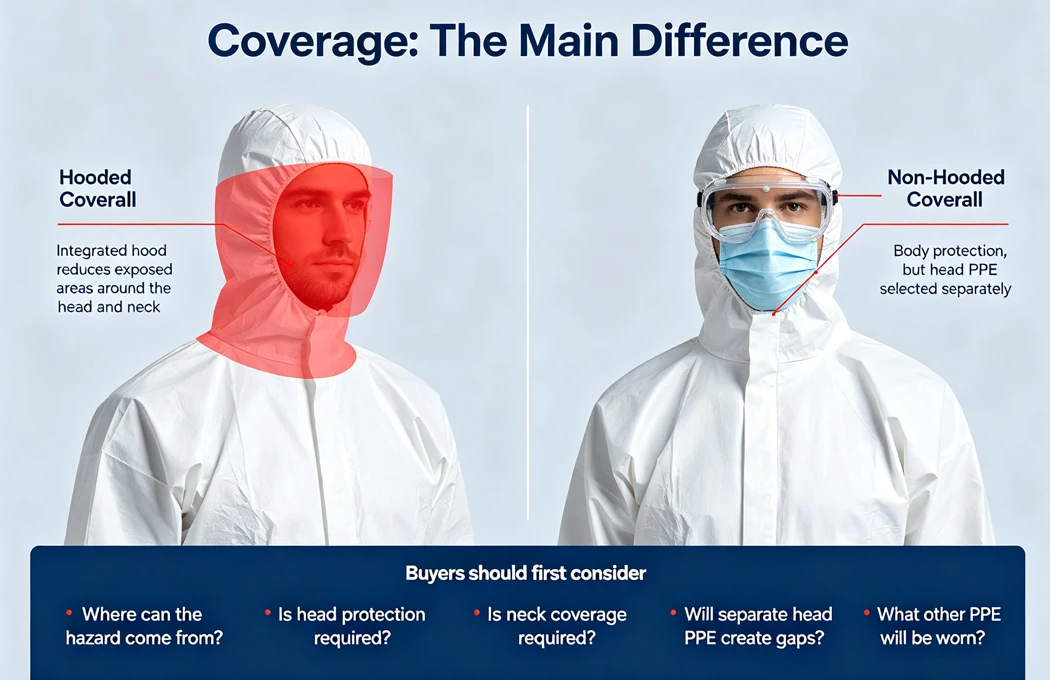
The primary reason to choose a hooded coverall is increased coverage around the head and neck.
When workers may encounter contamination, liquid splashes, dust, or particles around the upper body, an integrated hood can help reduce exposed areas between the coverall and other PPE.
A non-hooded coverall provides body protection while allowing head protection to be selected separately.
Therefore, buyers should first consider:
- Where can the hazard come from?
- Is head protection required?
- Is neck coverage required?
- Will separate head PPE create gaps?
- What other PPE will be worn?
The CDC recommends considering garment coverage, barrier properties, seams, closures, comfort, and compatibility with other PPE when selecting protective clothing.
How Material Affects the Choice
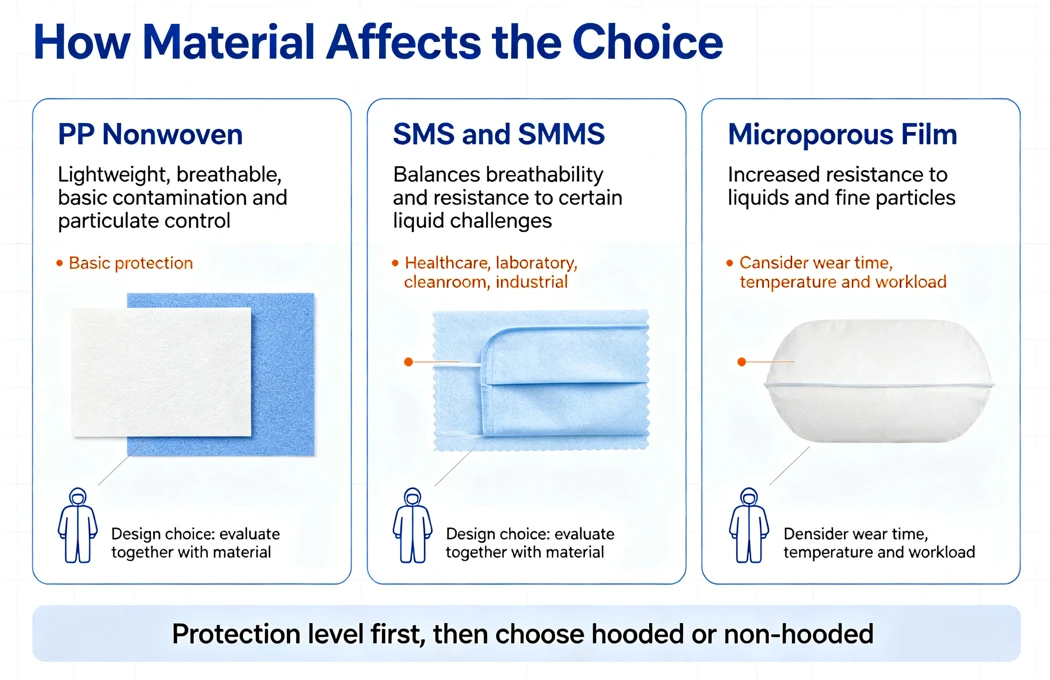
The difference between hooded and non-hooded coveralls should always be evaluated together with the material.
PP Nonwoven
Spunbond polypropylene (PP) is lightweight and breathable. It is commonly used for basic contamination and particulate-control applications.
A PP coverall with a hood can provide integrated coverage while maintaining a lightweight construction.
SMS and SMMS
SMS and SMMS nonwoven structures can provide a balance of breathability and resistance to certain liquid challenges.
They are used in healthcare, laboratory, cleanroom, and industrial applications depending on the specific garment design and performance requirements.
Microporous Film
Microporous film laminated coveralls can provide increased resistance to liquids and fine particles compared with basic PP, depending on the product construction and testing.
Because laminated materials can have lower breathability, buyers should consider wearing time, workplace temperature, and physical workload.
The material should therefore be selected according to the required protection level rather than simply choosing a hooded or non-hooded design.
Comfort and Mobility
Hood configuration can also affect wearer comfort.
A hood adds material around the head and neck, while a non-hooded coverall leaves this area more open.
Actual comfort depends on:
- Fabric type
- GSM
- Air permeability
- Hood design
- Temperature
- Physical activity
- Wearing duration
For warm or physically demanding environments, buyers should consider breathability and wearing conditions together with the required coverage.
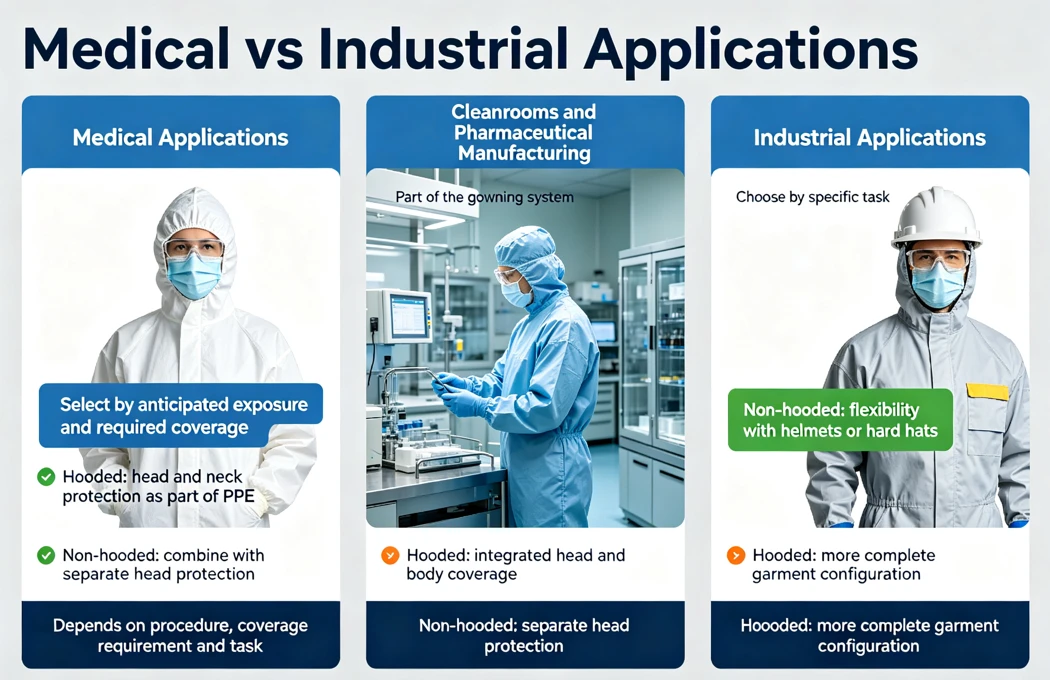
Medical vs Industrial Applications
Medical Applications
Medical facilities should select protective clothing according to the anticipated exposure and required coverage.
A hooded coverall may be considered when protection around the head and neck forms part of the required PPE configuration.
For other medical tasks, a non-hooded coverall can be combined with separate head protection when appropriate.
Cleanrooms and Pharmaceutical Manufacturing
In controlled environments, the garment configuration may be selected as part of the facility’s gowning system.
A hooded coverall can integrate head and body coverage, while a non-hooded design allows head protection to be selected separately.
The appropriate choice depends on the facility procedure and contamination-control requirements.
Industrial Applications
Industrial users may choose between the two designs according to the specific task.
For applications requiring separate helmets or hard hats, a non-hooded coverall may provide greater flexibility.
Where integrated head and body coverage is preferred, a hooded coverall can provide a more complete garment configuration.
How to Choose a Coverall With or Without Hood
A simple selection process is:
1. Identify the hazard.
Determine whether workers may encounter liquids, particles, dust, biological contamination, or other workplace hazards.
2. Determine the required coverage.
Decide whether the head and neck need to be covered as part of the protective garment.
3. Select the material.
Compare PP, SMS, SMMS, microporous film, or other materials according to barrier performance and breathability.
4. Check PPE compatibility.
Make sure the coverall works with respirators, goggles, face shields, helmets, gloves, and other required PPE.
5. Review product specifications.
Check the garment’s seams, closures, sizes, GSM, packaging, and available test data.
Hubei Ruichen Disposable Protective Coveralls
Hubei Ruichen Protective Products Co., Ltd. manufactures and exports disposable protective products from Xiantao, Hubei, China.
The company’s disposable protective clothing range includes protective coveralls and other disposable PPE for healthcare, laboratories, pharmaceutical manufacturing, food processing, cleanrooms, and industrial applications.
For buyers specifically looking for integrated head coverage, disposable hooded protective coveralls are available in different material and construction options.
For applications where barrier performance is a key consideration, buyers can also review disposable barrier protective coveralls and compare the available specifications.
Ruichen supports customization of material, GSM, color, size, packaging, branding, and OEM/ODM requirements for bulk orders.
Conclusion
The main difference between a disposable coverall with hood and without hood is the way head and neck coverage is provided.
A hooded coverall integrates head and body coverage into one garment, while a non-hooded coverall allows users to select separate head protection.
Neither configuration is universally better. The right choice depends on the workplace hazard, required coverage, material performance, comfort, and compatibility with the complete PPE system.
For B2B buyers, evaluating these factors together makes it easier to select the appropriate disposable protective coverall for the intended application.
Frequently Asked Questions
Is a coverall with a hood more protective than one without a hood?
Not necessarily. A hood provides additional head and neck coverage, but overall protection also depends on the material, seams, closures, fit, and complete PPE configuration.
Can I wear a separate cap with a non-hooded coverall?
Yes. A non-hooded coverall can be combined with a disposable cap or other head protection when the application and PPE requirements allow it.
Which material is best for a hooded coverall?
There is no single best material for every application. PP is lightweight and breathable, while SMS, SMMS, and microporous film provide different combinations of breathability and barrier performance.
Are hooded coveralls suitable for industrial use?
Yes. Hooded coveralls can be used in various industrial applications when their material, construction, and protection characteristics match the identified workplace hazards.
What should I consider when choosing between hooded and non-hooded coveralls?
Consider the hazard, required head and neck coverage, material, breathability, PPE compatibility, garment construction, and applicable product requirements.