
Blog
What Does GSM Mean in Nonwoven Fabric?

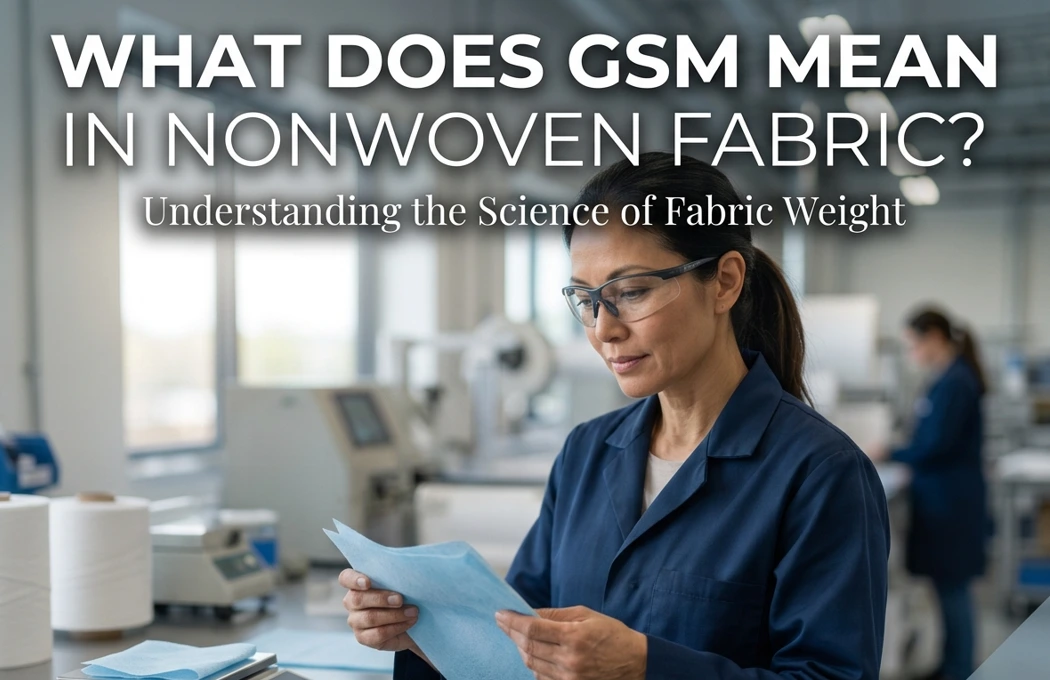
GSM is one of the first specifications buyers encounter when sourcing nonwoven fabric or disposable protective clothing. You may see 20 GSM PP fabric, 35 GSM SMS material, or a 50 GSM disposable coverall in a product specification sheet. But what do these numbers actually tell you?
GSM stands for grams per square meter. It measures the weight of a fabric over a specific area, giving buyers and manufacturers a common way to describe material weight.
For nonwoven products, GSM is more than a number on a label. It helps manufacturers control material consumption and gives buyers a starting point for evaluating thickness, handling, durability, and application suitability. However, a higher GSM does not automatically mean better protection.
Understanding how fabric weight works can make product selection easier, especially when comparing disposable gowns, coveralls, caps, masks, and other PPE products.
What Does GSM Mean in Nonwoven Fabric?
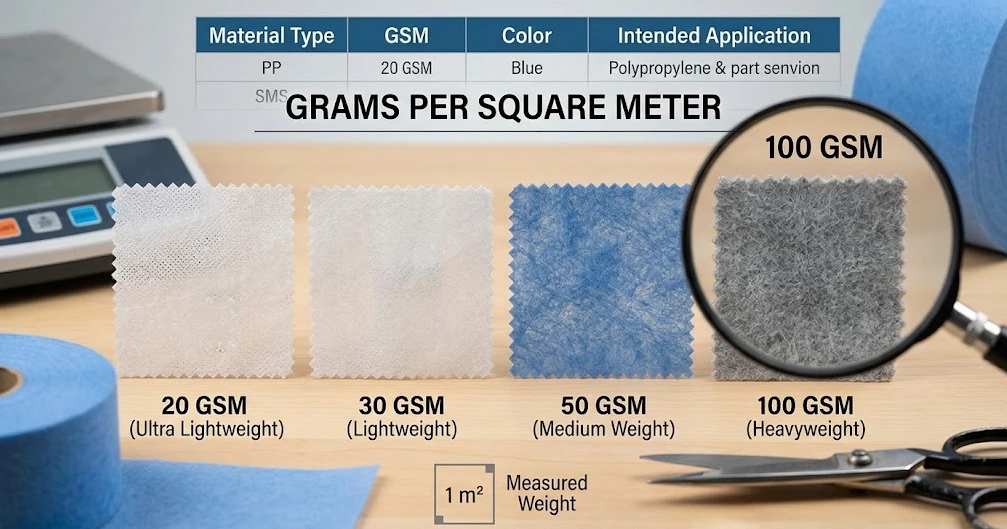
GSM means grams per square meter (g/m²). It describes how much one square meter of fabric weighs in grams.
For example:
- 20 GSM: One square meter of fabric weighs 20 grams.
- 30 GSM: One square meter of fabric weighs 30 grams.
- 50 GSM: One square meter of fabric weighs 50 grams.
The measurement is based on weight per unit area, not the thickness of the material. Two fabrics can have the same GSM but feel different because of their fiber structure, bonding method, and raw materials.
In nonwoven manufacturing, GSM is commonly used to specify the weight of polypropylene (PP), SMS, spunlace, and other nonwoven materials. It provides a measurable reference for production and purchasing.
For disposable PPE manufacturers, GSM is often included in product specifications alongside material type, size, color, construction, and intended application.
How Is Nonwoven Fabric Weight Measured?
Nonwoven fabric weight is generally determined by measuring a known area of material and weighing it under controlled conditions.
The basic formula is:
GSM = Fabric Weight (g) ÷ Fabric Area (m²)
For example, if a fabric sample measuring 1 square meter weighs 30 grams, its weight is 30 GSM.
For smaller samples, the same principle applies. A sample measuring 0.1 square meters and weighing 3 grams also has a GSM of 30.
In practical manufacturing and quality control, GSM can be checked by:
- Cutting a fabric sample to a known area.
- Weighing the sample using a suitable precision scale.
- Dividing the measured weight by the sample area.
- Comparing the result with the specified material weight.
Manufacturers may conduct checks at different positions across a fabric roll to identify weight variations. The acceptable tolerance depends on the product specification and the manufacturer’s quality requirements.
For buyers, it is useful to confirm whether the quoted GSM refers to the base fabric, a laminated material, or the complete finished material. This distinction can matter when comparing different constructions.
Why Does GSM Matter in Nonwoven Fabric?
GSM influences how a nonwoven fabric feels, performs, and is used. It is also closely related to material consumption during production.
Still, GSM should be considered alongside material composition and fabric construction. A lightweight SMS fabric and a lightweight PP spunbond fabric may behave quite differently, even if their measured weights are similar.
1. Fabric Thickness and Feel
Higher GSM fabrics often feel heavier and may be thicker, but weight and thickness are not interchangeable.
The thickness of nonwoven fabric depends on fiber arrangement, bonding pressure, fiber diameter, and manufacturing methods. A fabric with a higher GSM can sometimes be thinner than a lower-GSM fabric if its structure is more compact.
When selecting disposable protective clothing, buyers should consider how the fabric feels during use, including its flexibility, drape, and comfort.
2. Strength and Durability
Fabric weight can influence tensile strength, tear resistance, and resistance to handling damage. In some constructions, adding more material can improve these properties.
However, GSM alone cannot predict how strong a fabric will be. Fiber quality, bonding methods, and material composition also affect its mechanical performance.
For products such as disposable coveralls and isolation gowns, buyers may need to evaluate tensile strength, seam strength, and tear resistance rather than relying on GSM as the only specification.
3. Breathability and Wearing Comfort
Lightweight nonwoven materials are often selected for applications where flexibility and comfort are important.
A lower GSM may help reduce material weight, but it does not automatically mean better breathability. Air permeability also depends on pore structure, fiber arrangement, and any additional barrier layers.
For healthcare, food processing, and cleanroom environments, the appropriate balance between breathability and barrier performance depends on the intended use.
4. Material Consumption and Production Cost
GSM directly affects the amount of material used for a given fabric area.
A higher GSM generally requires more raw material per square meter. This can increase material consumption and influence the manufacturing cost of disposable PPE.
For bulk orders, even a small difference in GSM can affect the total amount of material required. Buyers should therefore evaluate fabric weight alongside product dimensions, cutting efficiency, production requirements, and the expected level of protection.
Common GSM Ranges for Nonwoven PPE Products
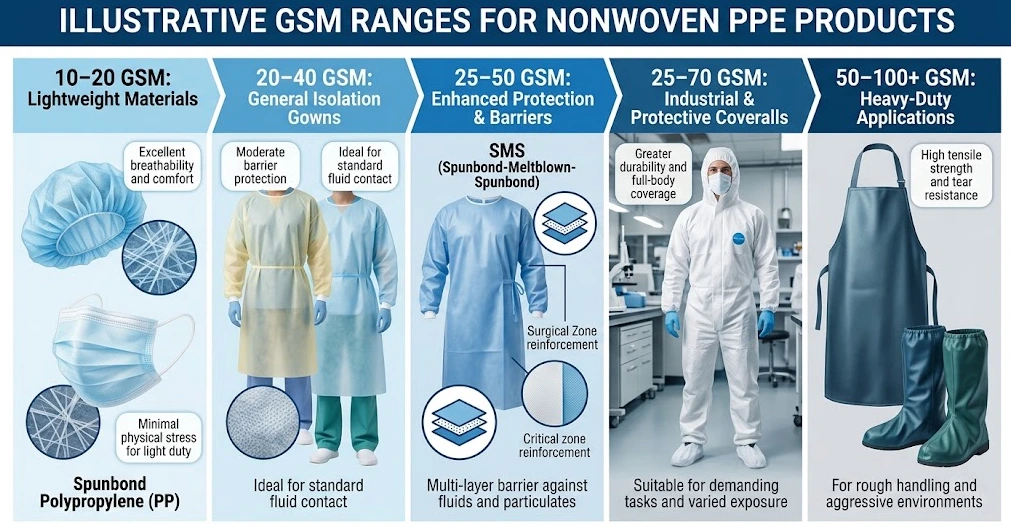
Different disposable PPE products use different fabric weights according to their design and intended application. The following table provides illustrative ranges for common nonwoven materials and products, rather than universal industry specifications.
| Product or material | Illustrative GSM range | Common consideration |
|---|---|---|
| Lightweight PP nonwoven | 10–20 GSM | Low material weight and flexibility |
| PP nonwoven for caps | 10–35 GSM | Lightweight coverage and fit |
| PP nonwoven for gowns | 20–40 GSM | Balance of weight and handling |
| SMS nonwoven | 25–50 GSM | Layered construction and barrier requirements |
| Disposable coveralls | 25–70 GSM | Coverage, durability, and intended use |
| Heavier nonwoven fabric | 50–100+ GSM | Higher material weight for specific applications |
Actual specifications vary by manufacturer, material construction, product design, and customer requirements. These ranges should not be treated as evidence of compliance with a particular protective standard.
For example, a 30 GSM PP gown and a 30 GSM SMS gown may have different performance characteristics. The material structure and applicable test results are more informative than weight alone.
How to Choose the Right GSM for Disposable PPE
Choosing the right fabric weight starts with understanding how the finished product will be used. A garment designed for light-duty coverage may have very different requirements from one intended for exposure to liquids or demanding industrial environments.
Consider the Application
The working environment determines which material properties matter most.
- Healthcare: Isolation gowns and other disposable garments may require a balance of comfort, coverage, and fluid resistance, depending on the intended clinical use.
- Food processing: Lightweight garments may be suitable for general hygiene applications where the primary requirement is covering clothing and containing loose particles.
- Laboratories: Fabric selection depends on the substances handled, potential exposure, and required barrier properties.
- Industrial environments: Garments may need additional tear resistance, coverage, or specialized barrier performance depending on workplace hazards.
GSM helps narrow down material options, but it should not replace an assessment of the actual exposure risks.
Evaluate Material Construction
Nonwoven fabrics can be produced using different structures, each with its own characteristics.
| Material | Construction | Selection consideration |
|---|---|---|
| PP spunbond | Continuous polypropylene filaments bonded into a sheet | Lightweight coverage, flexibility, and general-purpose applications |
| SMS | Spunbond, meltblown, and spunbond layers | A combination of fabric strength and barrier properties |
| SMMS | Spunbond, meltblown, meltblown, and spunbond layers | Multilayer construction for specified performance requirements |
| PP+PE laminated | PP nonwoven combined with a polyethylene film layer | Applications requiring a liquid barrier |
| Spunlace | Fibers bonded using high-pressure water jets | Softness, drape, and textile-like feel |
The material name provides information about construction, while GSM describes weight. Neither specification alone establishes the complete performance of the finished product.
Match GSM With Required Performance
For protective clothing, fabric selection should account for more than weight.
Consider the following factors:
- Tensile and tear resistance
- Air permeability and wearing comfort
- Liquid penetration resistance
- Seam construction and garment coverage
- Intended duration and conditions of use
- Applicable product standards and test reports
Where liquid or biological barrier performance is required, buyers should request relevant test data for the actual fabric or finished garment. A higher GSM should never be treated as a substitute for verified performance.
What Is a Coverall GSM Guide for Buyers?
When comparing disposable coveralls, GSM is a useful starting point for discussing fabric weight and material requirements. However, there is no single GSM that suits every coverall application.
A lightweight coverall may be appropriate for general dust and clothing coverage, while a heavier or laminated material may be considered for environments with more demanding barrier requirements.
When reviewing a coverall specification, buyers can use this checklist:
- Identify the application: Define the workplace, exposure type, and expected use of the coverall.
- Select the material: Compare PP spunbond, SMS, and laminated options according to the required properties.
- Confirm the GSM: Specify the target fabric weight and any agreed manufacturing tolerance.
- Review product construction: Check garment coverage, hood design, cuffs, closures, and seam details.
- Request performance data: Review relevant test reports when particular barrier or mechanical properties are required.
- Evaluate samples: Check fabric feel, fit, workmanship, and consistency against the agreed specifications.
For example, a 40 GSM SMS coverall and a 40 GSM PP coverall have the same nominal fabric weight, but their layer structures differ. Their suitability should be assessed according to the required performance, not the GSM figure alone.
For buyers sourcing disposable protective clothing in bulk, clearly defining GSM and material construction before production can also help reduce specification misunderstandings.
How GSM Affects PPE Manufacturing and Quality Control
In disposable PPE manufacturing, GSM is one of the material specifications that can be monitored throughout production. Maintaining consistency helps ensure that incoming materials and finished products remain aligned with agreed requirements.
Manufacturers commonly consider several checkpoints:
- Incoming material inspection: Verify fabric weight, material type, roll dimensions, and visual condition.
- Production monitoring: Check material specifications and identify noticeable variations during processing.
- Finished product inspection: Review garment dimensions, stitching or bonding, workmanship, and other specified quality characteristics.
- Specification verification: Compare inspection records and, where required, laboratory test results against customer requirements.
GSM variation can affect material consumption and the feel of the finished garment. However, an acceptable tolerance should be agreed upon in the product specification rather than assumed to be the same for every material or product.
For international buyers, it is helpful to confirm whether the supplier’s GSM specification applies to the base material or the finished laminated fabric. This can make quotations, sample approvals, and quality inspections easier to compare.
If you are sourcing disposable PPE for different working environments, you can explore disposable body protection products to compare garments such as isolation gowns and coveralls, or review head protection products for disposable caps and hoods.
Other product categories, including face protection , hand protection , foot protection , and PPE accessories , may also have different material weight and construction requirements according to their intended applications.
Conclusion
GSM is a straightforward way to describe the weight of nonwoven fabric, but it only tells part of the story. It helps buyers compare material consumption and provides a starting point for evaluating fabric characteristics.
When selecting nonwoven materials for disposable PPE, GSM should be considered alongside fiber structure, bonding methods, breathability, strength, and barrier performance. The right specification depends on the product’s intended use and the requirements of the working environment.
For manufacturers and procurement teams, clearly defining fabric weight, material type, and required performance before production can help ensure that the selected material meets the needs of the finished product.
Frequently Asked Questions
1. What does GSM mean in nonwoven fabric?
GSM stands for grams per square meter. It measures the weight of one square meter of fabric. For example, 30 GSM nonwoven fabric weighs 30 grams per square meter.
2. Does higher GSM mean better nonwoven fabric?
Not necessarily. Higher GSM means more weight per unit area, but it does not automatically indicate better strength, breathability, or barrier performance. Material composition and manufacturing methods also matter.
3. What is the difference between 20 GSM and 40 GSM nonwoven fabric?
A 40 GSM fabric weighs twice as much per square meter as a 20 GSM fabric. It may feel heavier or have a different thickness, but actual strength and performance depend on the fabric structure and material properties.
4. What GSM is suitable for disposable coveralls?
The appropriate GSM depends on the coverall’s intended application, material, and required performance. Common product specifications may fall within an illustrative range of 25–70 GSM, but buyers should assess barrier requirements, strength, and applicable standards before selecting a fabric.
5. Is higher GSM nonwoven fabric more breathable?
Not always. Breathability depends on fiber arrangement, pore structure, bonding methods, and additional layers or coatings. A higher GSM fabric may be breathable, while a lighter laminated fabric may have limited air permeability.
6. How can buyers verify the GSM of nonwoven fabric?
Buyers can request material specifications and inspection records from the manufacturer. GSM can be verified by weighing a fabric sample of a known area and dividing its weight by that area. For bulk orders, buyers can also agree on sampling methods and acceptable tolerances before production.