
Blog
Bound Seam vs Taped Seam Coveralls: Key Differences

When choosing disposable protective coveralls, seam construction is an important detail to consider. The seam connects different sections of the garment, so its construction can affect the overall barrier performance of the coverall.
Two common seam constructions are bound seams and taped seams.
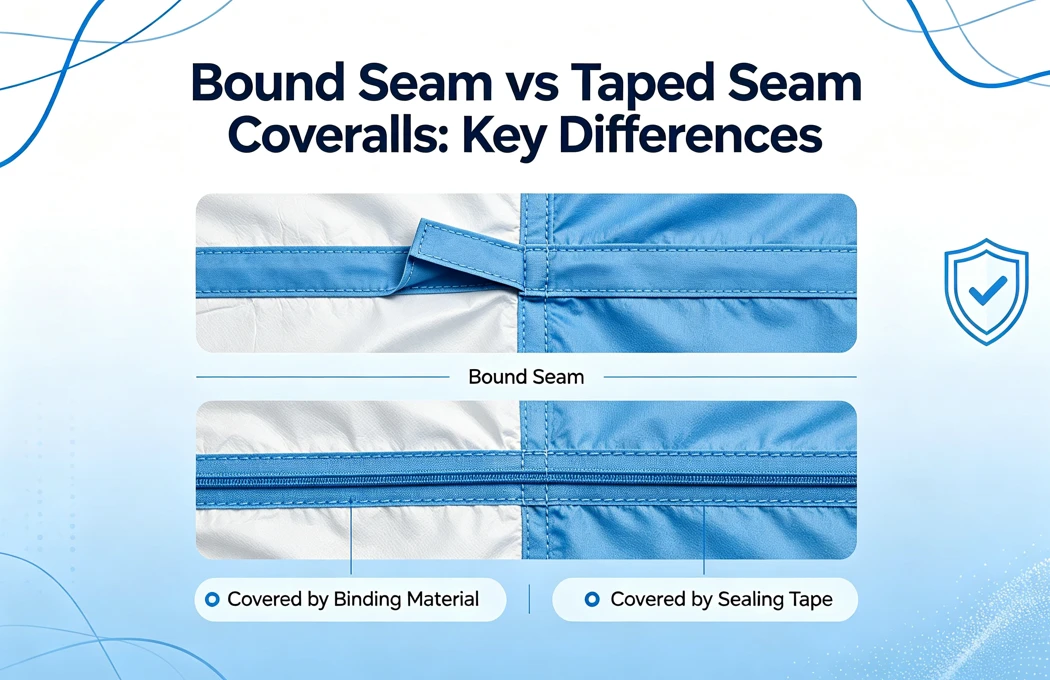
Although both are used to improve the construction of protective garments, they work differently. A bound seam uses a binding material to cover the sewn seam, while a taped seam uses sealing tape over the seam.
Understanding the difference can help buyers select a coverall that better matches the intended application and required level of protection.
What Is a Bound Seam Coverall?
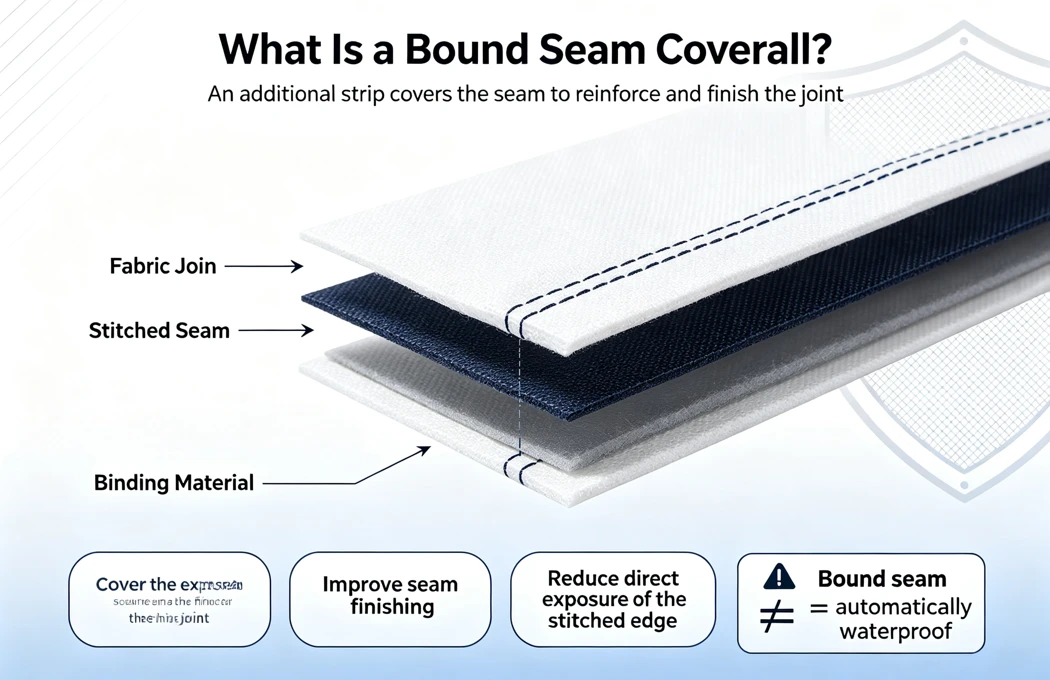
A bound seam is a sewn seam covered with an additional strip of material.
During manufacturing, two pieces of fabric are joined by stitching. A binding material is then applied over the seam to cover the stitched area.
The binding can help:
- Cover the exposed seam
- Reinforce the joint
- Improve seam finishing
- Reduce direct exposure of the stitched edge
- Provide a more finished garment construction
Bound seams are commonly considered for applications where reinforced garment construction is needed but the application does not necessarily require sealed seams.
However, a bound seam should not automatically be considered waterproof or liquid-tight. The actual performance depends on the fabric, stitching, binding material and complete garment construction.
What Is a Taped Seam Coverall?
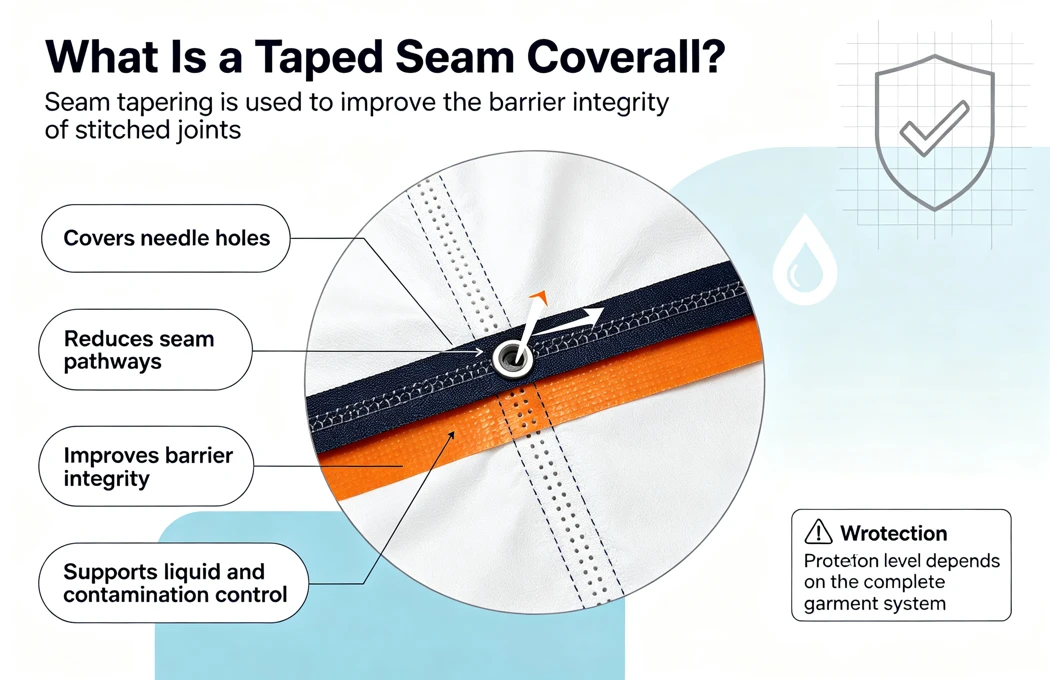
A taped seam is a sewn seam covered with sealing tape.
The tape is applied directly over the stitched area to reduce potential pathways through the seam. This is particularly relevant for protective garments because stitching creates small needle holes through the material.
The main purpose of seam taping is therefore to improve the barrier integrity of the seam.
Taped seams can be particularly relevant when a coverall is intended for applications where liquid penetration or contamination through the seam needs to be controlled.
However, a taped seam alone does not determine the protection level of the finished coverall. The fabric, zipper, hood, cuffs, garment construction and applicable test results also need to be considered.
Bound Seam vs Taped Seam Coveralls
The main difference is how the sewn seam is treated after stitching.
| Feature | Bound Seam | Taped Seam |
|---|---|---|
| Construction | Sewn seam covered with binding material | Sewn seam covered with sealing tape |
| Main purpose | Reinforcement and seam coverage | Improved seam barrier integrity |
| Stitching | Present | Present |
| Additional material | Binding strip | Sealing tape |
| Liquid protection | Depends on the complete garment | More suitable when enhanced seam sealing is required |
| Typical consideration | General protective applications | Applications with greater liquid or contamination concerns |
| Cost | Generally lower | Generally higher due to additional processing |
| Selection | Based on application and protection requirements | Based on application, protection requirements and seam sealing needs |
The difference can be summarized simply:
A bound seam primarily covers and reinforces the sewn seam, while a taped seam is designed to improve the barrier performance of the seam.
Bound Seam vs Taped Seam: Which Is Better?
There is no single seam construction that is best for every disposable coverall.
The appropriate option depends on the working environment and the protection required.
When a Bound Seam May Be Suitable
A bound seam may be considered for applications where the main requirements include general protective coverage, dust control or contamination control.
Examples may include:
- General industrial work
- Maintenance
- Cleaning
- Construction
- Dust-control applications
- General-purpose disposable protection
For these applications, buyers should evaluate whether the complete garment provides the required level of protection rather than selecting a product based only on the seam type.
When a Taped Seam May Be Suitable
A taped seam may be more relevant when seam penetration is an important concern.
Potential applications include:
- Liquid-handling environments
- Chemical splash applications
- Decontamination work
- Wet processing environments
- Applications requiring enhanced barrier integrity
For these applications, buyers should verify the actual performance of the finished garment and any relevant test documentation.
Does a Taped Seam Make a Coverall Waterproof?
Not necessarily.
This is an important distinction.
A taped seam can help reduce penetration through the stitched seam, but the seam is only one part of the garment.
Overall liquid resistance can also depend on:
- Fabric construction
- Film or coating
- Seam quality
- Zipper construction
- Hood design
- Cuff design
- Garment assembly
- Applicable testing
For example, a coverall made from a liquid-resistant laminated material may provide different protection from a standard nonwoven coverall even when the seam construction is similar.
Therefore, taped seam should not automatically be used as a synonym for waterproof coverall.
How Does Seam Construction Affect Disposable Coverall Protection?
A disposable coverall is assembled from multiple fabric sections.
These sections create seams around areas such as:
- Shoulders
- Sleeves
- Torso
- Legs
- Hood
- Crotch
Because stitching creates openings through the material, seam construction becomes particularly important when the garment needs to provide a stronger barrier.
The basic principle is:
The fabric provides the primary material barrier, while the seam construction helps maintain that barrier where different garment sections are joined.
This is why buyers should evaluate the material and seam together.
How to Choose Between Bound and Taped Seam Coveralls
Instead of choosing a seam type first, start with the application.
Ask these questions:
1. What Hazard Does the Worker Face?
Is the main concern:
- Dust?
- Dirt?
- General contamination?
- Water?
- Liquid splashes?
- Chemical exposure?
The answer affects the required garment construction.
2. Is Liquid Penetration a Concern?
If the application involves significant liquid exposure, seam sealing may become more important.
If liquid exposure is minimal, a simpler seam construction may be sufficient depending on the required protection level.
3. What Material Is Used?
Check whether the coverall is made from:
- PP
- SMS
- PP+PE
- Microporous laminated nonwoven
The material should be evaluated together with the seam construction.
4. What Protection Level Is Required?
For regulated PPE applications, buyers should check the applicable protection classification and test results rather than relying on terms such as “bound seam” or “taped seam” alone.
Ruichen Disposable Protective Coveralls
Hubei Ruichen Protective Products Co., Ltd. manufactures and exports disposable nonwoven and plastic protective products from Xiantao, Hubei, China.
Its disposable protective clothing range includes PP, SMS, PP+PE and microporous laminated coveralls for different applications.
For buyers evaluating coverall construction, several Ruichen products can be considered according to material and intended use.
Disposable PP Protective Coveralls – White
Ruichen’s Disposable PP Protective Coveralls – White are made from polypropylene nonwoven and provide lightweight disposable coverage for general protective applications.
Disposable PP Protective Coveralls – White
Disposable SMS Protective Coveralls – White
Ruichen’s Disposable SMS Protective Coveralls – White use SMS nonwoven and can be considered for applications where lightweight construction, breathability and practical barrier coverage are required.
Disposable SMS Protective Coveralls – White
Type 5B/6B Disposable Microporous Protective Coveralls – White
For applications involving water or liquid splashes, Ruichen offers Type 5B/6B Disposable Microporous Protective Coveralls – White made from microporous laminated nonwoven.
Type 5B/6B Disposable Microporous Protective Coveralls – White
Type 5B/6B Microporous Protective Coveralls with Blue Seams
Ruichen also offers Type 5B/6B Microporous Protective Coveralls with Blue Seams, combining a microporous laminated construction with blue seam detailing.
Type 5B/6B Microporous Protective Coveralls with Blue Seams
Key Takeaway
The difference between bound seam and taped seam coveralls is mainly the treatment of the sewn seam.
Bound seams use binding material to cover and reinforce the seam, while taped seams use sealing tape to improve seam barrier integrity.
Neither construction is universally better. The correct choice depends on the application, hazard, material, required protection level and performance of the complete garment.
For disposable coverall buyers, evaluating material + seam construction + garment design + required protection level provides a more reliable basis for product selection than looking at the seam type alone.
FAQ
What is the main difference between bound and taped seams?
A bound seam uses binding material to cover and reinforce a sewn seam. A taped seam uses sealing tape over the sewn seam to improve seam barrier integrity.
Are taped seam coveralls better than bound seam coveralls?
Not necessarily. The appropriate seam depends on the application, required protection level, material and overall garment construction.
Are bound seam coveralls waterproof?
Not automatically. Water resistance depends on the fabric, seam construction and complete garment design.
Are taped seam coveralls waterproof?
A taped seam can help improve seam barrier performance, but it does not by itself make the entire coverall waterproof. The complete garment must be evaluated.
Which seam is better for liquid protection?
Taped seams may be considered when enhanced seam sealing is required. However, the material and complete garment construction are equally important.
Can PP coveralls be used for liquid protection?
Standard PP nonwoven is generally intended for lightweight disposable protection. Where greater resistance to water or liquid splashes is required, a suitable laminated construction should be considered.
Are microporous coveralls suitable for liquid splash applications?
Microporous laminated nonwoven can provide enhanced resistance to water and liquid splashes. Buyers should check the specific product construction and applicable protection requirements.
What should I check when buying disposable coveralls?
Consider the application, hazard, material, GSM, seam construction, zipper, hood, cuffs, protection level and applicable test results.