

Blog
Nitrile vs Latex Gloves: Material, Comfort & Protection

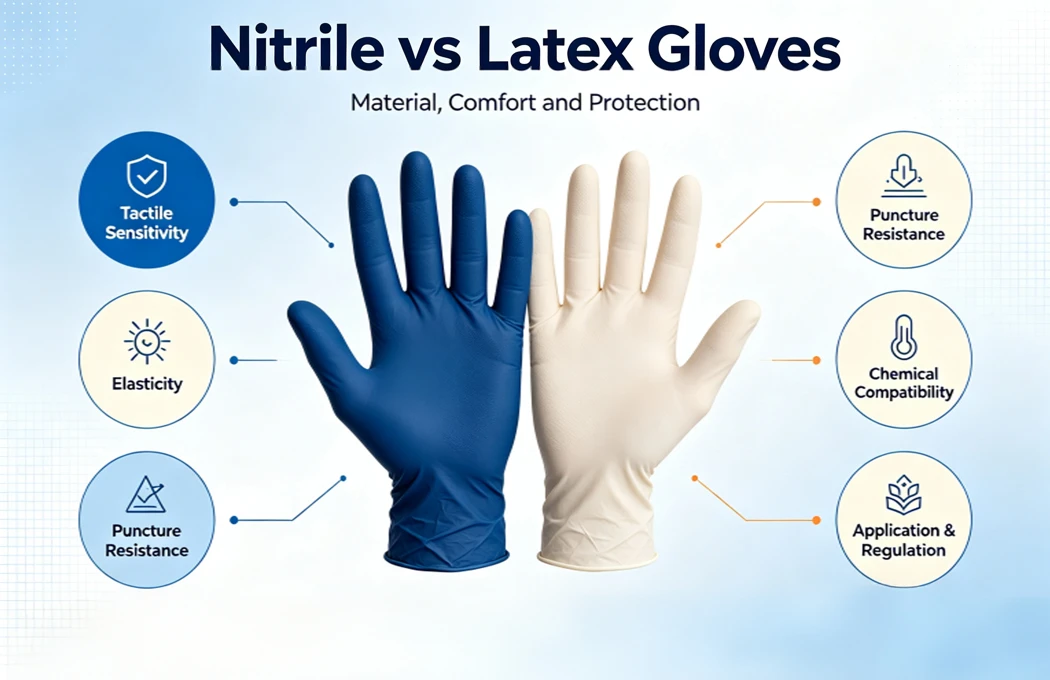
Choosing between nitrile vs latex gloves depends on more than price or material preference. PPE buyers need to consider tactile sensitivity, elasticity, puncture resistance, chemical compatibility, latex allergy considerations, intended application, and applicable regulatory requirements.
Both nitrile and latex disposable gloves are widely used for medical, laboratory, food handling, cleaning, and industrial applications. However, their material properties make them better suited to different working environments.
For B2B procurement teams, the right comparison is not simply “nitrile or latex.” The better approach is to match the glove material and product specification with the actual task, exposure conditions, user requirements, and market regulations.
Nitrile vs Latex Gloves: Quick Comparison
| Feature | Latex Gloves | Nitrile Gloves |
|---|---|---|
| Material | Natural rubber latex | Synthetic nitrile rubber (NBR) |
| Material source | Natural rubber | Synthetic polymer |
| Elasticity | Excellent | Very good |
| Tactile sensitivity | Excellent | Very good to excellent, depending on design |
| Puncture resistance | Generally lower than nitrile | Generally higher than latex |
| Oil resistance | Limited for some applications | Generally better suited to oils and many chemicals |
| Latex protein concern | Yes | No natural rubber latex proteins |
| Common applications | Medical examination, dental, laboratory, precision tasks | Medical examination, laboratory, food handling, cleaning, industrial applications |
| Main buying consideration | Elasticity, fit and tactile feel | Latex-free material, durability and chemical compatibility |
Performance varies by formulation, thickness, manufacturing process, and product specification. Buyers should therefore use the manufacturer’s technical data and test reports when comparing specific products.
What Are Latex Gloves?
Latex gloves are made from natural rubber latex, a material derived from rubber tree sap. Natural rubber has high elasticity and can provide a close, flexible fit.
This combination of elasticity and tactile sensitivity has made latex examination gloves widely used for applications requiring precise hand movements.
However, natural rubber latex contains proteins that can cause allergic reactions in susceptible individuals. For this reason, latex allergy considerations are an important part of glove selection, particularly in healthcare and other environments with frequent glove use.
ASTM D3578-19(2023), for example, covers natural rubber examination gloves used for medical examinations, diagnostic and therapeutic procedures, and handling contaminated medical material. The specification includes requirements related to dimensions, physical properties, freedom from holes, tensile strength, elongation, and protein-related characteristics.
Key Properties of Latex Gloves
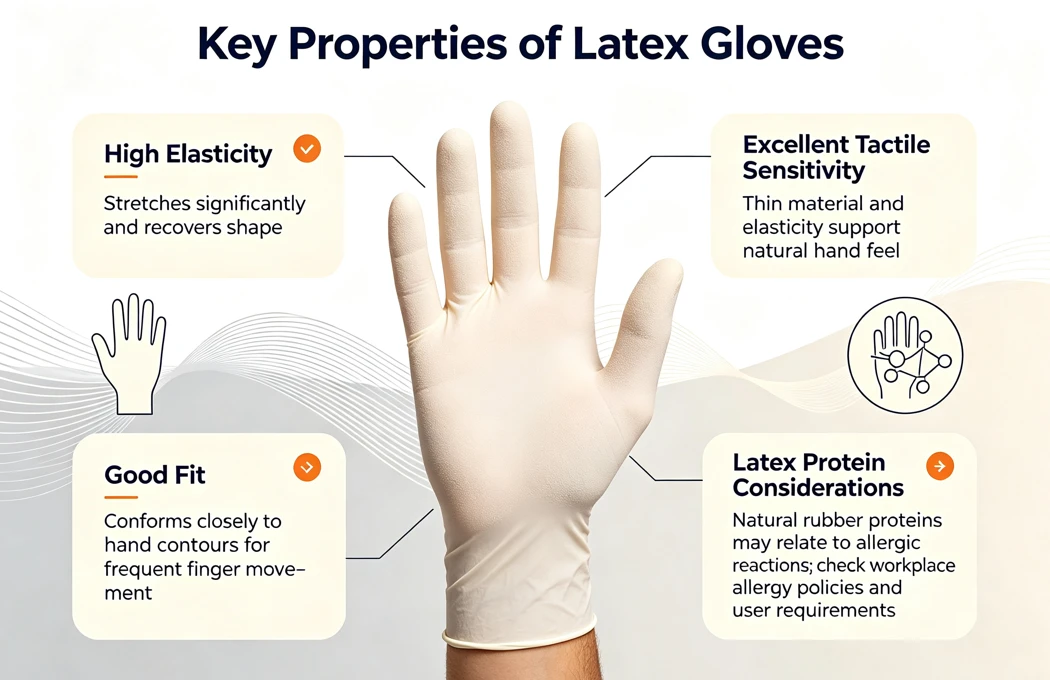
High elasticity: Latex can stretch significantly and recover its shape, helping the glove conform closely to the hand.
Excellent tactile sensitivity: The combination of thin material and elasticity can provide a natural hand feel for precision tasks.
Good fit: Latex can conform closely to the contours of the hand, which is useful for applications involving frequent finger movement.
Latex protein considerations: Natural rubber latex can contain proteins associated with allergic reactions. Buyers should consider workplace allergy policies and user requirements when selecting latex gloves.
What Are Nitrile Gloves?
Nitrile gloves are made from nitrile rubber, a synthetic copolymer commonly referred to as acrylonitrile butadiene rubber (NBR).
Unlike natural rubber latex gloves, nitrile gloves do not contain natural rubber latex proteins. This makes them a common option for workplaces implementing latex-free glove policies.
Nitrile formulation can also provide good resistance to punctures and compatibility with many oils and chemicals. However, chemical resistance is substance-specific, so buyers should always verify permeation or compatibility data for the chemicals involved.
For medical applications, ASTM D6319-19(2023) specifies requirements for nitrile rubber examination gloves used for medical examinations, diagnostic and therapeutic procedures. The specification covers factors including freedom from holes, physical requirements, tensile strength, elongation, and other product characteristics.
Nitrile vs Latex Gloves: Key Differences
1. Material
The most fundamental difference is the raw material.
Latex gloves are manufactured from natural rubber latex, while nitrile gloves are manufactured from a synthetic rubber compound.
This difference affects elasticity, tactile response, chemical compatibility, and latex allergy considerations.
2. Comfort and Fit
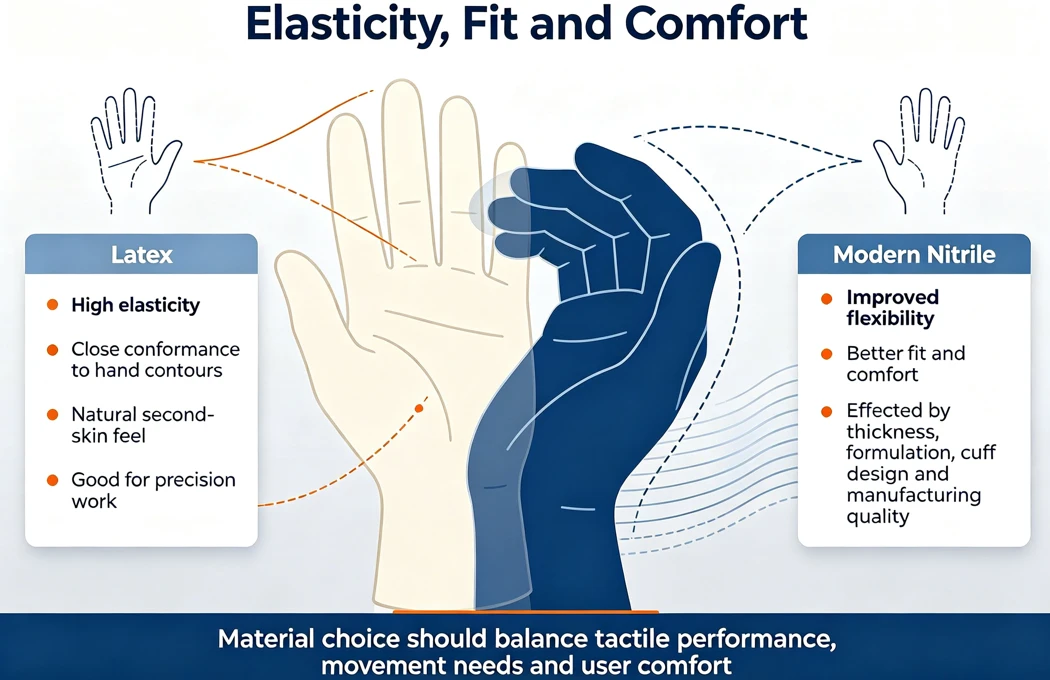
Latex is known for its elasticity and ability to conform closely to the hand. This can provide a natural, “second-skin” feel during precision work.
Modern nitrile gloves have also improved substantially in flexibility and fit. Glove thickness, formulation, cuff design, and manufacturing quality can significantly affect comfort.
Therefore, it is better to evaluate the actual glove rather than assuming that all latex gloves are more comfortable than all nitrile gloves.
3. Tactile Sensitivity
Both materials can provide high tactile sensitivity when properly formulated and manufactured.
Latex has traditionally been valued for its elasticity and natural hand feel, making it suitable for tasks involving fine finger movements.
Nitrile can also provide excellent tactile feedback, particularly in thinner examination glove designs.
For applications such as medical examination, dental work, laboratory procedures, and precision handling, buyers should evaluate the glove’s thickness, fit, texture, and sample performance.
4. Puncture Resistance
Nitrile gloves are generally known for higher puncture resistance than comparable latex examination gloves.
This can be valuable in environments where the glove may encounter sharp edges, instruments, or mechanical stress.
However, puncture resistance is not determined by material alone. Thickness, formulation, manufacturing quality, and glove design also influence performance.
For high-risk applications, buyers should request the relevant test data rather than relying solely on the material name.
5. Chemical Resistance
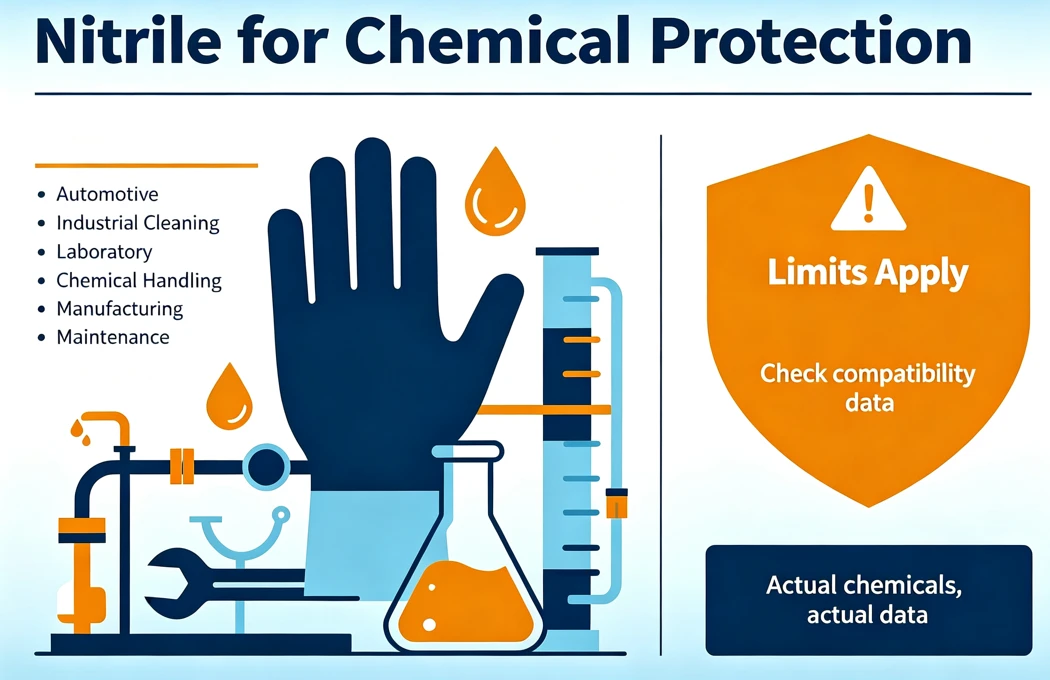
One of the major nitrile glove benefits is its compatibility with many oils, greases, and chemicals.
This makes nitrile gloves common in:
- Automotive maintenance
- Industrial cleaning
- Laboratories
- Chemical handling
- Manufacturing
- Maintenance work
However, “chemical resistant” does not mean resistant to every chemical.
Chemical permeation depends on the specific substance, concentration, exposure time, temperature, and glove formulation. Buyers handling hazardous chemicals should request chemical compatibility or permeation data for the actual substances involved.
6. Latex Allergy Considerations
Latex gloves contain natural rubber latex proteins that can cause allergic reactions in susceptible users.
Nitrile gloves do not contain natural rubber latex proteins, which is why they are widely used in latex-free workplace policies.
This does not mean nitrile gloves are completely free from all possible skin reactions. Other glove components, chemicals used during manufacturing, or individual sensitivities can still cause skin irritation or allergic reactions.
For healthcare and high-use environments, buyers should review product composition and user requirements before selecting a glove material.
Nitrile vs Latex Gloves: Which Is Better for Different Applications?
There is no universal winner between nitrile and latex gloves. The appropriate choice depends on the application.
Healthcare and Medical Examination
Both nitrile and latex examination gloves can be used for medical applications when the specific product meets the applicable requirements.
Nitrile is often selected when a facility wants latex-free gloves or requires good puncture resistance.
Latex may still be selected where elasticity and tactile sensitivity are important and latex allergy risks are appropriately managed.
For U.S. medical glove procurement, buyers should verify the product’s regulatory status and applicable standards. FDA materials reference medical glove standards including ASTM D3578 and ASTM D6319.
Laboratory Applications
Laboratories should select gloves according to the chemicals, biological materials, and procedures involved.
Nitrile is commonly selected for general laboratory work because of its broad utility and resistance to many common laboratory substances.
For hazardous chemicals, however, material selection should be based on chemical-specific permeation data rather than simply choosing nitrile because it is labeled “chemical resistant.”
Food Processing and Food Handling
Nitrile gloves are widely used in food handling because they do not contain natural rubber latex proteins and can provide useful resistance to oils and fats.
For food-contact applications, buyers must verify that the specific glove complies with the food-contact requirements applicable in the target market.
Ruichen also offers Disposable White Food Grade Nitrile Protective Examination Gloves for food-related applications.
Cleaning and Janitorial Work
Nitrile can be suitable for many cleaning applications because of its resistance to oils and a range of cleaning chemicals.
The glove should still be selected according to the actual cleaning agents used.
Industrial and Automotive Applications
Nitrile is commonly used for automotive maintenance and industrial tasks involving oils, lubricants, and mechanical handling.
For tasks involving hazardous chemicals, workers should use gloves selected from chemical-specific resistance data and applicable occupational safety requirements.
Nitrile vs Latex Gloves: Standards and Compliance
Standards are an important part of B2B glove procurement.
However, buyers should avoid listing standards as if every nitrile or latex glove automatically complies with them.
The applicable standard depends on the product type, intended use, target market, and regulatory classification.
United States
For medical examination gloves, ASTM D6319 covers nitrile rubber examination gloves, while ASTM D3578 covers natural rubber examination gloves. Both are active ASTM specifications.
FDA materials also reference ASTM D6319 and D3578 among standards relevant to medical gloves. Whether a specific product requires FDA clearance or another regulatory pathway depends on its intended use and classification.
European Union
For medical gloves in the EU, buyers should check the applicable Medical Device Regulation requirements and current harmonized standards.
The EU’s current harmonized standards list includes EN 455-1:2020+A2:2024 for freedom from holes and EN 455-2:2024 for physical properties of single-use medical gloves.
For gloves intended to provide protection against chemicals or microorganisms, additional requirements may apply depending on the product classification and intended use.
What Is AQL in Medical Glove Procurement?
AQL, or Acceptable Quality Limit, is commonly used in sampling and quality-control procedures for gloves.
However, it should not be interpreted as meaning that a batch simply contains a fixed percentage of defective gloves.
For medical glove procurement, buyers should confirm:
- The applicable AQL requirement
- Sampling plan
- Test method
- Batch inspection procedure
- Freedom-from-holes testing
- Physical property requirements
- Supplier quality-control documentation
ASTM D6319 and D3578 include freedom-from-holes and physical performance requirements for their respective medical examination glove categories.
Nitrile vs Latex Gloves: B2B Procurement Checklist
| Procurement Factor | What Buyers Should Verify |
|---|---|
| Material | Nitrile or natural rubber latex |
| Intended use | Medical, laboratory, food, industrial, cleaning, etc. |
| Allergy considerations | Whether natural rubber latex is acceptable |
| Fit | Size range and hand conformity |
| Thickness | Product-specific specification |
| Puncture resistance | Relevant test data |
| Chemical resistance | Compatibility with actual chemicals |
| Standards | Applicable market and product standards |
| Test reports | Product-specific laboratory documentation |
| Quality control | AQL, hole testing and physical properties |
| Packaging | Box, case and private-label requirements |
| MOQ | Supplier minimum order quantity |
| Customization | Color, size, packaging and branding |
| Samples | Pre-order sample availability |
Conclusion
The choice between nitrile vs latex gloves should be based on the actual application rather than a simple material preference.
Nitrile gloves are commonly selected for latex-free environments, good puncture resistance, and compatibility with many oils and chemicals. Latex gloves remain valuable for applications where elasticity, fit, and tactile sensitivity are important.
For B2B procurement, the most reliable selection process is to evaluate material, application, fit, thickness, puncture resistance, chemical compatibility, allergy considerations, applicable standards, test reports, and supplier quality controls together.
Before placing a bulk order, buyers should request product-specific documentation and samples to confirm that the glove meets the technical and regulatory requirements of the intended market.
FAQ: Nitrile vs Latex Gloves
Are nitrile gloves better than latex gloves?
Neither material is universally better. Nitrile is often selected when latex-free protection, puncture resistance, or compatibility with oils and many chemicals is important. Latex is valued for elasticity, fit, and tactile sensitivity.
What is the main difference between nitrile and latex gloves?
Latex gloves are made from natural rubber latex, while nitrile gloves are made from synthetic nitrile rubber. This difference affects elasticity, tactile feel, chemical compatibility, puncture resistance, and latex allergy considerations.
Are nitrile gloves latex-free?
Nitrile gloves do not contain natural rubber latex proteins. However, buyers should check the manufacturer’s material declaration if a completely latex-free procurement specification is required.
Are nitrile gloves more chemical resistant than latex gloves?
Nitrile generally provides better resistance to many oils, greases, and chemicals than latex. However, no glove material is resistant to every chemical. For hazardous substances, buyers should verify product-specific chemical permeation data.
Which gloves are better for medical examinations?
Both nitrile and natural rubber latex examination gloves can be used for medical examination applications when they meet the applicable requirements. Nitrile is often selected for latex-free environments, while latex may be chosen when elasticity and tactile sensitivity are priorities.
Are latex gloves suitable for food handling?
They may be used in some food-handling applications when permitted by the applicable food-contact requirements. However, facilities should consider the potential transfer of natural rubber latex proteins and should verify the glove’s food-contact compliance for the target market.
What does AQL mean for disposable gloves?
AQL is a statistical sampling concept used in quality inspection. It should not be interpreted simply as a guaranteed percentage of defective gloves in every production batch. Buyers should review the supplier’s sampling plan and applicable testing requirements.
What standards apply to nitrile examination gloves?
ASTM D6319-19(2023) is an active ASTM specification covering nitrile rubber examination gloves for medical applications.
What standards apply to latex examination gloves?
ASTM D3578-19(2023) is an active ASTM specification covering natural rubber examination gloves for medical examinations and related applications.