
Blog
How Does an Isolation Gown Protect the Back and Front?

How Does an Isolation Gown Protect the Back and Front of the Body?
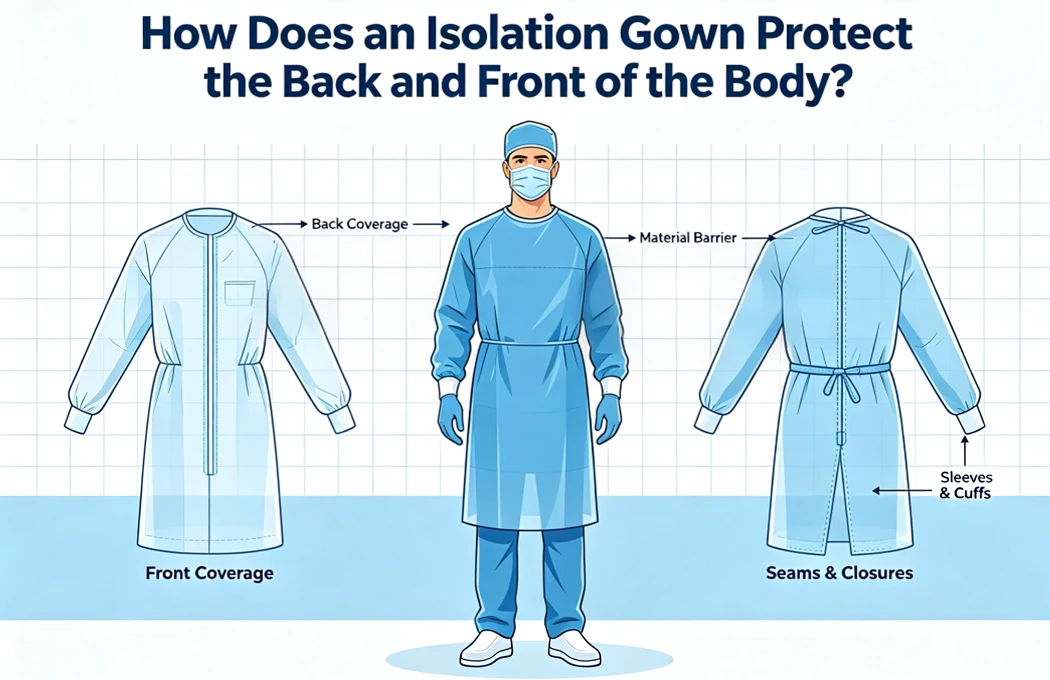
An isolation gown protects healthcare workers by covering the body and creating a barrier against contact with blood, body fluids, and other contaminants. The level of protection depends on the gown’s front and back coverage, material, sleeves, seams, closures, and overall design.
The back and front do not always use the same construction. The appropriate design depends on the intended application and required level of protection.
How Does an Isolation Gown Protect the Front?
The front of an isolation gown provides coverage across the torso and is commonly exposed during patient care.
Depending on the required protection, manufacturers may use materials such as PP nonwoven, SMS, SMMS, or PP+PE laminated fabric.
For example, a blue disposable PP+PE long sleeve non-woven medical isolation gown combines PP nonwoven with a PE film layer to provide increased resistance to liquid penetration compared with basic PP nonwoven.
The actual protection depends on the complete garment construction and applicable test requirements, not material type alone.
How Does an Isolation Gown Protect the Back?
Back coverage varies by gown design.
Some isolation gowns use an open or partially open back, while others provide greater back coverage through overlapping panels or a more enclosed design.
A gown with greater back coverage can reduce exposed areas during movement. However, the appropriate design depends on the intended application rather than simply choosing the gown with the most coverage.
When evaluating back protection, buyers should consider:
- Back panel coverage
- Panel overlap
- Neck and waist closures
- Garment size
- Expected body movement
- Required protection level
The CDC recommends considering coverage, barrier properties, seams, closures, comfort, and PPE compatibility when selecting protective clothing. (cdc.gov)
Isolation Gown Front vs. Back Coverage
| Feature | Front | Back |
|---|---|---|
| Main purpose | Protect torso from anticipated exposure | Maintain coverage around the body |
| Common design | Continuous body panel | Open, overlapping, or enclosed |
| Important factors | Material, sleeves, seams | Overlap, closures, fit |
| Movement consideration | Reaching and bending | Turning, bending, and sitting |
The key point is that isolation gown body coverage should be evaluated as a complete garment, rather than looking only at the front panel.
How Does Material Affect Gown Coverage?
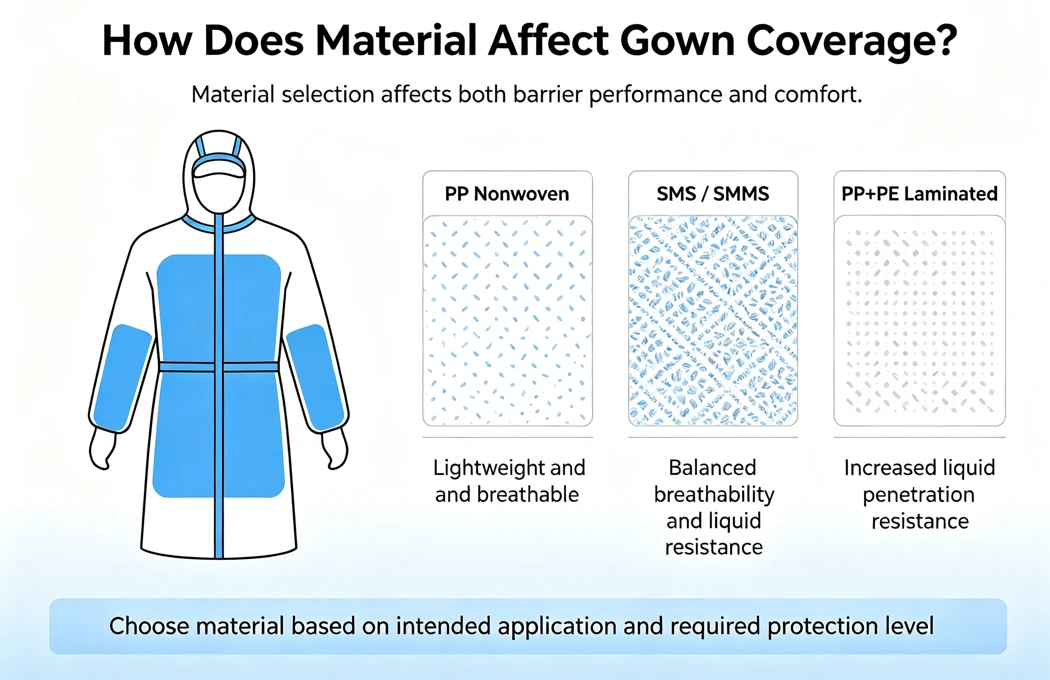
Material selection affects both barrier performance and comfort.
PP nonwoven is lightweight and breathable and is commonly used for basic protective applications.
SMS and SMMS can provide a balance between breathability and resistance to certain liquid challenges.
PP+PE laminated material can provide increased resistance to liquid penetration, depending on the product construction and test results.
For example, a blue disposable SMS short sleeve non-woven medical isolation gown provides lightweight body coverage with greater arm mobility.
There is no single material that is suitable for every isolation gown application.
How to Choose the Right Isolation Gown Coverage
When selecting an isolation gown, consider five factors:
- Expected exposure – Identify the type and level of fluid or contamination exposure.
- Front and back coverage – Check whether the garment provides sufficient coverage for the intended task.
- Material – Compare PP, SMS, SMMS, PP+PE, or other materials according to required performance.
- Garment construction – Review sleeves, seams, closures, cuffs, and back design.
- PPE compatibility – Make sure the gown works with gloves, masks, eye protection, and other required PPE.
FDA guidance identifies ANSI/AAMI PB70 as the classification system used to describe liquid barrier performance of protective apparel used in healthcare facilities. (fda.gov)
Ruichen Disposable Isolation Gowns
Hubei Ruichen Protective Products Co., Ltd. manufactures and exports disposable protective products from Xiantao, Hubei, China.
Its disposable isolation gown range includes different materials, sleeve configurations, and designs for healthcare, clinical, laboratory, and other professional applications.
Ruichen can provide options using PP nonwoven, SMS, and PP+PE laminated materials, with customization available for material, GSM, color, size, packaging, and OEM/ODM requirements.
Conclusion
An isolation gown protects the body through a combination of front coverage, back coverage, material, garment construction, and proper fit.
The front usually provides continuous torso coverage, while the back may use an open, overlapping, or more enclosed design. The right configuration depends on the intended application and required protection level.
For healthcare procurement, the most important step is to match the gown’s coverage and material performance with the actual exposure risks.
FAQ
Does an isolation gown protect both the front and back?
Yes. The overall garment provides body coverage through its front, back, sleeves, and closures. The exact coverage depends on the gown design.
Does an isolation gown need to cover the entire back?
Not always. Back coverage depends on the gown configuration, intended application, and required protection level.
Which material is best for an isolation gown?
There is no universal best material. PP, SMS, SMMS, and PP+PE provide different combinations of breathability and barrier performance.
Is a full-back gown always better?
Not necessarily. More coverage may be appropriate for some applications, while other tasks may prioritize mobility and comfort. Selection should be based on the expected exposure.
What should buyers check when selecting an isolation gown?
Review the required coverage, material, barrier performance, sleeves, seams, closures, sizing, and compatibility with the complete PPE system.