
Blog
AAMI Isolation Gown Standards: Level 1-4 Protection Guide

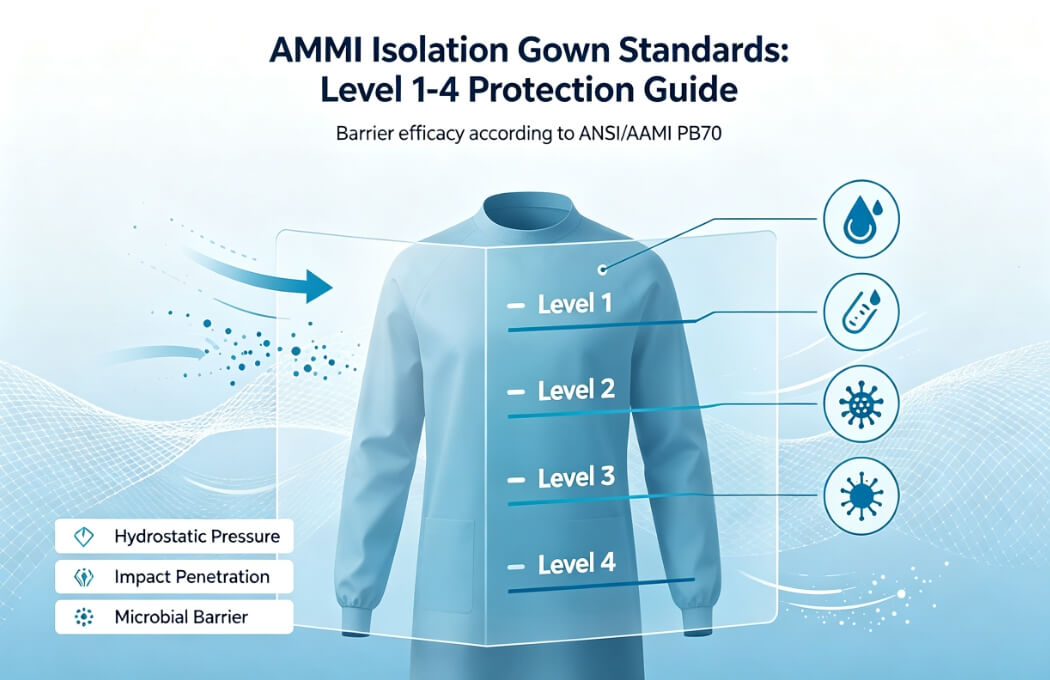
In the complex ecosystem of hospital-acquired infections (HAIs) and occupational safety, the selection of barrier protection is a critical decision point for clinical leadership. The isolation gown serves as a primary defense mechanism, protecting both healthcare personnel and patients from the transfer of microorganisms and body fluids. However, not all gowns provide equal protection. To standardize the performance of protective apparel, the Association for the Advancement of Medical Instrumentation (AAMI) developed the ANSI/AAMI PB70 standard. This framework provides a consistent language for manufacturers and procurement professionals to categorize the barrier efficacy of isolation gowns. Understanding these nuances is essential for ensuring that the protection level matches the clinical risk.
Defining the Medical Isolation Gown
A medical isolation gown is a piece of personal protective equipment (PPE) designed to protect the wearer from the spread of infection or illness if the wearer comes in contact with potentially infectious liquid or solid material. Unlike surgical gowns, which are used in sterile environments like operating rooms, isolation gowns are utilized in a broader range of clinical settings—from routine patient care to high-risk infectious disease wards.
The primary distinction lies in the “critical zones” of protection. For a gown isolation product to be compliant with AAMI standards, the entire garment, including seams but excluding cuffs and hems, must meet the specified barrier performance requirements. This ensures that the healthcare worker is shielded from multiple angles of potential fluid strike-through.
The ANSI/AAMI PB70 Standard Framework
The ANSI/AAMI PB70 standard identifies four levels of barrier protection. These levels are determined by standardized tests that measure a fabric’s resistance to liquid penetration. When sourcing disposable isolation gowns, understanding these levels is the first step in risk mitigation.
AAMI Level 1 Isolation Gowns: Minimal-Risk Protection
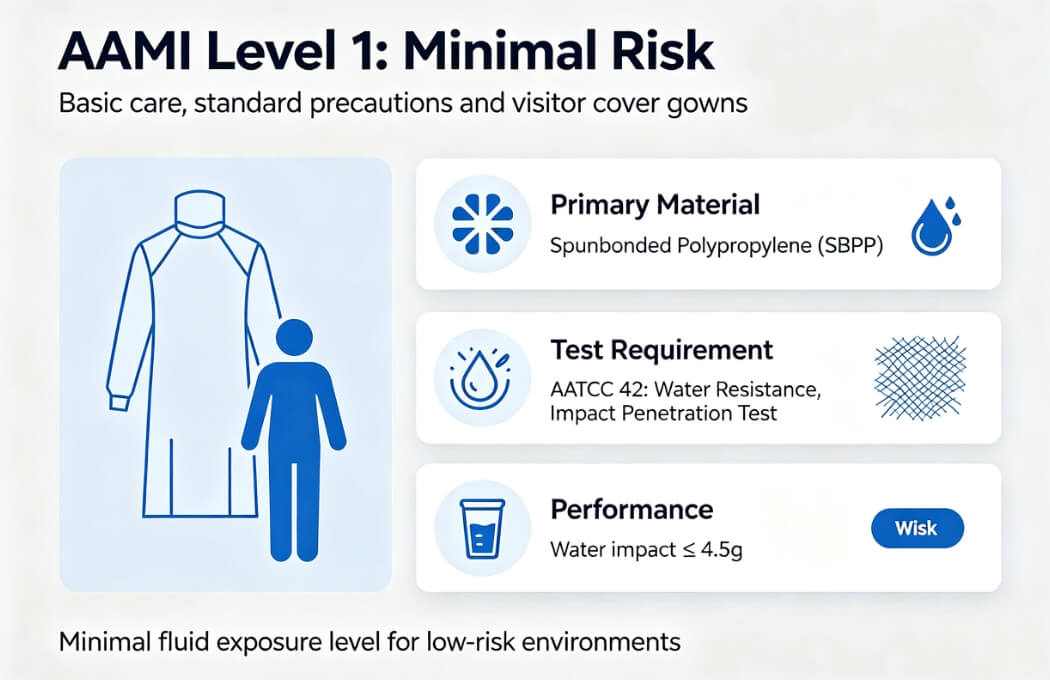
AAMI Level 1 isolation gowns provide minimal fluid barrier protection and are designed for situations with a low likelihood of fluid exposure. They are commonly used for basic patient care, standard precautions, and visitor protection where significant exposure to blood or body fluids is not anticipated.
- Primary Material: Spunbonded Polypropylene (SBPP).
- Test Requirement: AATCC 42 (Water Resistance: Impact Penetration Test).
- Performance: Water impact ≤ 4.5g.
AAMI Level 2: Low Risk
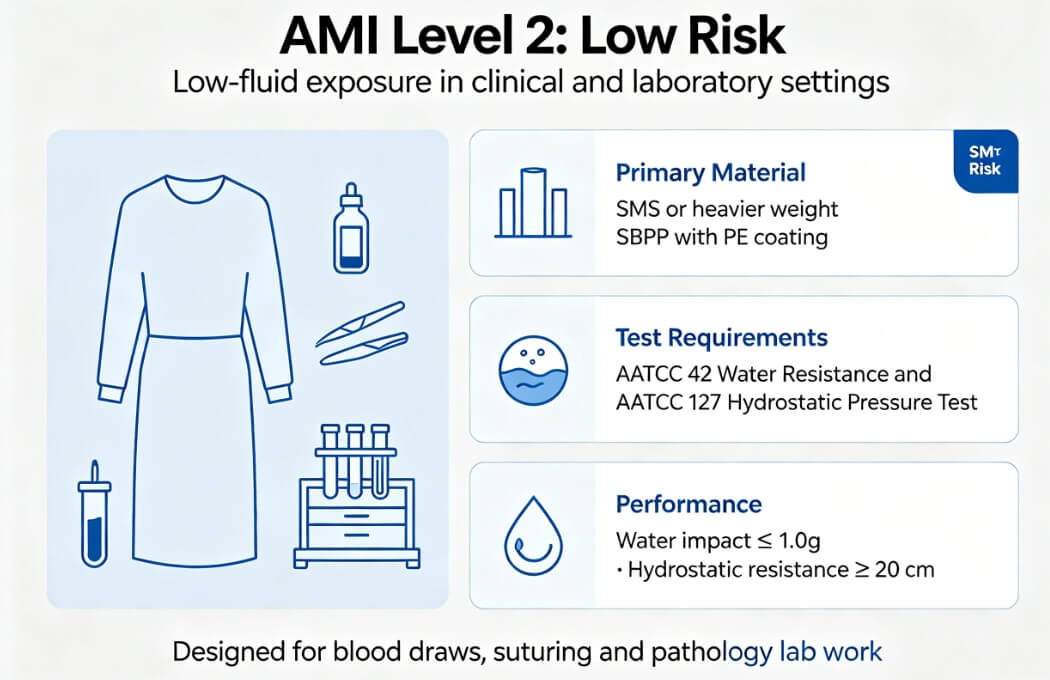
Level 2 gowns are designed for scenarios involving low-fluid exposure, such as blood draws, suturing, or working in a clinical pathology lab.
- Primary Material: SMS (Spunbond-Meltblown-Spunbond) or heavier weight SBPP with PE coating.
- Test Requirements: AATCC 42 and AATCC 127 (Hydrostatic Pressure Test).
- Performance: Water impact ≤ 1.0g; Hydrostatic resistance ≥ 20 cm.
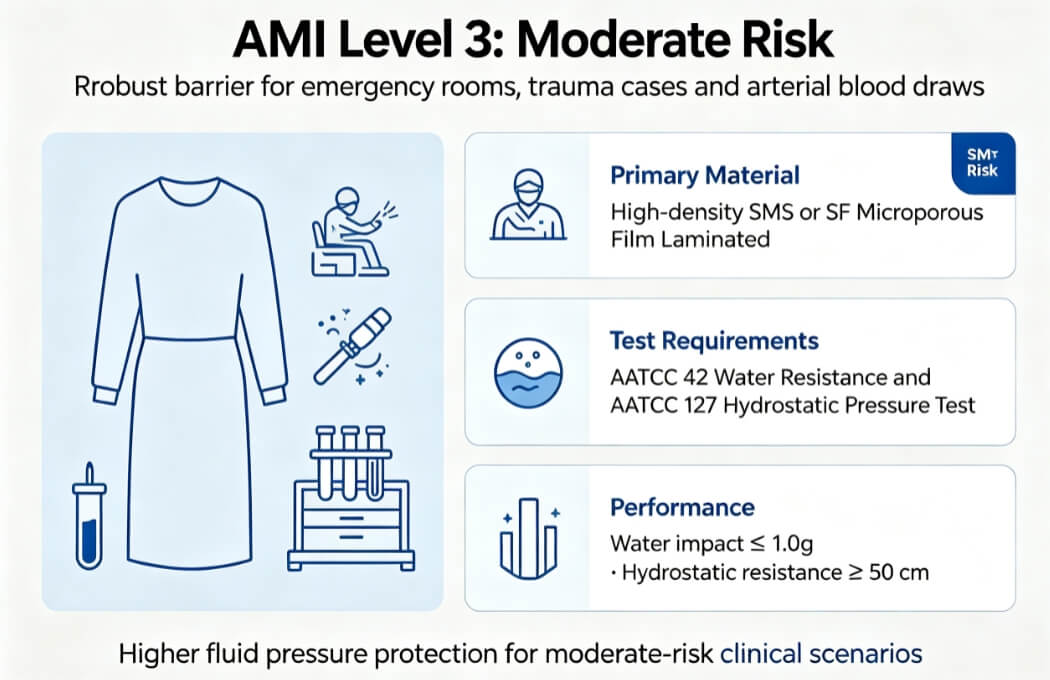
AAMI Level 3: Moderate Risk
Level 3 isolation gowns are the workhorse of the medical facility, used in emergency rooms, trauma cases, and for arterial blood draws. They provide a robust barrier against liquid splash and more significant fluid pressure.
- Primary Material: High-density SMS or SF (Microporous film laminated).
- Test Requirements: AATCC 42 and AATCC 127.
- Performance: Water impact ≤ 1.0g; Hydrostatic resistance ≥ 50 cm.
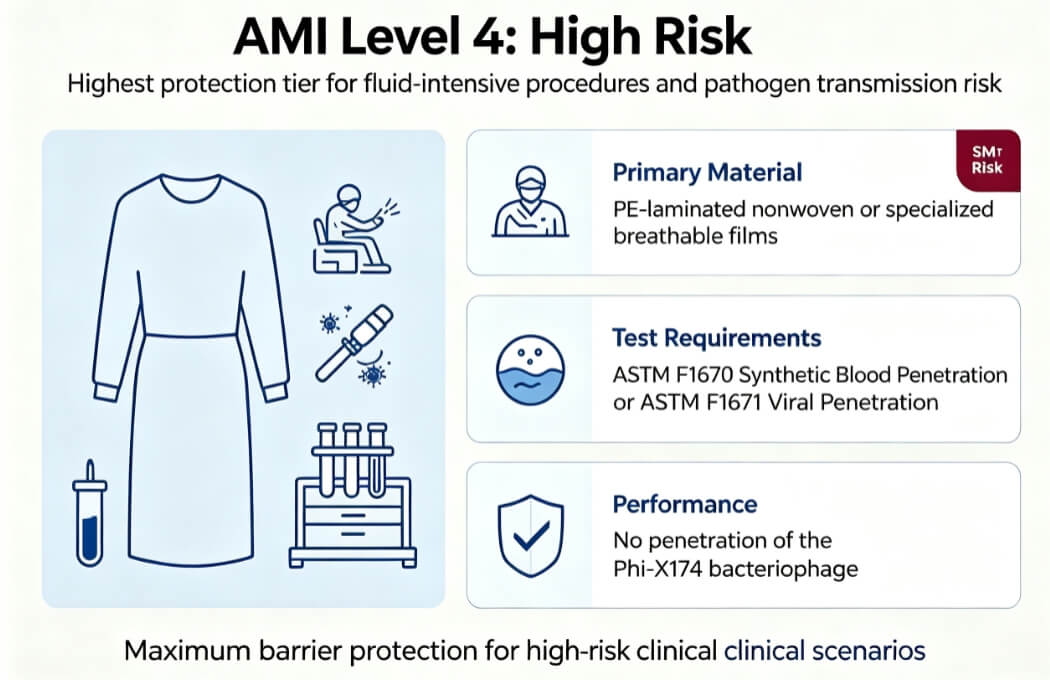
AAMI Level 4 Isolation Gown: Highest Barrier Protection
An AAMI Level 4 isolation gown provides the highest level of barrier protection under the ANSI/AAMI PB70 classification. It is designed for situations involving significant fluid exposure and potential exposure to infectious materials requiring resistance to viral penetration.
- Primary Material: PE-laminated nonwoven or specialized breathable films.
- Test Requirements: ASTM F1670 (Synthetic blood penetration) or ASTM F1671 (Viral penetration).
- Performance: No penetration of the Phi-X174 bacteriophage.
| AAMI Level | Risk Category | Key Test | Performance Metric | Common Applications |
|---|---|---|---|---|
| Level 1 | Minimal | AATCC 42 | < 4.5g | Basic care, visitor protection |
| Level 2 | Low | AATCC 42 & 127 | < 1.0g / > 20cm | Blood draw, ICU, Lab work |
| Level 3 | Moderate | AATCC 42 & 127 | < 1.0g / > 50cm | ER, Trauma, Arterial draws |
| Level 4 | High | ASTM F1671 | Pass (No viral penetration) | Pathogen containment, Surgery |
Isolation Gown Requirements: Key Factors to Consider
Medical isolation gown requirements depend on the intended level of exposure and applicable regulatory or performance standards. In general, buyers and healthcare facilities should evaluate the following factors:
1. Barrier Protection Performance
The gown should provide an appropriate level of resistance to fluid penetration based on the expected exposure risk.
2. Material Performance
Materials should provide a balance between fluid resistance, breathability, tensile strength, and wearer comfort.
3. Garment Coverage
Medical isolation gowns typically require sufficient coverage of the torso and arms to protect the wearer from contamination during clinical activities.
4. Seam Performance
Seams should maintain the required barrier performance of the gown. Higher-risk applications may require bonded or sealed seam construction.
5. Applicable Standards
Depending on the market and intended use, manufacturers and buyers may evaluate products according to standards such as ANSI/AAMI PB70 and other applicable regulatory requirements.
Critical Barrier Testing Methods
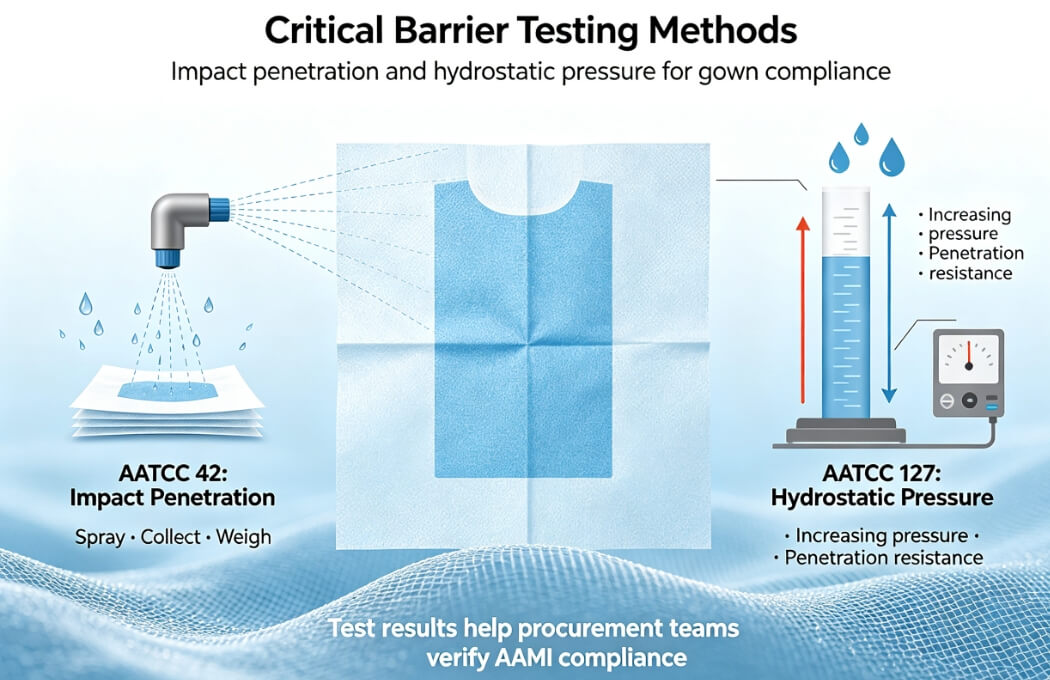
For a manufacturer to certify medical isolation gowns disposable, the materials must undergo rigorous laboratory testing. Procurement teams should look for these specific test results in the technical data sheets to ensure compliance with aami isolation gown standards.
AATCC 42: Impact Penetration
This test measures the resistance of fabrics to the penetration of water by impact. A volume of water is sprayed against the taut surface of the specimen, and the amount of water that passes through to a blotter paper is weighed. This simulates a splash of fluid hitting the ppe disposable gown.
AATCC 127: Hydrostatic Pressure
This test evaluates a fabric’s resistance to the penetration of water under constant and increasing hydrostatic pressure. It is crucial for determining how a gown will perform when a clinician leans against a fluid-saturated surface, such as an operating table or a wet bedsheet.
Material Selection and Seam Integrity
The performance of disposable isolation gowns is fundamentally linked to the non-woven material technology used during the manufacturing process.
- Spunbonded Polypropylene (SBPP): A single-layer fabric that offers basic breathability but limited fluid resistance. However, it provides less protection against liquid exposure than multilayer materials. It is the standard for Level 1 applications.
- SMS (Spunbond-Meltblown-Spunbond): A multi-layer fabric. The “Meltblown” layers act as a filter for fluids and bacteria, while the “Spunbond” layers provide tensile strength. Together, these layers create a balance between filtration performance and material strength. High-GSM SMS is commonly used for disposable isolation gowns requiring a balance between breathability and barrier performance. For product-specific configurations, buyers can explore our SMS long sleeve isolation gown and SMS short sleeve isolation gown options.
- PP+PE (Polypropylene with Polyethylene Lamination): Laminating non-woven polypropylene with a PE film can significantly improve liquid resistance and barrier performance. This material construction is commonly selected for applications where increased protection against fluid penetration is required. Depending on wearer mobility and coverage requirements, buyers may choose a PP+PE short sleeve isolation gown or a PP+PE long sleeve isolation gown.
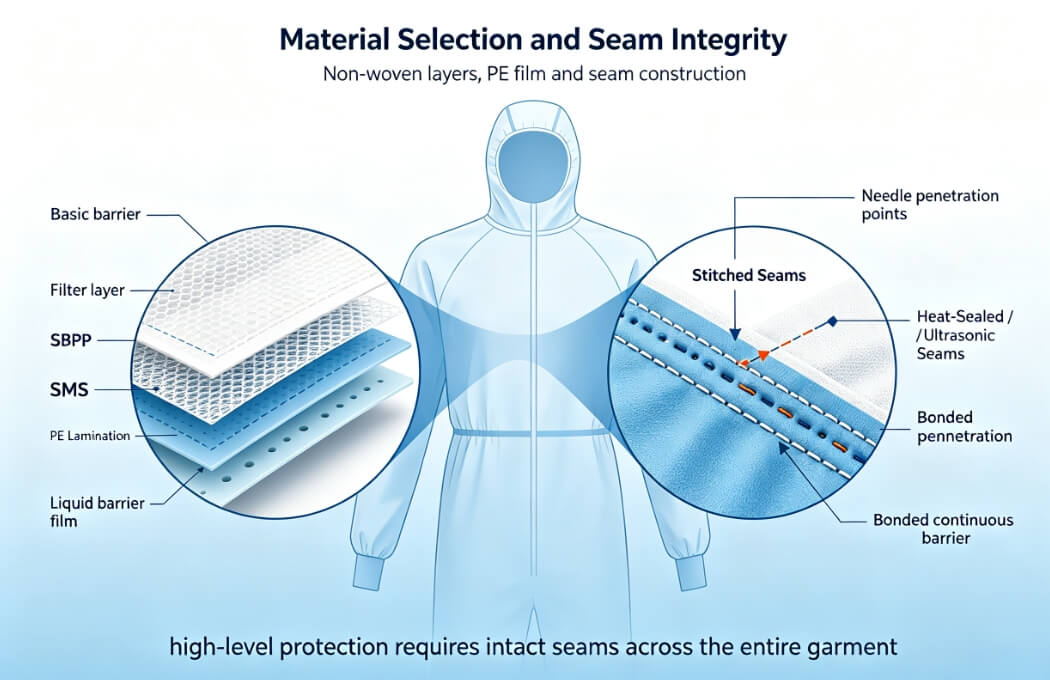
A common oversight in PPE procurement is focusing solely on the fabric while ignoring the seams. In a high-quality isolation gown, the seams are part of the critical zone. Stitched seams are common in Level 1 and 2 gowns; however, Heat-Sealed or Ultrasonic Seams are essential for Level 3 and Level 4 protection. These methods bond the fabric without needles, ensuring the barrier remains intact across the entire garment.
Disposable Isolation Gown Specifications
A disposable isolation gown specification should be selected based on the intended clinical environment rather than material alone. Buyers typically evaluate barrier level, fabric construction, garment design, and packaging requirements together.
| Specification | Common Options |
|---|---|
| Material | PP, SMS, SMMS, PP+PE, Microporous Film |
| AAMI Protection Level | Level 1, Level 2, Level 3, Level 4 |
| Fabric Weight | Depends on material and protection requirement |
| Cuff Type | Elastic cuff or knitted cuff |
| Closure | Tie closure or hook-and-loop closure |
| Sleeve Design | Long sleeves |
| Sterility | Sterile or non-sterile |
| Color | Blue, White, Yellow, Green |
| Size | S, M, L, XL, XXL or customized |
| Application | Hospital, clinic, laboratory, isolation area |
The required specifications should match the intended level of fluid exposure and clinical environment. Buyers should also request technical data sheets and applicable test reports when sourcing medical disposable isolation gowns.
View our full disposable isolation gown collection.
Selection Guide for Clinical Scenarios
Choosing the right ppe disposable gown requires a risk assessment of the task at hand. For routine patient care where there is no expected contact with blood or body fluids, a Level 1 gown is sufficient. When treating patients with MRSA, C. diff, or VRE in infectious disease wards, Level 2 or Level 3 isolation gowns are recommended to prevent cross-contamination.
Due to the unpredictable nature of fluid exposure in the Emergency Room, Level 3 is often the institutional standard for trauma response. Level 4 gowns are mandatory when dealing with unknown viral threats or highly contagious fluids, where the risk of viral penetration is a matter of life and death. For comprehensive product specifications and bulk procurement options, technical buyers may explore our specialized Isolation Gown portfolio.
Conclusion
Understanding aami isolation gown standards is more than a regulatory requirement—it is a cornerstone of healthcare safety. By aligning the AAMI level with the specific clinical risk, healthcare facilities can optimize their spend while maximizing the safety of their frontline workers. When evaluating a supplier, always request full test reports and ensure the manufacturer adheres to ISO 13485 quality management systems to guarantee consistency in every batch.
FAQ
1. What is the difference between an isolation gown and a surgical gown?
While both fall under ANSI/AAMI PB70, an isolation gown is intended to protect the wearer from contamination in general clinical settings and must provide a barrier across the entire garment. A surgical gown is used in sterile environments, and its “critical zones” are typically limited to the front and sleeves.
2. Can disposable isolation gowns be reused if they are not soiled?
No. Medical isolation gowns disposable are designed for single use. The structural integrity of the non-woven fibers and the fluid-repellent treatments are degraded after one use and cannot be guaranteed after laundering or prolonged wear.
3. How do I verify if a gown truly meets AAMI Level 3?
Check the manufacturer’s technical data sheet for the AATCC 127 test result. It must show a hydrostatic pressure resistance of at least 50 cm. Additionally, ensure the manufacturer is ISO certified and the product carries the necessary CE or FDA registration.
4. Is a higher AAMI level always better?
Not necessarily. Higher-level gowns (like Level 4) are often less breathable and more expensive. For low-risk tasks, a Level 1 or 2 gown provides better comfort and thermal regulation for the staff while being more cost-effective.
5. What materials are best for Level 3 protection?
Generally, a high-quality SMS (Spunbond-Meltblown-Spunbond) fabric or a PP+PE laminated fabric is required to achieve the 50cm hydrostatic pressure threshold required for Level 3.