
Blog
Disposable Protective Clothing Material Guide

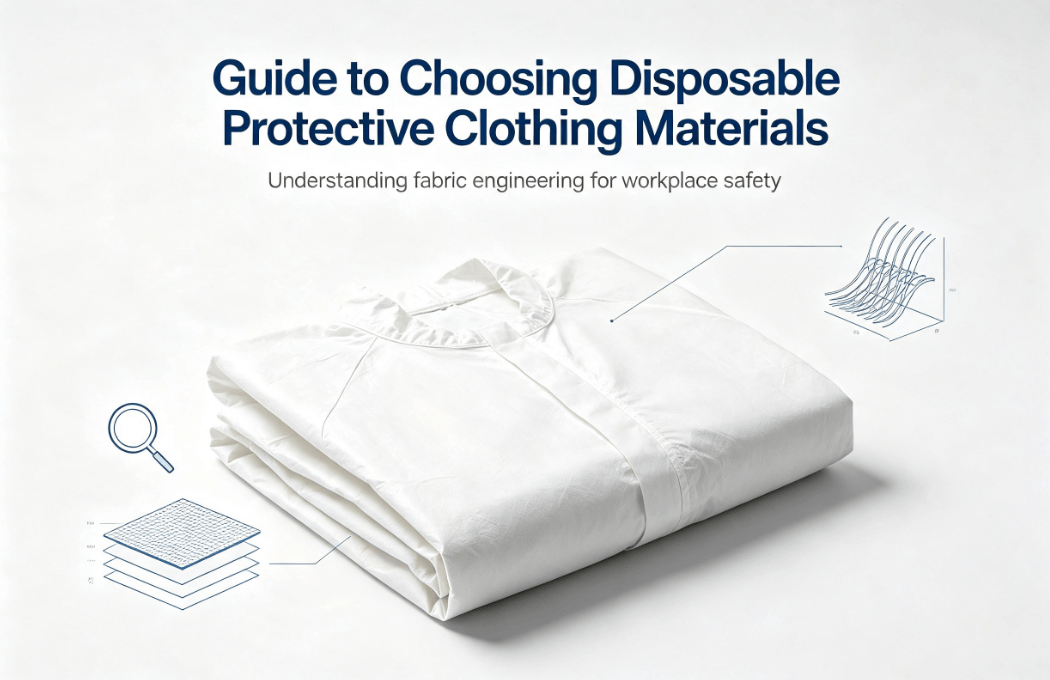
Selecting appropriate disposable protective clothing materials requires a deep understanding of workplace risks and fabric engineering. Procurement managers and safety officers must match specific nonwoven structures to their facility requirements. Choosing the wrong fabric can compromise worker safety or lead to unnecessary procurement costs. This technical guide explores the distinct properties of various nonwoven and laminated materials. We will examine how manufacturing processes impact barrier performance, breathability, and fluid resistance.
Evaluating these materials objectively ensures compliance with international safety protocols. Infection control specialists and industrial hygienists rely on data-driven metrics to make informed decisions. Fabric weight, structural composition, and seam construction all play critical roles in overall garment efficacy. Understanding these technical specifications helps organizations optimize their personal protective equipment (PPE) inventory.
Understanding Core Protective Clothing Materials
The medical and industrial sectors primarily utilize synthetic polymers for disposable garments. Polypropylene and polyethylene dominate the market due to their versatility and cost-effectiveness. Each material undergoes specific extrusion and bonding processes to achieve desired performance characteristics.
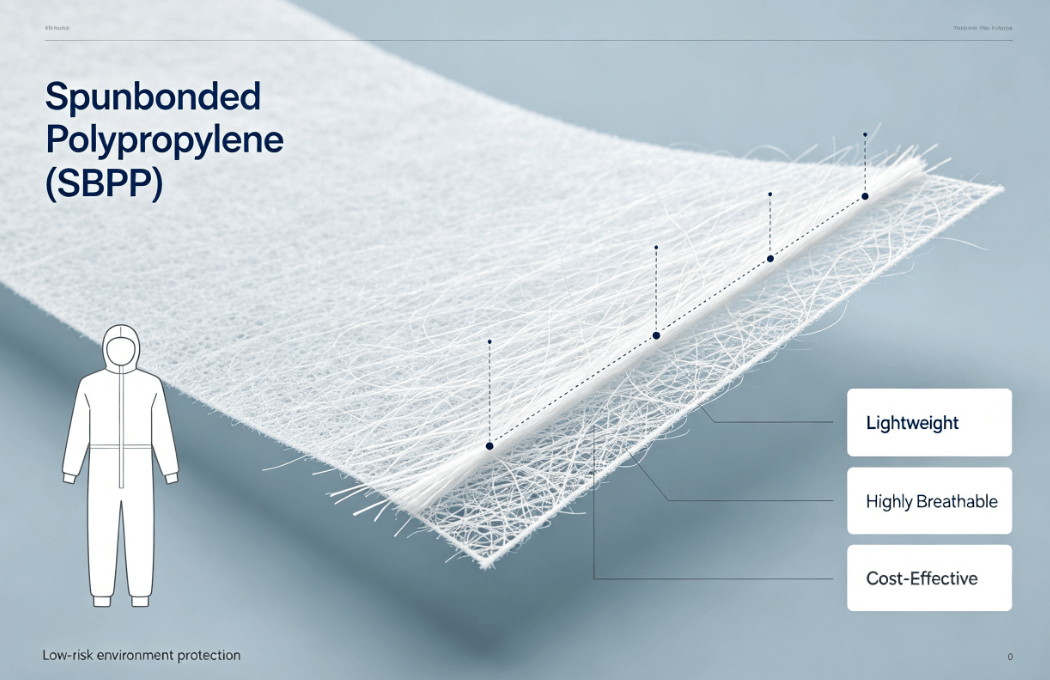
Spunbonded Polypropylene (SBPP) offers fundamental protection for low-risk environments. The manufacturing process spins thermoplastic polymer into continuous filaments. These filaments form a web bonded by thermal or chemical means. SBPP is lightweight, highly breathable, and cost-effective. However, it provides minimal resistance to fluids and fine particulates.
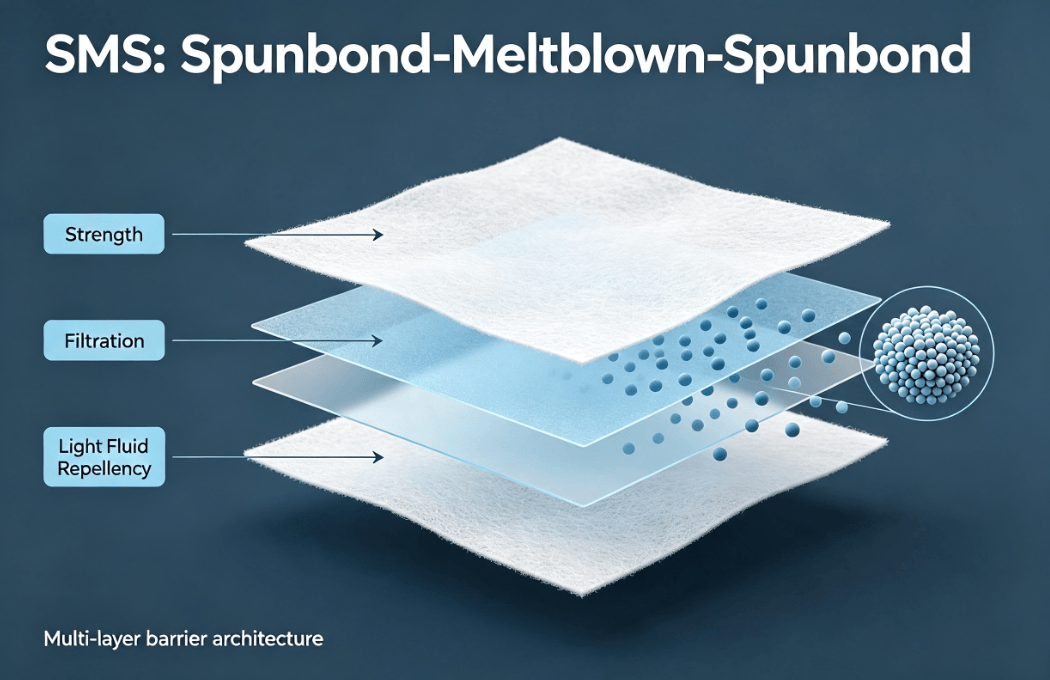
SMS (Spunbond-Meltblown-Spunbond) introduces a sophisticated multi-layer architecture. The outer spunbond layers provide physical strength and abrasion resistance. The inner meltblown layer acts as a dense filtration web. This microscopic web effectively traps dry particulates and repels light fluid splashes. SMMS variations add a second meltblown layer for enhanced barrier efficacy.
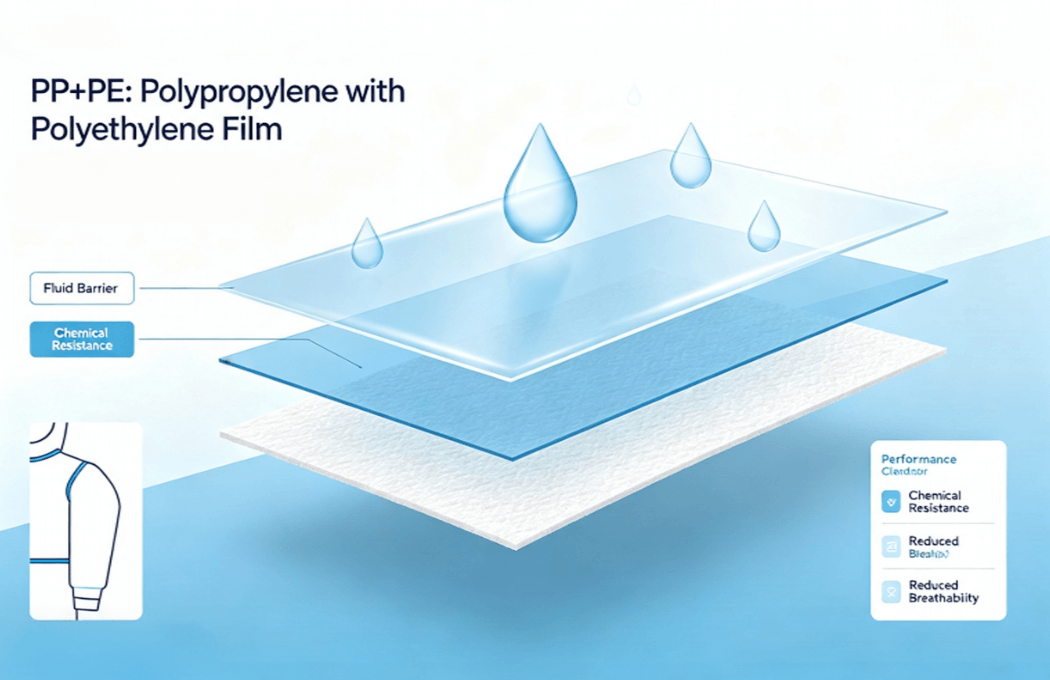
Polypropylene with Polyethylene Film (PP+PE) creates a strict fluid barrier. Manufacturers laminate a layer of impervious PE film onto a spunbond PP base. The resulting material completely blocks blood, chemicals, and infectious fluids. The primary trade-off is significantly reduced breathability. Wearers may experience heat stress during extended use.
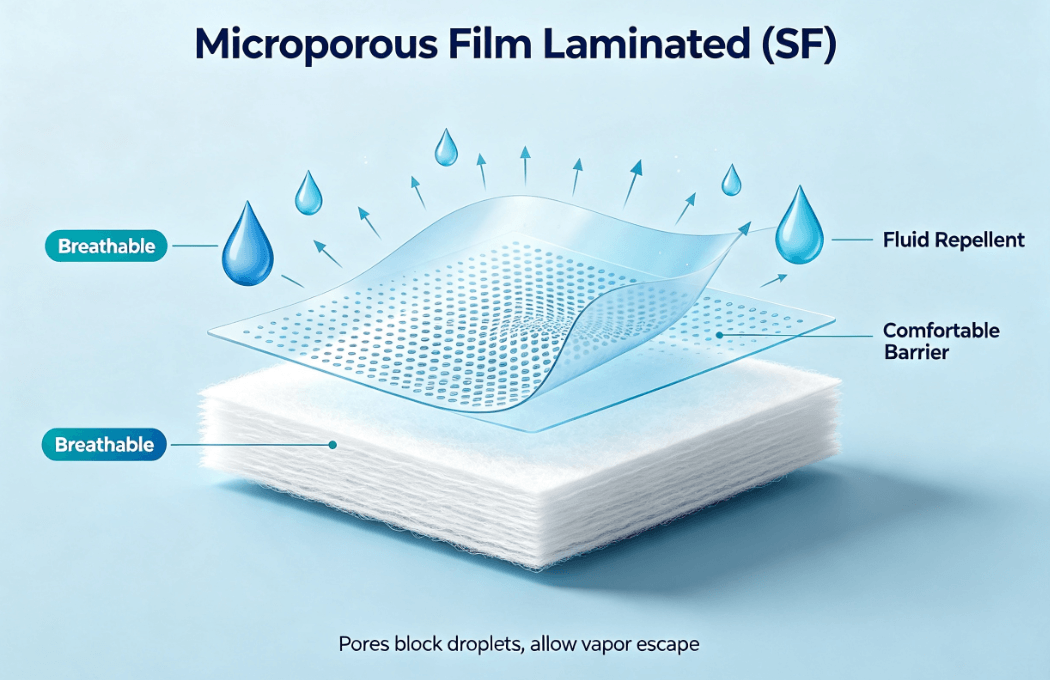
Microporous Film Laminated (SF) represents a balance between protection and comfort. A breathable microporous film is thermally bonded to a spunbond nonwoven base. The film contains microscopic pores smaller than liquid droplets but larger than moisture vapor molecules. This allows body heat to escape while preventing external fluid penetration.
Material Comparison Overview
| Material Type | Fluid Resistance | Breathability | Particulate Barrier | Cost Profile |
|---|---|---|---|---|
| SBPP | Low | Very High | Low | Economical |
| SMS / SMMS | Moderate | High | High | Moderate |
| PP+PE | Very High | Low | Very High | Moderate |
| Microporous (SF) | High | Moderate | Very High | Premium |
How Material Structure Impacts Barrier Performance
Barrier performance depends entirely on the microscopic structure of the protective clothing materials. Single-layer nonwovens rely on fabric thickness to delay liquid penetration. Laminated fabrics utilize physical barriers to stop fluid transmission entirely.
The meltblown process is crucial for particle filtration. Extruding melted polymer through high-velocity hot air creates microfibers. These fibers randomly overlap to create a dense, maze-like structure. Particles entering the fabric become trapped within this complex fibrous network.
Hydrostatic pressure testing determines a material’s ability to withstand fluid force. Fabrics like PP+PE excel in high-pressure scenarios, such as surgical environments. The solid polyethylene layer presents an impenetrable wall to aqueous liquids. Manufacturers often produce their own PE or CPE films to maintain strict quality control over this critical barrier.
Tensile strength and tear resistance ensure the garment remains intact during movement. A breach in the fabric immediately compromises the entire protective system. Spunbond layers provide the necessary mechanical strength to support fragile filtration layers.
Matching Materials to Application Scenarios
Different operational environments dictate specific material requirements. A universal approach to PPE procurement often results in inadequate protection or budget waste. Facilities must conduct thorough risk assessments before specifying garment fabrics.
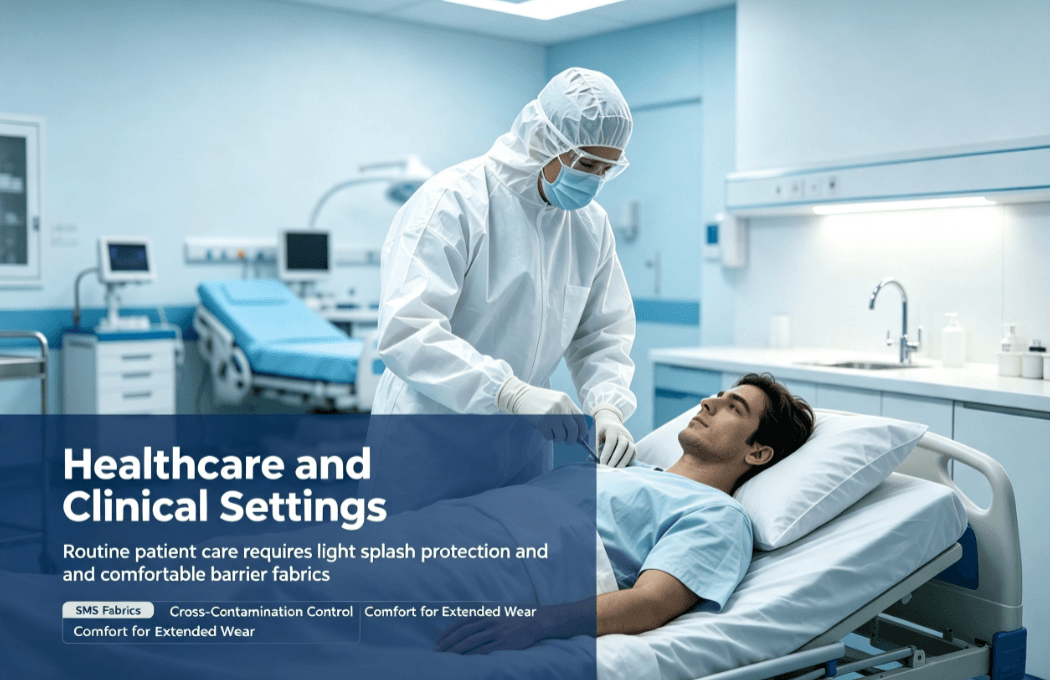
Healthcare and Clinical Settings
Hospitals require materials that prevent cross-contamination and protect against bloodborne pathogens. Standard isolation gowns typically utilize SMS fabrics for routine patient care. These provide sufficient protection against light splashes while keeping staff comfortable.
Surgical settings demand higher fluid resistance due to the risk of arterial spray. Surgeons rely on heavy-duty SMS or PP+PE laminated materials. These garments must pass stringent viral penetration testing to ensure absolute safety.
Industrial and Laboratory Environments
Chemical handling and pharmaceutical manufacturing involve exposure to hazardous dry and wet substances. Microporous film (SF) garments are the standard choice for these sectors. They offer excellent defense against chemical splashes and toxic dust particulates.

Cleanroom and Food Processing
Cleanrooms require lint-free materials that do not shed fibers into the controlled environment. Microporous laminates excel here because the outer film encapsulates the internal fibers. Food processing facilities often prioritize basic hygiene, relying on economical PE or CPE materials for simple fluid deflection.

Key Standards for Evaluating Nonwoven Protection
Procurement teams must verify that materials meet recognized international standards. Visual inspection alone cannot determine a fabric’s protective capabilities. Standardized testing provides quantifiable data regarding fluid and pathogen resistance.
In the United States, the AAMI PB70 standard categorizes medical protective apparel into four levels. Level 1 indicates minimal fluid resistance, suitable for basic care. Level 4 requires the material to pass ASTM F1671, proving resistance to bloodborne pathogens.
European standards utilize the EN 14126 directive for infective agents. Garments meeting this standard carry a “B” designation. Testing evaluates resistance to contaminated liquids, aerosols, and solid particles.
Industrial standards include EN 13034 for liquid chemical splashes. Evaluating these technical certifications ensures the chosen material aligns with local regulatory compliance. Buyers should always request independent laboratory test reports from manufacturers.
Procurement Considerations for Protective Garments
Selecting protective clothing materials involves more than just identifying the fabric type. Procurement professionals must evaluate manufacturing consistency, fabric weight, and construction methods. These factors directly influence the garment’s final performance and unit cost.
Fabric weight is measured in grams per square meter (GSM). A higher GSM generally indicates a thicker, stronger material with better barrier properties. However, excessive weight can increase wearer fatigue and decrease breathability. Buyers must find the optimal GSM balance for their specific application.
Seam construction is a critical vulnerability in any protective garment. Serged seams are common but leave tiny holes from the sewing needle. Bound seams add a layer of fabric over the stitch for better particle protection. Taped seams are mandatory for high-level fluid and chemical resistance, sealing the needle holes completely.
Evaluating manufacturer capabilities reduces supply chain risks. Factories that integrate film extrusion with garment assembly often provide better material consistency. Reviewing product specifications and quality control procedures is essential for long-term procurement success. To explore how different material configurations are applied in professional manufacturing, buyers can review standard protective clothing catalogs to compare technical specifications.
Consistent quality management systems, such as ISO 13485, indicate a manufacturer’s commitment to medical-grade production standards. Clear communication regarding material specifications prevents misunderstandings during bulk ordering. Always request material samples for physical evaluation before finalizing large procurement contracts.
Conclusion
Navigating the complexities of disposable protective clothing materials is essential for maintaining occupational safety. From the breathable nature of SMS to the rigorous fluid barriers of PP+PE and Microporous films, each fabric serves a distinct purpose. Matching the correct material architecture to specific environmental risks ensures optimal protection and wearer comfort. By understanding fabric properties, international standards, and manufacturing variables, procurement teams can source reliable, compliant protective garments that meet their facility’s exact requirements.
FAQ
1. What is the difference between SMS and Microporous film protective clothing?
SMS (Spunbond-Meltblown-Spunbond) utilizes a meltblown filtration layer to block particulates and light fluids while maintaining high breathability. Microporous film laminates an external breathable film onto a nonwoven base. The film provides superior protection against liquid chemicals and bloodborne pathogens compared to standard SMS.
2. How does fabric weight (GSM) affect protective clothing materials?
GSM (grams per square meter) measures the density and thickness of the material. A higher GSM typically increases tensile strength and improves the physical barrier against fluids and particles. However, heavier materials often reduce air permeability, potentially causing heat stress during extended shifts.
3. Which material provides the highest level of fluid resistance?
PP+PE (Polypropylene with Polyethylene film) and heavy-duty CPE (Chlorinated Polyethylene) provide the highest level of fluid resistance. The solid plastic film layer creates an impermeable barrier. These materials are heavily utilized in Level 4 surgical environments and intense fluid-exposure scenarios.
4. Can standard spunbond polypropylene (SBPP) protect against viruses?
No, standard SBPP offers minimal fluid resistance and lacks a dense filtration layer. It is designed for basic hygiene, dirt protection, and dry environments. Protection against viruses requires materials tested for viral penetration, such as high-grade laminated films with taped seams.
5. Why are seam types important when choosing protective clothing?
The fabric is only as strong as its weakest point, which is often the seam. Serged seams have needle holes that can allow fluids or fine dust to penetrate. Bound or heat-taped seams seal these vulnerabilities, ensuring the garment maintains the material’s original barrier integrity.
Reference Sources
CDC guidelines on selecting protective clothing for healthcare