

PE vs CPE Material: What’s the Difference?

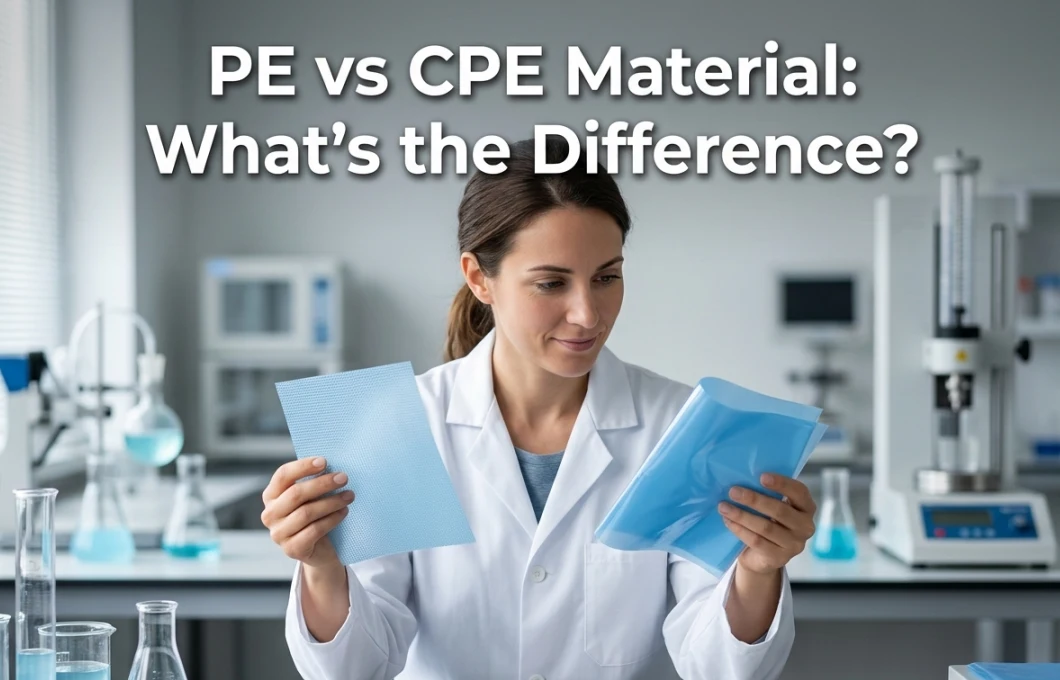
PE and CPE are both used to make disposable protective products, including shoe covers, aprons, gowns, and rainwear. They may look similar at first, but their material properties and production methods are different.
For buyers sourcing personal protective equipment (PPE), the choice is not simply about which material is stronger. Product cost, flexibility, moisture protection, intended use, and required performance all matter.
Understanding the difference between PE and CPE material makes it easier to select a suitable product without paying for properties that the application does not require.
What Is PE Material?
Polyethylene (PE) is a thermoplastic polymer made from ethylene. It is widely used in packaging, disposable products, and protective items because it is lightweight, moisture-resistant, and relatively economical.
PE comes in several forms, including low-density polyethylene (LDPE), high-density polyethylene (HDPE), and linear low-density polyethylene (LLDPE). Their flexibility, strength, and processing characteristics vary, so the properties of a finished product depend partly on the grade used.
Common Properties of PE
- Lightweight: PE can be made into thin films suitable for disposable protective products.
- Moisture resistance: It helps prevent water and other liquids from passing through an intact film.
- Flexible: Depending on the grade and thickness, PE can be made into soft or relatively stiff products.
- Cost-effective: Its relatively low material cost makes PE suitable for high-volume disposable items.
Where Is PE Used in PPE?
PE is commonly used for disposable shoe covers, aprons, protective gowns, and other products designed for basic splash or moisture protection.
For example, a disposable PE apron may suit food preparation, cleaning, or general-purpose tasks where protection against light splashes is needed. PE shoe covers can help keep floors clean and reduce the transfer of dirt between areas.
The actual level of protection depends on film thickness, product construction, seams, fit, and the substances involved. A PE product should not be assumed to provide protection against every chemical or liquid simply because its material resists water.
What Is CPE Material?
Chlorinated polyethylene (CPE) is produced by introducing chlorine into polyethylene’s polymer structure. This modification changes the material’s properties, including its flexibility, toughness, and resistance to certain environmental conditions.
CPE is used in several industrial applications, including some disposable protective products. In PPE, CPE film is often selected when buyers want a different combination of flexibility, surface feel, and resistance to tearing or handling damage.
Common Properties of CPE
- Material flexibility: CPE can provide a soft, flexible feel, depending on its formulation and thickness.
- Toughness: Appropriate CPE formulations can offer useful resistance to tearing and mechanical stress.
- Moisture protection: CPE film can act as a barrier against water and other liquids when the product is properly constructed.
- Application-specific performance: Its suitability depends on the formulation, film thickness, and intended exposure.
Where Is CPE Used in PPE?
CPE is used in disposable products such as shoe covers, aprons, and gowns. Buyers may consider it for environments where the product needs to remain flexible during movement or withstand routine handling.
However, CPE is not automatically suitable for every industrial or chemical-protection task. Resistance to a particular chemical must be verified against the specific formulation, concentration, temperature, and exposure time.
The same principle applies to flame resistance and low-temperature performance. These properties should be confirmed through relevant product specifications or test results rather than inferred from the material name alone.
PE vs CPE Material: Key Differences
The difference between PE and CPE material starts with their chemical structure, but purchasing decisions should focus on how each finished product performs in its intended environment.
| Comparison | PE Material | CPE Material |
|---|---|---|
| Material composition | Polyethylene polymer | Chlorinated polyethylene |
| Material feel | Varies by grade; can be soft or relatively stiff | Often selected for its flexible feel |
| Moisture resistance | Good barrier when the film remains intact | Good barrier when the film remains intact |
| Tear resistance | Depends on grade, thickness, and construction | Depends on formulation, thickness, and construction |
| Flexibility | Varies by PE grade and product design | Varies by formulation and processing |
| Typical cost | Often economical for basic disposable products | Depends on formulation and manufacturing costs |
| Common PPE uses | Shoe covers, aprons, gowns, and protective film products | Shoe covers, aprons, gowns, and other film-based protective products |
Neither material is universally better. A well-designed PE product may be the more practical choice for a basic, high-volume application, while a CPE product may suit buyers looking for a particular feel or mechanical performance.
The specifications of the actual product matter more than a general comparison of material names.
PE vs CPE Apron: Which Should You Choose?
When comparing a PE vs CPE apron, consider the work being performed, the type of liquid exposure, and how long the apron will be worn.
PE Aprons
PE aprons are often considered for food preparation, cleaning, housekeeping, and other tasks involving light splashes or routine hygiene requirements. Their relatively low cost can be attractive when large quantities are used and replaced frequently.
CPE Aprons
CPE aprons may be considered when buyers prefer a different surface feel or need product-specific flexibility and mechanical performance. The right choice still depends on film thickness, apron design, and the conditions of use.
Before placing a bulk order, check the apron dimensions, film thickness, material specification, packaging quantity, and any required test reports. If the apron will contact chemicals, confirm compatibility with those substances rather than relying on a general PE-versus-CPE comparison.
PE and CPE Materials for Other PPE Products
Material selection can change from one product to another. The same material may perform differently when used in a thin apron, a shoe cover, or a raincoat because the product design and exposure conditions are different.
Disposable Shoe Covers
PE shoe covers are commonly used to help keep floors and footwear clean in medical, food-processing, and general hygiene environments.
CPE shoe covers are another option for buyers who prefer their particular flexibility or surface characteristics. For either type, check the fit, thickness, slip resistance, and resistance to tearing during normal use.
CPE vs PE Raincoat
When comparing a CPE vs PE raincoat, focus on waterproofing, flexibility, comfort, and the expected conditions of use.
Both materials can be used in waterproof film products, but performance depends on film thickness, seams, closures, and garment design. A raincoat intended for occasional use may have different requirements from one worn for extended periods or in demanding weather.
Do not assume that either material provides chemical protection, flame resistance, or a particular level of durability without supporting specifications or test results.
Disposable Gowns and Protective Clothing
PE and CPE films may be used in disposable gowns and other protective clothing, depending on the product design.
For healthcare and industrial purchasing, distinguish basic fluid resistance from protection against specific biological or chemical hazards. A material name alone does not establish compliance with a medical or PPE standard.
Where a particular protection level is required, review the finished product’s applicable test results, certifications, and intended-use instructions.
How to Choose Between PE and CPE for PPE
For procurement teams, a practical comparison should begin with the application rather than the material label.
- Define the exposure. Identify whether the product needs to resist water, food splashes, cleaning liquids, oils, or specific chemicals.
- Confirm the required performance. Check whether the product needs basic moisture protection, additional mechanical strength, or compliance with a particular standard.
- Compare product specifications. Review thickness, dimensions, weight where applicable, seams, fit, and construction.
- Evaluate total purchasing cost. Consider unit price, packaging, product consumption, and replacement frequency.
- Request samples and documentation. Test the finished product under representative conditions and review any applicable test reports before committing to a large order.
These checks help buyers compare PE and CPE products on a consistent basis instead of choosing solely by material name or quoted price.
FAQ
Is CPE better than PE?
Not in every application. CPE may be preferred for certain flexibility or mechanical requirements, while PE is often suitable for economical disposable products. The best choice depends on the finished product’s specifications and intended use.
What is the difference between PE and CPE material?
PE is polyethylene, while CPE is polyethylene that has undergone chlorination. The modification changes its material properties, but the performance of each finished product depends on its formulation, thickness, and construction.
Are PE and CPE aprons waterproof?
Both can be made from films that resist water. Actual protection depends on the film, seams, coverage, and product condition. Neither should be assumed to protect against every liquid or chemical.
Can CPE shoe covers replace PE shoe covers?
They may be alternatives for some applications, but they are not automatically interchangeable. Compare fit, thickness, slip resistance, durability, and the required level of protection before switching materials.
What should buyers check before ordering PE or CPE PPE?
Confirm the intended application, material specification, thickness, product dimensions, packaging, minimum order quantity, and any required test documentation. For chemical or regulated medical applications, verify that the finished product meets the relevant requirements.
Choose the Material for the Job
PE and CPE both have a place in disposable protective products. PE can be a practical choice for basic, cost-sensitive applications, while CPE may suit products with different flexibility or mechanical requirements.
For procurement teams, the most reliable decision comes from comparing the finished products against the actual conditions of use. Material specifications, sample testing, and relevant documentation provide a stronger basis for selection than broad claims about either material.