
Blog
Impervious vs. Surgical Gowns: Key Differences & Standards

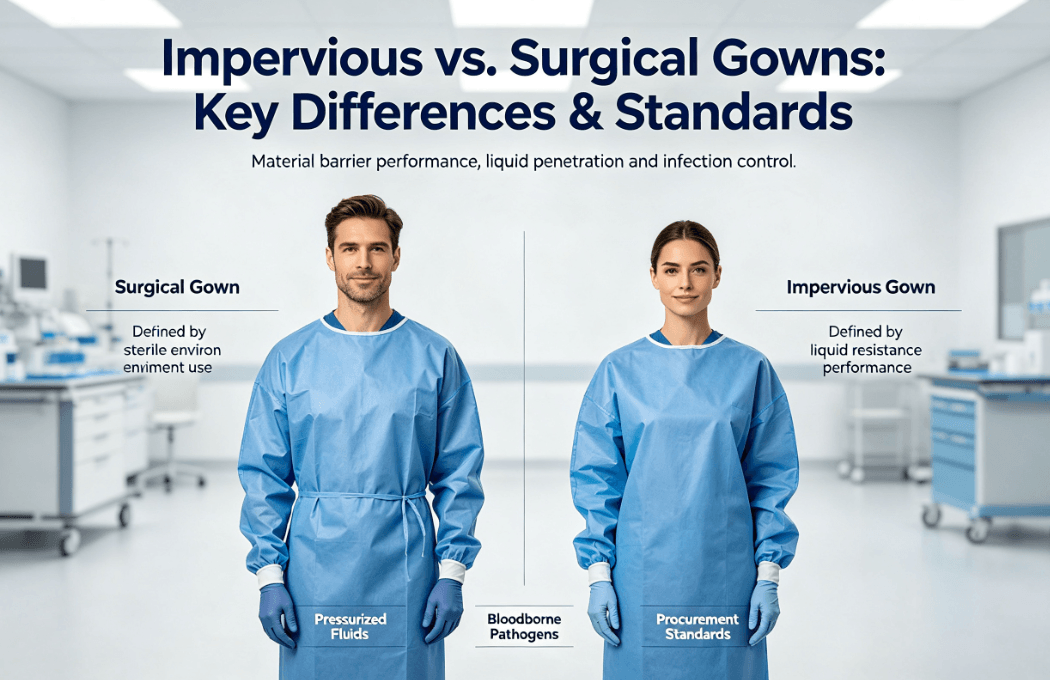
In the landscape of Personal Protective Equipment (PPE), the terms “surgical gown” and “impervious gown” are often used interchangeably. However, for infection control specialists and procurement managers, understanding the technical distinction between these two is critical. The primary difference lies not just in their intended use, but in their material barrier performance against pressurized fluids and bloodborne pathogens. A surgical gown is a functional category defined by its application in sterile environments. In contrast, an impervious gown refers to a specific performance characteristic—the total resistance to liquid penetration.
What Defines an Impervious Gown?
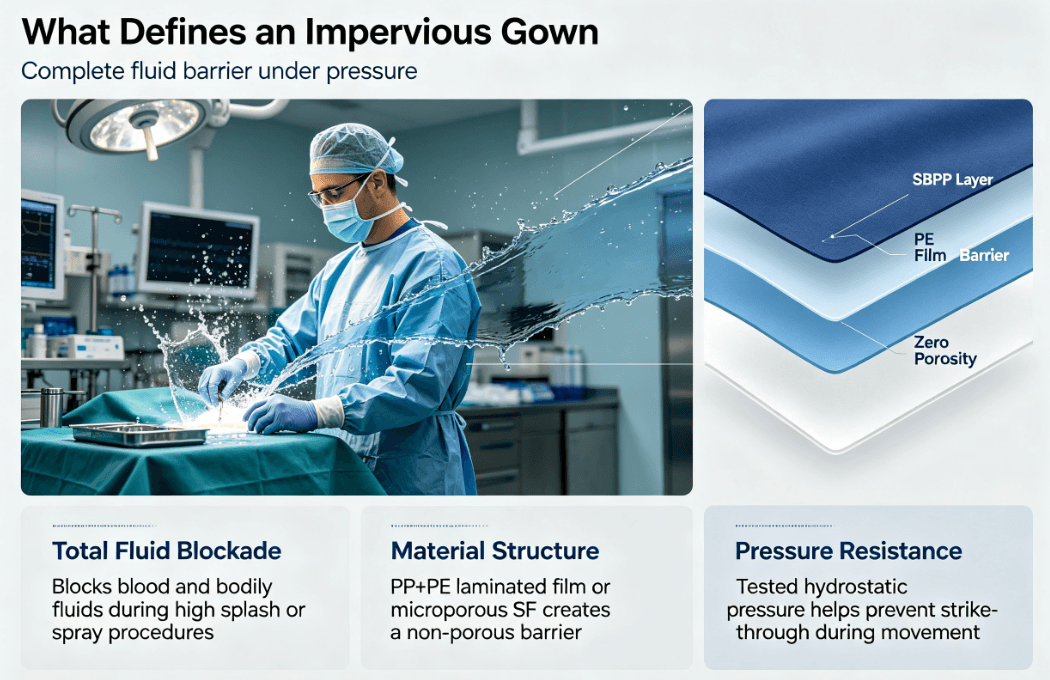
An impervious gown is engineered to provide a complete barrier against fluids, even under significant pressure. In technical terms, “impervious” means that no liquid can pass through the fabric. This is typically achieved through specialized material lamination. Most fluid resistant gowns utilize a multi-layer approach. Manufacturers often use Spunbonded Polypropylene (SBPP) laminated with a Polyethylene (PE) film. This combination ensures that the gown remains lightweight while the PE film provides a non-porous surface that prevents “strike-through.”
Key characteristics of impervious gowns include:
- Total Fluid Blockade: Designed for high-fluid procedures where blood or bodily fluids may splash or spray.
- Material Structure: Often composed of PP+PE or Microporous film (SF) to ensure zero porosity.
- Pressure Resistance: Manufacturers test these gowns against hydrostatic pressure to ensure the barrier remains intact when the wearer leans, moves, or works under pressure.
What Defines a Surgical Gown?
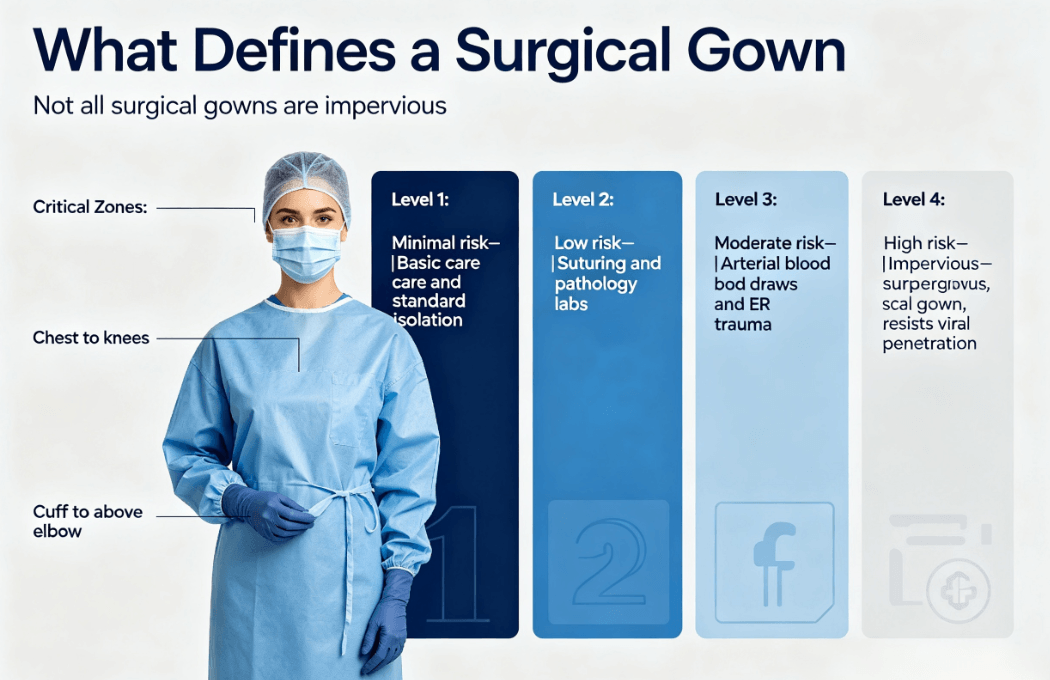
A surgical gown is a medical device intended to be worn by operating room personnel during surgical procedures. Its goal is to protect both the patient and the healthcare worker from the transfer of microorganisms and particulate matter. Unlike standard isolation gowns, surgical gowns have specific “critical zones.” According to the AAMI PB70 standard, the critical zones include the front of the gown (from chest to knees) and the sleeves (from cuff to above the elbow).
Not all surgical gowns are impervious. Surgical gowns are classified into four levels:
- Level 1: Minimal risk; used for basic care and standard isolation.
- Level 2: Low risk; used for suturing or pathology labs.
- Level 3: Moderate risk; used for arterial blood draws and ER trauma.
- Level 4: High risk; these are technically impervious surgical gowns capable of resisting viral penetration.
Technical Comparison: Barrier Performance and Standards?
The most significant differentiator is the ASTM testing standard applied to the materials. The following table highlights the material and testing gaps between common surgical options and true impervious products.
| Feature | Impervious Gowns | Standard Surgical Gowns (Level 2/3) |
|---|---|---|
| Material | PP+PE Laminated / Microporous Film | SMS (Spunbond-Meltblown-Spunbond) |
| Primary Test | ASTM F1671 (Viral Penetration) | ASTM F1670 (Synthetic Blood) |
| Breathability | Low (due to film layer) | Moderate to High (multi-layer non-woven) |
| Fluid Resistance | Total blockade under pressure | Fluid repellent but not waterproof |
| Application | High-fluid orthopedic or cardiovascular surgery | General surgical procedures |
Material Composition: SMS vs. Lamination?
Standard surgical gowns are frequently made of SMS fabric. This material relies on the “meltblown” layer to filter bacteria and repel fluids. While highly effective for most procedures, SMS is naturally breathable and porous. Impervious gowns prioritize the barrier over breathability. By laminating a layer of polyethylene film onto the non-woven base, manufacturers eliminate the pores through which fluids could travel. This makes them the gold standard for procedures involving high volumes of irrigation or heavy blood loss.
When to Choose Impervious Gowns Over Standard Gowns?
The choice between these products depends on the anticipated level of fluid exposure and the duration of the procedure.
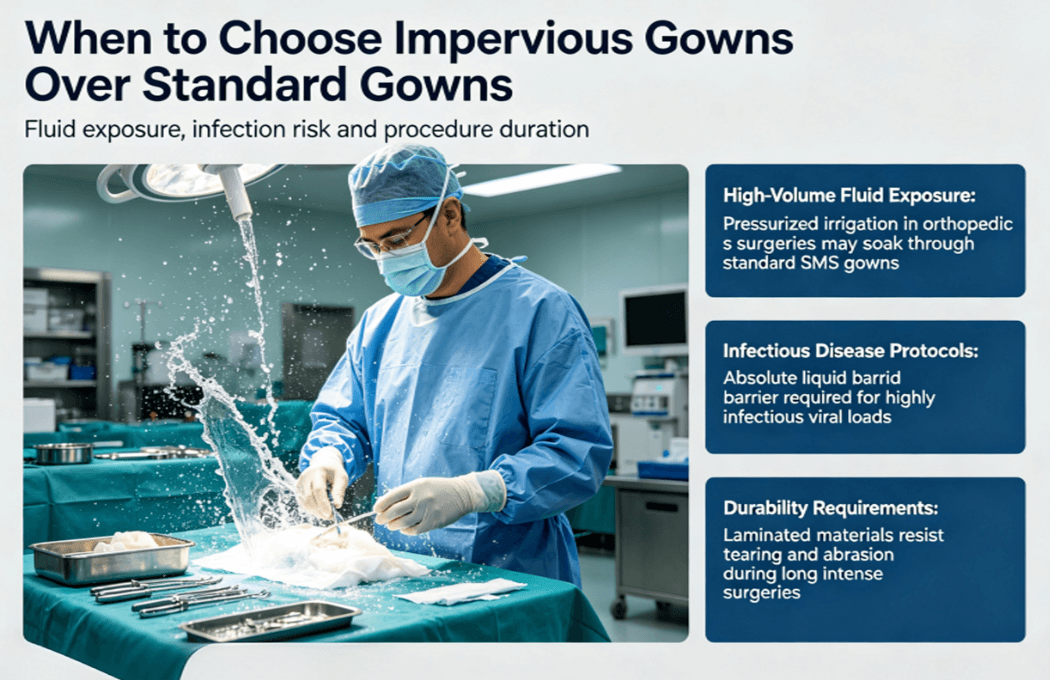
- High-Volume Fluid Exposure: During orthopedic surgeries (like total joint replacements), the use of pressurized irrigation systems necessitates impervious gowns. Standard SMS gowns may eventually soak through under prolonged pressure.
- Infectious Disease Protocols: Healthcare professionals may require an impervious gown when treating patients with highly infectious diseases or when maximum fluid protection is necessary.
- Durability Requirements: Laminated materials used in impervious gowns are often more resistant to tearing and abrasion than standard non-woven materials, making them suitable for long, intense surgeries.
Manufacturing Considerations for Healthcare Buyers?
As a professional manufacturer, we recognize that the quality of the PE film lamination is the “make or break” factor for an impervious product. At Hubei Ruichen, we produce our own PE and CPE films in-house. This allows us to control the thickness and consistency of the impervious layer, ensuring that every batch meets the necessary safety certifications including CE and ISO13485.
When evaluating a supplier for fluid resistant gowns, buyers should look for:
- Seam Integrity: To provide a truly impervious barrier, manufacturers typically use taped or ultrasonically welded seams. Standard stitched seams can create needle holes that allow fluid bypass.
- Certification Transparency: Ensure the manufacturer provides valid test reports for ASTM F1671 or EN 14126 standards.
- Customization (OEM): Many surgical environments require specific cuff designs, neck closures, or other features to help maintain a secure protective barrier.
For more technical information on gown selection, you may visit our product resources:
Technical Specifications for Isolation Gowns
Advanced Medical Protective Clothing Solutions
Conclusion
While all impervious surgical gowns are categorized as surgical gowns, not all surgical gowns provide an impervious barrier. Standard surgical gowns (AAMI Level 1-3) focus on repelling fluids and maintaining a sterile field through SMS filtration. Impervious gowns, matching AAMI Level 4 criteria, provide a physical, non-porous barrier intended for high-pressure, high-fluid, and high-risk environments. Selecting the right material is not just a matter of comfort, but a critical decision for healthcare safety.
FAQ
1. Is an AAMI Level 3 gown considered impervious?
Technically, no. An AAMI Level 3 gown is highly fluid-resistant and can withstand moderate hydrostatic pressure, but it is not “impervious” to viral penetration. Only Level 4 gowns are classified as truly impervious.
2. Why are impervious gowns less breathable?
Imperviousness is achieved by adding a solid film layer like Polyethylene to the fabric. This film blocks both liquids and air. While some microporous films exist, they are generally less breathable than standard SMS fabrics.
3. Can I use an impervious gown for chemotherapy?
Yes, impervious gowns are often preferred for handling hazardous drugs because the film layer provides a better barrier against chemical permeation compared to standard non-woven materials.
4. How can I tell if a gown is truly impervious during a quick inspection?
Look at the fabric structure. An impervious gown will often have a shiny or plastic-like inner or outer layer, indicating a film lamination. You can also perform a simple water bead test to check resistance.
5. Are impervious gowns always sterile?
Not necessarily. While most impervious surgical gowns used in the OR are sterile, you can also find non-sterile impervious isolation gowns used for decontaminating medical instruments or in ICU settings.
Reference Sources
AAMI PB70: Liquid barrier performance standards.
FDA Medical Gown Classification and Regulations.