

Blog
FFP2 Mask: Uses & FFP2 vs KN95

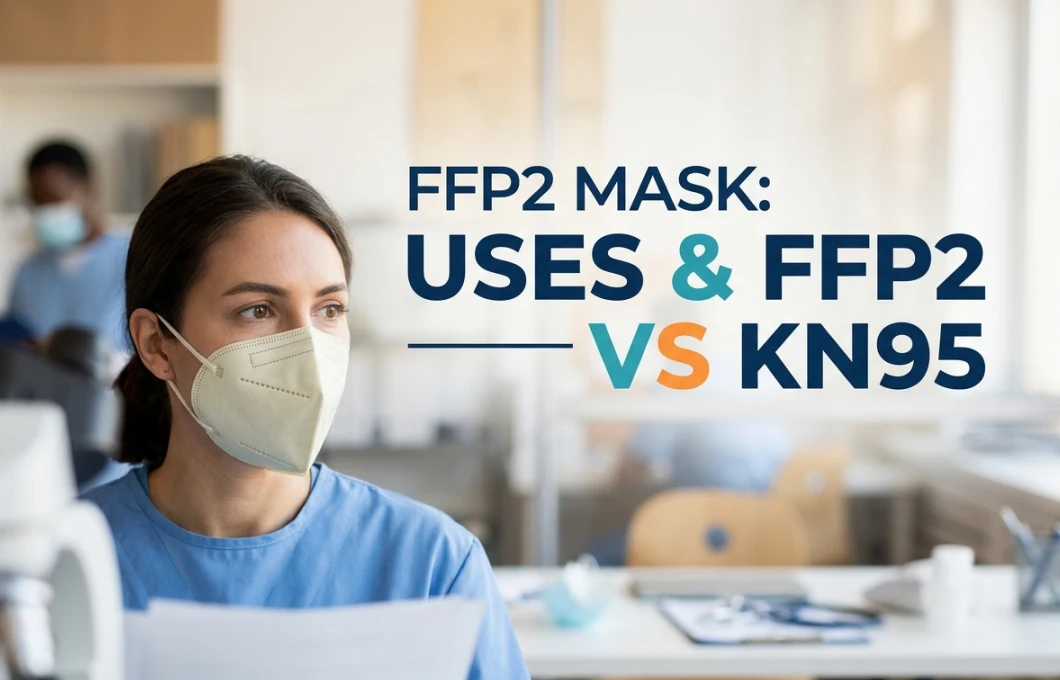
An FFP2 mask is a filtering facepiece respirator designed to reduce the inhalation of airborne particles when it fits correctly. It is commonly used in workplaces where dust, aerosols, or other airborne contaminants may present an inhalation risk.
FFP2 respirators are widely recognized in European respiratory protection standards. KN95 respirators follow a different Chinese standard, although both product categories are designed to filter airborne particles.
The distinction matters when selecting respiratory protection for healthcare, manufacturing, construction, or other occupational settings. A filtration percentage alone cannot tell you whether two respirators offer equivalent protection.
Understanding their intended uses, testing requirements, and fit characteristics helps buyers and safety professionals make more informed decisions.
What Is an FFP2 Mask and How Does It Work?
FFP2 stands for Filtering Face Piece, Class 2. The classification comes from the European standard EN 149, which covers filtering half masks designed to protect against particles.
Unlike an ordinary face covering, an FFP2 respirator is tested against defined performance requirements. These include filter penetration, total inward leakage, breathing resistance, and other requirements specified by the applicable standard.
The respirator works through a combination of filtration mechanisms. Fibrous filter layers capture particles as air passes through the material.
Depending on the filter design, particles can be captured through mechanisms such as interception, inertial impaction, and electrostatic attraction. The relative contribution of each mechanism depends on the filter construction and testing conditions.
What Does the FFP2 Classification Mean?
Under EN 149, FFP2 respirators must meet a minimum filtration efficiency of 94% under the standard’s specified test conditions.
This figure is frequently misunderstood. It describes a laboratory performance requirement for the filter, not a guarantee that the wearer will receive 94% protection in every situation.
The standard also evaluates how much air can leak inward around the face seal. A respirator may have an effective filter but still provide inadequate protection if it does not fit the wearer properly.
Several characteristics help explain how an FFP2 respirator is evaluated:
- Filter penetration: Measures how much of the test aerosol passes through the filter under specified conditions.
- Total inward leakage: Evaluates particle entry through the filter and leakage around the face seal.
- Breathing resistance: Measures resistance to airflow during inhalation and exhalation.
- Practical fit: Determines whether the respirator can maintain an appropriate seal on the individual wearer.
- Product marking: Helps users identify the classification and relevant conformity information.
FFP2 respirators may use molded cup-shaped designs or foldable constructions. Some models include an exhalation valve, while others have no valve.
These design differences affect comfort, handling, and intended use. They do not automatically establish which model offers better protection.
FFP2 Respirators Are Not the Same as Medical Face Masks
A medical face mask and an FFP2 respirator serve different purposes.
Medical face masks are generally designed to provide a barrier against droplets and splashes, depending on their classification and intended use. Their performance requirements differ from those for particulate-filtering respirators.
FFP2 respirators are designed to reduce the inhalation of airborne particles when used correctly. Their performance depends on the filter, face seal, and conditions of use.
Some respirators are also designed and certified for medical applications. However, an FFP2 classification alone does not automatically establish compliance with every requirement for a medical face mask or medical device.
For procurement teams, the intended application should be established before comparing products. A product’s appearance or general description is not enough to determine whether it meets the relevant requirements.
What Are FFP2 Mask Uses in Different Work Environments?
FFP2 respirators are used in a range of environments where airborne particles may be present. The appropriate choice depends on the type of contaminant, its concentration, exposure conditions, and the applicable workplace requirements.
Healthcare and Clinical Settings
Healthcare professionals may use suitable filtering facepiece respirators when respiratory protection against airborne particles is required.
The exact requirements depend on the task, local infection-control guidance, and workplace risk assessment. A healthcare facility should not select a respirator based solely on its FFP2 label.
Fit testing, user training, and correct donning procedures may also be necessary under the applicable respiratory protection program.
Construction and Manufacturing
Construction workers may encounter dust generated by cutting, drilling, grinding, or handling certain building materials.
Manufacturing environments can present similar challenges. Depending on the process, airborne particles may come from material handling, machining, sanding, or other production activities.
An FFP2 respirator may be suitable for some particulate hazards, but the hazard must be assessed before selecting the equipment.
For example, a respirator intended for particles should not be assumed to protect against gases or vapors. Some hazardous dusts may also require a different protection class or a specialized respiratory protection system.
Laboratories and Industrial Workplaces
Laboratories, workshops, and industrial facilities may use FFP2 respirators for selected tasks involving particulate exposure.
The suitability of a particular model depends on the substances involved, exposure levels, duration of work, and other protective measures.
Employers should consider the entire exposure-control strategy rather than relying on a disposable respirator alone. Ventilation, containment, work procedures, and appropriate personal protective equipment may all be relevant.
Everyday Situations Involving Airborne Particles
Some individuals choose FFP2 respirators in crowded indoor environments or during periods of elevated particulate pollution.
The practical benefit depends on the respirator’s quality, fit, condition, and correct use. Facial hair in the sealing area, damaged straps, or gaps around the nose and cheeks can reduce performance.
An FFP2 respirator is not a universal solution for every airborne hazard. Its intended use and limitations should always be considered.
FFP2 vs KN95: What Are the Main Differences?
FFP2 and KN95 respirators are often compared because both are designed to filter airborne particles. However, they are certified under different standards and should not be treated as automatically interchangeable.
FFP2 respirators are classified under European standard EN 149. KN95 respirators are classified under China’s GB 2626 standard.
The standards use different test methods and include their own performance requirements. A higher numerical filtration threshold does not, by itself, prove that one respirator provides better overall protection.
| Comparison factor | FFP2 respirator | KN95 respirator |
|---|---|---|
| Primary standard | EN 149 | GB 2626 |
| Typical minimum filter efficiency requirement | 94% | 95% |
| Certification framework | European PPE conformity requirements, where applicable | Chinese respiratory protective equipment requirements |
| Fit and leakage evaluation | Evaluated under EN 149 requirements | Evaluated under GB 2626 requirements |
| Common applications | Selected occupational and healthcare settings | Selected occupational and general particulate-exposure settings |
| Market acceptance | Depends on applicable European requirements | Depends on applicable Chinese or destination-market requirements |
The figures above refer to the respective standards’ filtration requirements, not guaranteed real-world protection. Always check the applicable edition of the standard and the specific product documentation.
Why Are Their Filtration Percentages Different?
The 94% and 95% figures are frequently used as a quick comparison. However, the figures come from different certification systems.
Testing conditions, aerosol characteristics, airflow requirements, and other evaluation procedures can differ between standards. The results therefore should not be interpreted as a direct, like-for-like measurement of real-world performance.
Both classifications require more than a simple claim printed on the packaging. Buyers should verify that the product has been assessed under the stated standard and that its documentation matches the exact model being purchased.
A KN95 label does not establish EN 149 compliance. Similarly, an FFP2 label does not automatically establish compliance with every requirement for products sold in China or other markets.
Does an FFP2 Mask Provide Better Protection Than a KN95?
There is no universal answer based solely on the classification.
A properly certified respirator that fits the wearer well may provide better practical protection than a poorly fitting respirator with a nominally higher filtration figure. Product authenticity, fit, correct use, and the exposure conditions all matter.
When evaluating the two types, consider:
- Whether the product meets the required standard for the destination market.
- Whether its certification and test documentation can be verified.
- Whether the model fits the intended wearer.
- Whether the respirator is suitable for the specific airborne hazard.
- Whether the supplier can provide consistent, traceable product information.
For procurement, the right choice is the model that meets the actual technical and regulatory requirements, rather than the one with the more attractive label.
How to Choose the Best FFP2 Mask for Your Needs
The best FFP2 mask is not necessarily the most expensive model or the one with the most features. It is the respirator that meets the required standard, fits the wearer, and suits the intended working conditions.
A practical evaluation starts with the exposure risk and ends with verification of the specific product.
1. Identify the Intended Application
Determine what the wearer may be exposed to. Dust, biological aerosols, and other particulate hazards may require different risk-control measures.
Check the relevant workplace requirements before selecting a respirator. Do not assume that all particulate hazards can be managed by an FFP2 product.
2. Verify the Standard and Product Documentation
For products sold as FFP2 respirators, examine the product marking and relevant conformity documents.
Where European PPE compliance is required, check the applicable EU conformity documentation and the relationship between the product model, manufacturer, and supporting assessment records.
A CE mark alone should not be treated as sufficient evidence that every claim about a product is correct. Documentation should be consistent, verifiable, and appropriate to the intended market.
3. Check Fit and Comfort
A respirator should form an appropriate seal around the nose and mouth.
Nose clips, headbands, ear loops, and overall shape vary by design. These differences can affect how well a particular model fits an individual.
A fit assessment is more informative than choosing a model based on appearance. Where workplace rules require fit testing, users should follow the applicable procedure.
4. Consider Construction and Wearing Conditions
Cup-shaped and foldable respirators can differ in storage, handling, and facial fit.
Other practical considerations include strap durability, nose-clip design, breathing resistance, and compatibility with protective eyewear.
An exhalation valve may reduce resistance during exhalation, depending on the design. However, a valved respirator may not be suitable when source control is required or when workplace rules specify an unvalved model.
5. Evaluate Product Consistency When Buying in Bulk
For distributors, importers, and institutional buyers, selection extends beyond an individual sample.
The supplier should be able to identify the exact model, provide relevant technical documentation, and explain how product specifications are controlled during production.
Before committing to a large order, consider reviewing:
- Product specifications and model identification.
- Applicable certification and test records.
- Packaging labels and traceability information.
- Sample consistency and agreed acceptance criteria.
- Storage conditions and shelf-life documentation, where applicable.
These checks help buyers distinguish a documented, specification-based purchasing decision from one based mainly on price or marketing claims.
Conclusion
FFP2 and KN95 respirators share a similar purpose: filtering airborne particles to reduce inhalation exposure. Their classifications, however, come from different standards, and the products are not automatically interchangeable.
The most useful comparison goes beyond filtration percentages. Standard compliance, product authenticity, fit, breathing resistance, and the intended application all deserve attention.
For individual users, the priority is selecting a suitable respirator and wearing it correctly. For businesses and procurement teams, verifying the exact model and its supporting documentation is equally important.
A clear understanding of these differences makes it easier to choose respiratory protection that matches the actual requirements of the workplace or application.
FAQ
What is an FFP2 mask used for?
An FFP2 mask is a filtering facepiece respirator used to reduce the inhalation of airborne particles. It may be used in selected healthcare, construction, manufacturing, and other occupational settings, depending on the exposure risk and applicable requirements.
Is an FFP2 mask the same as a KN95 mask?
No. FFP2 respirators are classified under EN 149, while KN95 respirators follow China’s GB 2626 standard. Both are designed to filter airborne particles, but their testing requirements and conformity frameworks differ.
Is FFP2 better than KN95?
Neither classification is universally better. The filtration figures come from different standards and testing conditions. Product authenticity, fit, correct use, and suitability for the intended hazard are also important.
What is the filtration efficiency of an FFP2 mask?
FFP2 respirators must meet a minimum filtration efficiency of 94% under the applicable EN 149 test requirements. This is a laboratory performance requirement, not a guarantee of the same level of protection in every real-world situation.
Can an FFP2 mask protect against viruses?
A properly selected and well-fitting FFP2 respirator can reduce the inhalation of airborne particles, including particles that may carry viruses. Its effectiveness depends on fit, correct use, exposure conditions, and other relevant protective measures. It does not guarantee complete protection against infection.
Can an FFP2 mask be reused?
Reuse depends on the specific product instructions and applicable workplace guidance. Many disposable FFP2 respirators are intended for limited use, and contamination, damage, moisture, or reduced fit can affect their suitability for continued use.
Users should follow the manufacturer’s instructions and relevant workplace procedures rather than assuming that every disposable respirator can be reused safely.
How can buyers verify an FFP2 respirator?
Buyers should check the model identification, manufacturer information, product marking, applicable conformity documents, and supporting test records. For products intended for the European market, the relevant PPE conformity requirements should be verified against the specific product and its documentation.
A label or supplier statement alone is not enough to establish that a product meets every applicable requirement.
What should businesses consider when purchasing FFP2 masks in bulk?
Businesses should establish the required standard, intended application, target-market regulations, and product specifications before requesting quotations. They should also verify documentation, packaging, traceability, sample consistency, and the supplier’s ability to maintain the agreed specifications across the order.