
Blog
Coveralls for Food Processing: PPE Guide

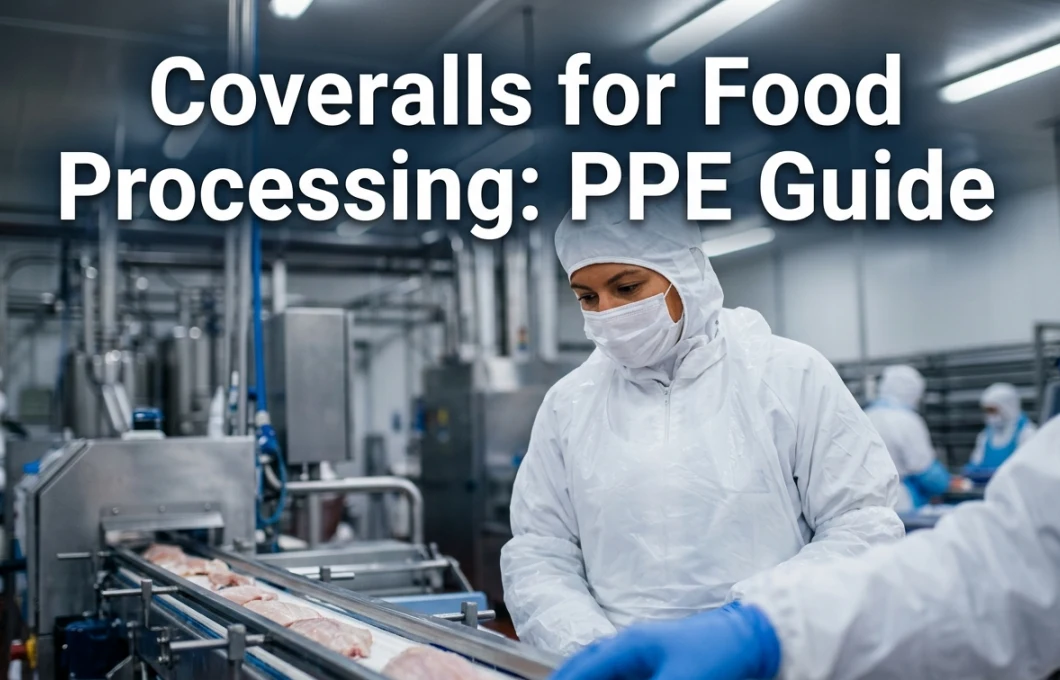
Food processing coveralls help keep workers’ everyday clothing separate from production environments where exposed ingredients, open packaging, and hygiene-sensitive operations require careful contamination control. The right garment depends on what employees handle, how the facility is organized, and which hazards need to be controlled.
A coverall used in a dry ingredient warehouse may have very different requirements from one worn in a chilled meat processing room or a ready-to-eat food packaging area. Choosing suitable protective clothing starts with understanding these differences rather than simply ordering the same garment for every department.
For food manufacturers, distributors, and PPE purchasing teams, the practical question is straightforward: which disposable coveralls provide the required coverage without making routine work unnecessarily difficult?
Why Food Processing Facilities Need Protective Coveralls
Food processing environments face several potential contamination sources. Employees move between workstations, handle equipment, and come into contact with surfaces that may be close to exposed ingredients or finished products.
Ordinary work clothing can carry dust, loose fibers, hair, and other particles into production areas. Depending on the task, clothing may also become contaminated with food residues, cleaning agents, or moisture.
Food processing coveralls provide an additional barrier between personal clothing and the working environment. They support established hygiene procedures, but they cannot replace handwashing, equipment sanitation, appropriate hair restraints, or other required controls.
Common contamination risks
Food facilities should assess risks according to their products and production processes.
- Personnel-related contamination: Hair, skin particles, and contaminants carried on clothing can enter hygiene-sensitive areas.
- Cross-contamination: Moving between raw-material handling, processing, and packaging zones without changing protective clothing may transfer contaminants.
- Foreign-body contamination: Loose garment fibers, damaged fasteners, and detached components can create additional concerns around exposed food.
- Moisture and food residues: Splashes or spills may contaminate clothing and indicate a need for garment replacement.
- Cleaning operations: Workers handling detergents or sanitation chemicals may need different protective clothing from employees performing routine food handling.
The risks are not identical across all facilities. A dry bakery, a dairy plant, and a seafood processing line may require different garment specifications and changing procedures.
How coveralls fit into food facility PPE requirements
Food facility PPE requirements should be based on the site’s documented hygiene program, hazard assessment, applicable food safety rules, and the tasks employees perform.
Protective coveralls are only one part of that system. Depending on the operation, workers may also need hairnets, beard covers, face masks, disposable aprons, gloves, and suitable footwear.
A useful starting point is to map each production area and identify where exposed food, sensitive ingredients, or clean packaging materials could be affected by personnel-related contamination.
The facility can then define which garments are required, when employees must change them, and whether clothing needs to be restricted to particular zones.
What Makes a Suitable Food Processing Coverall?
The best coveralls for food industry applications are not necessarily the thickest or most expensive garments. They are the ones that match the facility’s hygiene needs, working conditions, and required protection level.
Several practical factors deserve attention before a purchasing decision is made.
Fabric structure and material selection
Disposable coveralls are available in different nonwoven and laminated materials. Their performance varies with fabric construction, garment design, and the properties established through testing.
SMS nonwoven fabric
SMS consists of spunbond, meltblown, and spunbond layers. It is commonly selected when a balance of breathability, lightweight construction, and particle-barrier performance is needed.
For routine food handling, packaging, and general hygiene applications, SMS coveralls may be appropriate when their documented properties match the facility’s requirements.
However, the term SMS alone does not establish a garment’s complete protective performance. Buyers should confirm the specific product construction and relevant test results.
Polypropylene (PP) nonwoven fabric
PP nonwoven garments are often considered for light-duty applications where basic clothing coverage and hygiene management are the main concerns.
Their relatively lightweight construction can be useful for routine tasks, but an ordinary PP coverall should not automatically be treated as suitable for wet processing, chemical handling, or substantial liquid exposure.
Microporous laminated fabric
Microporous coveralls combine a textile substrate with a film layer designed to provide a barrier against specified particles and liquids.
They may be worth evaluating for operations involving light splashes or greater contamination-control demands. The actual level of protection depends on the material, seams, closure design, and applicable test results.
A laminated garment may also feel warmer than a more breathable nonwoven option. That trade-off matters when employees wear protective clothing throughout long shifts.
Key garment features to check
Fabric selection is only part of the decision. The finished garment must also fit the work being performed.
- Coverage: Long sleeves and full-body construction can help cover ordinary work clothing.
- Cuffs and ankles: Elasticated or otherwise secured openings can help keep garment coverage in place during movement.
- Front closure: A secure zipper or other suitable closure makes donning and removal more manageable.
- Hood design: An attached hood may be appropriate in some areas, while separate head coverings may better suit other hygiene procedures.
- Fit and mobility: Workers need enough room to bend, reach, lift, and operate equipment without the garment tearing or catching on machinery.
- Low-linting performance: Facilities handling exposed products or sensitive packaging should evaluate fiber shedding where it could affect product quality.
- Packaging and cleanliness: Garments should arrive in packaging suitable for the facility’s storage and hygiene procedures.
No single design feature makes a coverall appropriate for every food production environment. Buyers should evaluate the complete garment against the intended application.
Choosing Coveralls for Different Food Processing Areas
Different departments within the same factory may have different hygiene and exposure requirements. Standardizing one coverall across the entire site can simplify purchasing, but it may not be the best operational choice.
| Work area | Main considerations | Garment selection approach |
|---|---|---|
| Dry ingredient handling | Dust, particles, and exposed ingredients | Lightweight garments with suitable coverage and shedding characteristics |
| Bakery and snack production | Flour dust, food residues, and worker movement | Comfortable garments suited to dry processing tasks |
| Meat and seafood processing | Moisture, splashes, and frequent garment changes | Evaluate liquid resistance, durability, and task-specific PPE needs |
| Dairy processing | Wet cleaning routines and hygiene-sensitive production | Select according to the exposure assessment and sanitation procedures |
| Ready-to-eat food packaging | Personnel-related contamination and exposed finished products | Prioritize hygiene controls, suitable coverage, and low-linting performance where needed |
| Quality control laboratories | Sample integrity and potential contact with testing materials | Match garment requirements to laboratory procedures and identified hazards |
| Cleaning and sanitation | Detergents, disinfectants, and wet conditions | Select chemical-compatible protection based on the products handled |
These are starting points, not universal specifications. A coverall suitable for dry packaging work may be unsuitable for cleaning tasks involving concentrated chemicals or pressurized liquids.
Facilities should assess the complete task, including how workers enter the area, interact with equipment, and remove contaminated clothing.
Food processing coveralls versus other protective garments
Food processing coveralls, isolation gowns, surgical gowns, and industrial protective clothing serve different purposes. Their names should not be treated as interchangeable.
- Food processing coveralls: Designed to provide body coverage for designated hygiene or workplace protection tasks.
- Isolation gowns: Commonly associated with healthcare settings where the intended use and required barrier performance determine garment selection.
- Surgical gowns: Intended for surgical environments and selected according to applicable medical requirements.
- Chemical protective coveralls: Selected according to the specific chemicals, exposure routes, and protection performance required.
- Cleanroom garments: Designed around particle-control and cleanliness requirements for controlled environments.
A garment marketed for food processing is not automatically approved for medical use or chemical protection. Likewise, medical PPE certification does not by itself establish suitability for every food manufacturing process.
Disposable Coveralls for Food Processing: How to Choose and Use Them
Disposable garments can simplify clothing management in facilities that need frequent changes or have clearly separated hygiene zones. Their value depends on whether the facility has workable procedures for selection, use, replacement, and disposal.
Disposable versus reusable workwear
Both options can be appropriate. The decision depends on hygiene controls, labor requirements, laundering arrangements, waste management, and the number of garments consumed.
| Consideration | Disposable coveralls | Reusable workwear |
|---|---|---|
| Garment management | Single-use handling can simplify changeover | Requires collection, laundering, inspection, and redistribution |
| Initial garment cost | Usually evaluated per use | Often evaluated across multiple wear cycles |
| Hygiene control | Depends on clean storage, correct use, and timely disposal | Depends on validated or appropriate laundering and handling procedures |
| Waste | Creates recurring garment waste | May reduce garment disposal when garments remain serviceable |
| Inventory | Requires a dependable supply of replacement garments | Requires stock, tracking, and replacement planning |
| Suitability | Useful where frequent changes are operationally appropriate | Useful where laundering and reuse can be managed effectively |
A purchasing comparison should consider the total operating cost rather than the unit price alone. For reusable clothing, include laundering, labor, inspection, storage, and replacement. For disposable clothing, account for consumption rates, waste handling, and replenishment.
A practical selection workflow
Food manufacturers and PPE buyers can use the following process before placing a bulk order.
- Identify the work environment. Record whether the area handles dry ingredients, exposed ready-to-eat products, wet processing, or cleaning chemicals.
- Define the required protection. Establish the necessary coverage, barrier performance, and any specific garment or material requirements.
- Compare available materials. Review PP, SMS, and microporous options against the actual exposure and comfort requirements.
- Confirm garment specifications. Check sizes, fabric construction, closures, cuffs, hood options, colors, and packaging.
- Review supporting documents. Request relevant test reports, material specifications, and applicable compliance documentation.
- Evaluate samples where practical. Assess fit, movement, seam integrity, closure performance, and comfort under representative working conditions.
- Establish use and replacement rules. Train workers on garment changes, damaged clothing, movement between zones, and disposal procedures.
- Review performance after implementation. Gather feedback from hygiene teams, production supervisors, and workers, then adjust specifications if necessary.
This approach helps procurement teams connect product specifications with actual workplace needs instead of relying solely on catalog descriptions.
Common mistakes that increase contamination risks
Even a well-selected garment can be ineffective when it is used incorrectly.
Common problems include wearing the same coverall across incompatible hygiene zones, continuing to use torn garments, storing clean clothing near used PPE, and allowing employees to remove garments in ways that spread contaminants.
Poor fit can create another issue. Loose fabric may snag on equipment, while tight garments can restrict movement and increase the likelihood of tearing.
Facilities should also avoid assuming that disposable means sterile, antimicrobial, waterproof, or suitable for chemical exposure. Those properties require separate evidence and should only be claimed when supported by the product’s specifications and applicable testing.
What Buyers Should Verify Before Ordering in Bulk
For distributors, importers, and food manufacturers purchasing disposable coveralls for food processing, consistent specifications are especially important when products will be reordered regularly.
A detailed purchase specification reduces ambiguity between the buyer’s requirements and the manufacturer’s actual product.
Before confirming an order, review the following:
- Material and construction: Confirm the fabric type, layer structure where relevant, and any coating or lamination.
- Size range: Verify the available sizes and garment measurements against the intended workforce.
- Design options: Specify colors, hood configurations, cuffs, ankle openings, and closure preferences.
- Performance evidence: Request test documentation relevant to the intended application rather than relying on broad claims such as “high protection.”
- Packaging: Confirm individual or bulk packaging, quantities per bag or carton, labeling, and storage instructions.
- Quality control: Ask how incoming materials, garment dimensions, seams, closures, and finished-product consistency are checked.
- Production planning: Confirm order quantities, sample availability, customization requirements, and realistic production and shipping schedules.
- Export documentation: Clarify the commercial and product documents needed for the destination market.
For customized orders, it is useful to approve a written specification before production begins. This provides a reference for sample approval, bulk production, and future repeat orders.
Manufacturers should also communicate any limitations that affect the intended application. For example, a lightweight garment designed for routine hygiene work should not be presented as a substitute for chemical-resistant PPE without supporting evidence.
Conclusion
Choosing food processing coveralls involves more than selecting a disposable garment from a catalog. The right option depends on the food product, production environment, contamination risks, employee comfort, and the facility’s established hygiene procedures.
SMS may suit some routine processing and packaging applications, while PP or microporous garments may be appropriate for other defined requirements. None should be selected on material name alone; the complete garment and its documented performance need to match the intended task.
For purchasing teams, a clear specification, relevant test documentation, sample evaluation, and consistent quality checks help reduce avoidable sourcing problems. When these details are established before a bulk order, facilities can make more informed decisions about protective clothing and maintain more consistent garment-management procedures.
FAQ
What are food processing coveralls used for?
Food processing coveralls provide an additional barrier between workers’ personal clothing and hygiene-sensitive production environments. They can help manage personnel-related contamination when used alongside appropriate hand hygiene, sanitation, and clothing-change procedures.
Which material is suitable for disposable coveralls for food processing?
The choice depends on the task. PP nonwoven may suit basic clothing coverage, SMS can offer a balance of breathability and particle-barrier performance, and microporous laminated materials may be considered where additional barrier properties are required. Buyers should confirm the specifications and test evidence for the actual garment.
What are the main food processing coverall risks?
Common concerns include contamination transferred between production zones, garment fibers or detached components, damaged clothing, moisture exposure, and incorrect removal or disposal. The significance of each risk depends on the facility’s products and processes.
Are disposable coveralls better than reusable workwear?
Neither option is universally better. Disposable garments can simplify frequent changes, while reusable clothing may reduce waste when suitable laundering and inspection systems are in place. Facilities should compare hygiene controls, operating costs, garment consumption, and waste-management requirements.
Are all disposable coveralls suitable for food contact environments?
No. A garment intended for worker clothing coverage is not automatically a food-contact material or suitable for direct contact with food. Facilities should follow applicable food safety requirements and confirm the garment’s intended use and supporting documentation.
How often should food processing workers change coveralls?
There is no single interval suitable for every facility. Change procedures should follow the site’s hygiene program and risk assessment. Garments should be replaced when damaged or contaminated and when workers move between areas requiring different protective clothing.
What should buyers check before ordering food processing coveralls in bulk?
Confirm the fabric, size range, garment design, relevant performance documentation, packaging, quality-control procedures, order quantity, and delivery schedule. For customized products, approve the written specification and, where appropriate, a representative sample before bulk production.