
Blog
Types of Disposable Hair Caps for Different Industries

Choosing the right disposable hair cap is an important part of contamination control in healthcare, food processing, cleanrooms and many industrial workplaces. Hair coverings help contain loose hair and reduce the risk of hair or related particulate contamination entering controlled work areas.
However, not every disposable head cover is designed for the same environment. The correct choice depends on the required level of coverage, material, fit, exposure conditions, comfort and facility hygiene procedures.
This guide explains the main types of disposable hair caps, compares common non-woven materials, and shows how buyers can select disposable head covers for healthcare, food processing and industrial applications.
What Is a Disposable Hair Cap?
A disposable hair cap is a single-use head covering designed to contain hair and help support workplace hygiene or contamination-control procedures. Depending on its construction, a disposable hair cover may use an elastic edge, pleated structure, ties, or a more comprehensive hood-style design.
The term disposable hair cap is often used interchangeably with:
- Disposable hair cover
- Disposable head cover
- Disposable bouffant cap
- Disposable mob cap
- Hairnet
- Surgical cap
- Disposable protective hood
These products are not always equivalent. A simple hairnet primarily controls hair, while a full-coverage hood can also cover the neck and other exposed areas.
For facilities using PPE, selection should be based on the hazards and operational requirements of the workplace rather than on the product name alone. OSHA, for example, requires employers covered by its general PPE provisions to assess workplace hazards and select PPE that addresses the identified hazards and fits the employee properly.
Understanding Disposable Hair Cap Materials
The material is one of the most important factors when comparing different disposable hair cap types. Common options include polypropylene, SMS, spunlace and nylon, but the appropriate material depends on the application and the level of barrier performance required.
PP Spunbond Disposable Hair Caps
Polypropylene (PP) spunbond is one of the most widely used materials for disposable head covers.
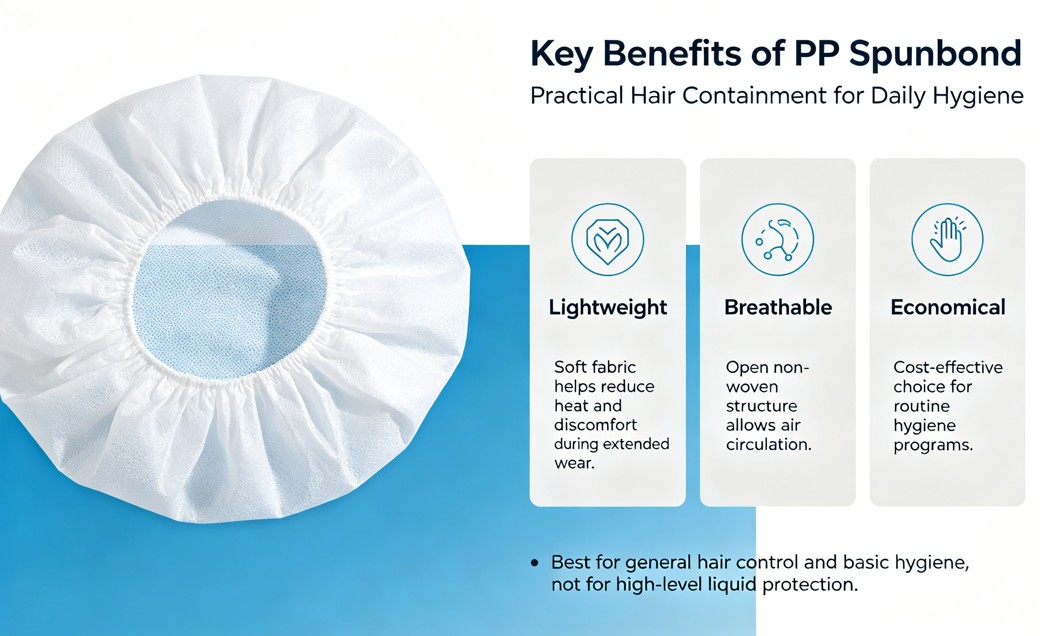
It is lightweight, economical and breathable, making it suitable for routine hygiene and hair-containment applications. The fabric is formed from thermoplastic polypropylene filaments bonded into a non-woven structure.
Typical applications include:
- General healthcare areas
- Food processing
- Packaging
- Electronics assembly
- General manufacturing
- Clean Work Areas: Facilities use these caps in clean work areas when workers need basic hair containment.
PP spunbond is often a practical choice when the main objective is hair containment and general hygiene rather than high-level liquid protection.
SMS Disposable Hair Caps
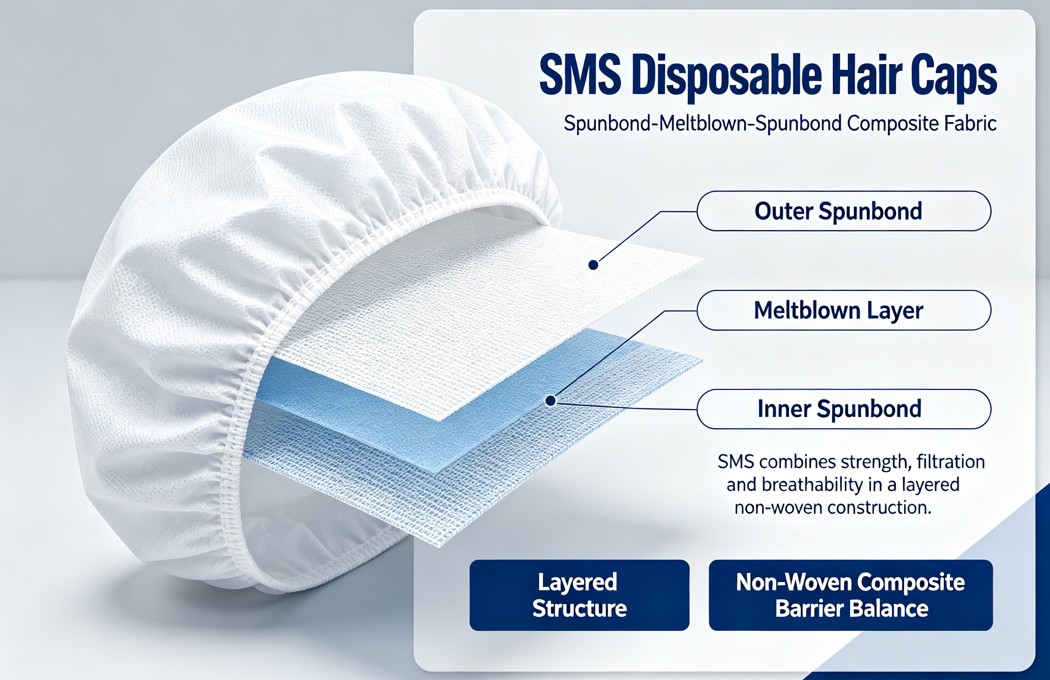
SMS stands for Spunbond-Meltblown-Spunbond. The material combines spunbond layers with a meltblown layer.
Compared with basic spunbond construction, SMS can provide a different balance of fluid resistance, filtration and breathability. However, actual performance depends on fabric weight, layer construction, product design and test results.
SMS may be considered for healthcare or industrial applications where additional barrier performance is required.
Importantly, buyers should not assume that every SMS product provides the same level of protection. Product specifications and applicable performance standards should be reviewed before procurement.
Spunlace Disposable Hair Caps
Spunlace is a non-woven material produced by entangling fibers with high-pressure water jets. It is known for a softer, more textile-like hand feel.
Spunlace can be useful when user comfort is a major consideration, particularly in applications involving long working hours.
Typical considerations include:
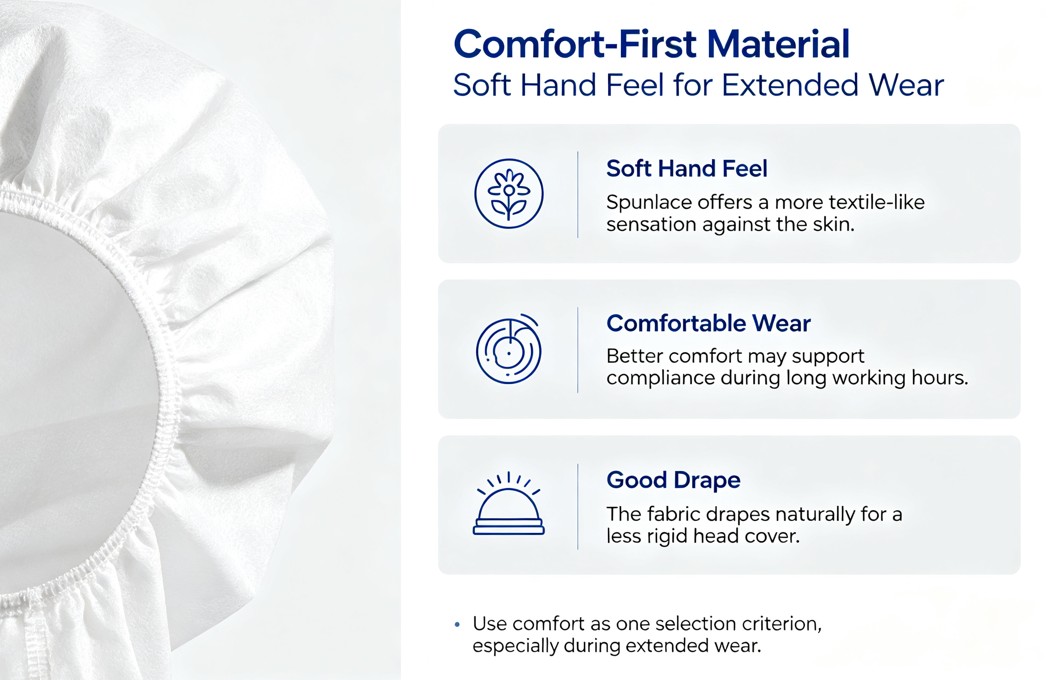
- Soft hand feel
- Comfortable wear
- Good drape
- Fabric-Like Texture: These caps suit applications where workers prefer a softer, more fabric-like texture.
For medical or controlled environments, buyers should also consider lint performance and the complete product specification instead of selecting material solely on softness.
Microporous Laminated Materials
Some full-coverage protective hoods use a spunbond base laminated with a microporous film.
This construction can provide a stronger barrier against liquids and particulates than basic spunbond material, depending on the film and the product’s test performance.
These products are generally more suitable for applications where contamination or fluid resistance is more important than maximum breathability.
They should be selected according to the actual exposure scenario and relevant product performance data rather than by material name alone.
Nylon Hairnets
Nylon hairnets use an open mesh structure that allows substantial airflow while physically restraining hair.
They can be suitable for low-risk hair-control applications, but their open structure should not be treated as equivalent to a solid non-woven barrier. Where particulate or fluid barrier performance is required, a non-woven cap or hood may be more appropriate.
Main Types of Disposable Hair Caps
Different disposable head covers are designed to meet different requirements for hair volume, coverage, fit and workplace conditions.
1. Disposable Bouffant Caps
Bouffant caps use a circular or gathered structure with an elastic opening around the perimeter.
Their relatively spacious design makes them suitable for workers with different hair lengths and volumes. They are also simple to put on and remove, which is useful in high-volume workplaces where employees may need to change head covers frequently.
Common applications include:
- Hospitals and clinics
- Food production
- Pharmaceutical manufacturing
- Packaging
- Electronics
- General manufacturing
The main advantages are spacious coverage, simple donning and broad compatibility with routine hygiene procedures.
2. Clip Caps or Mob Caps
Clip caps, also called mob caps, use a pleated structure that folds into a compact strip for storage and packaging.
When opened, the pleats expand to form the head covering.
Their compact folded format can be advantageous for:
- High-volume distribution
- Space-efficient storage
- Bulk packaging
- Routine manufacturing operations
- Food processing facilities
The choice between a bouffant cap and clip cap is often less about barrier performance and more about cap structure, storage efficiency, user preference and procurement requirements.
3. Surgical Caps
Surgical caps are designed around the needs of clinical environments and may use elastic, ties or other fastening methods depending on the product design.
A surgical cap should be selected based on:
- Coverage requirements
- Hair containment
- Fit and adjustability
- Material properties
- Expected fluid exposure
- Clinical protocol
Healthcare PPE selection should be based on risk assessment and the type of patient interaction or exposure anticipated. CDC guidance similarly emphasizes selecting PPE according to the anticipated exposure and mode of transmission rather than using one universal PPE configuration for every situation.
4. Full-Coverage Protective Hoods
Some applications require substantially more coverage than a conventional hair cap can provide.
Full-coverage hoods may extend beyond the scalp to cover areas such as the neck, ears and shoulders, depending on design.
RuiChen offers several hood-style disposable head protection options for buyers looking for more extensive coverage:
Disposable Ninja-Style Non-Woven Full Head Protective Hood
White Disposable Elastic Protective Hood with Face Mask
Disposable PP Non-Woven Hood Style Face Mask
These products should be evaluated according to the required coverage, material construction and intended operating environment.
For a broader range of disposable head protection products, see the Disposable Head Covers category.
Disposable Hair Cap Types Compared
| Hair Cap Type | Typical Material | Main Benefit | Common Applications |
|---|---|---|---|
| Bouffant Cap | PP Spunbond | Spacious fit and easy use | Healthcare, food processing, packaging |
| Clip / Mob Cap | PP Spunbond | Compact folded design | General manufacturing, food processing |
| Surgical Cap | PP, SMS, spunlace or other non-woven materials | Designed for clinical hair containment | Hospitals, clinics, procedure areas |
| Full-Coverage Hood | PP, SMS, microporous laminate or similar materials | Greater head and neck coverage | Controlled environments, industrial protection |
| Nylon Hairnet | Nylon mesh | High airflow and hair restraint | Low-risk food and service applications |
Material and product performance vary by manufacturer and specification, so this table should be used as a product-selection framework rather than as a substitute for technical documentation.
How to Choose Disposable Hair Caps for Different Industries
The best disposable hair cap depends on what the facility is trying to control.
Healthcare and Medical Applications
Healthcare facilities use risk-based infection prevention practices. CDC guidance states that PPE selection should be based on the anticipated exposure and the nature of the patient interaction.
For healthcare applications, buyers should evaluate:
- Hair containment
- Required coverage
- Breathability
- Fit and comfort
- Fluid exposure
- Lint considerations
- Facility infection-control procedures
- Applicable product requirements in the destination market
Standard PP caps may be sufficient for routine hair containment in some areas, while more protective hood-style designs may be appropriate for applications requiring greater coverage.
WHO likewise treats PPE as part of a broader infection prevention and control system and provides guidance on PPE use and selection in healthcare environments.
Food Processing Applications
Food processing facilities place particular importance on effective hair restraint because loose hair can contaminate exposed food, equipment or food-contact items.
The FDA Food Code 2022 states that food employees should wear effective hair restraints such as hats, hair coverings or nets to keep hair from contacting exposed food, clean equipment, utensils, linens and unwrapped single-use items, subject to the conditions and exceptions in the code.
When selecting disposable caps for food processing, procurement teams commonly evaluate:
- Secure hair containment
- Comfortable fit
- Cap size
- Easy donning and removal
- Visibility and workplace color-coding practices
- Packaging and dispensing
- Material consistency
- Compatibility with plant hygiene procedures
Blue disposable hair caps are widely used in food-processing environments because the color provides strong visual contrast against many food products. However, blue should be treated as a common industry practice rather than a universal FDA requirement. Facilities should follow their own HACCP, food safety and site-specific hygiene procedures.
Some high-risk processing lines may also specify metal-detectable or detectable hair restraints. These are specialized products and should be purchased according to the requirements of the specific production line and detection system.
Pharmaceutical and Cleanroom Applications
Controlled environments often place greater emphasis on contamination control than general workplaces.
When selecting a head cover for a cleanroom or pharmaceutical environment, buyers should consider:
- Particle shedding
- Coverage
- Material construction
- Packaging
- Garmenting procedures
- Cleanroom classification
- Compatibility with other protective garments
A standard disposable bouffant cap may be suitable for some controlled areas, while higher-coverage hood designs may be used where the facility requires more extensive containment.
A product should not be labeled “cleanroom suitable” solely because it is made from non-woven fabric. Suitability should be supported by the manufacturer’s specifications and the requirements of the facility.
General Manufacturing and Industrial Applications
Industrial workplaces can have very different requirements depending on the process.
For general assembly or packaging, a lightweight PP disposable cap may provide practical hair containment and employee comfort.
For processes involving liquids, chemicals, dust or contamination-sensitive products, the selection process should account for the identified hazard and the desired level of barrier protection.
OSHA’s PPE framework emphasizes workplace hazard assessment, selection of appropriate PPE and proper fit and training.
This means procurement teams should start with the operating environment rather than selecting a cap solely because it has a particular material name.
Key Factors to Consider Before Purchasing Disposable Hair Caps
1. Material
Select the material according to the actual application.
PP spunbond is commonly used for lightweight, breathable hair containment. SMS or laminated structures may be considered where additional barrier characteristics are needed. Spunlace may be preferred when a softer hand feel is important.
2. Cap Structure
The structure affects both containment and user experience.
Bouffant caps provide relatively generous internal space. Clip caps offer compact folded storage. Tie-on or adjustable designs can provide a more customized fit. Full-coverage hoods provide substantially greater coverage.
3. Size
A cap that is too small may create discomfort and encourage improper adjustment. A cap that is too large may slip during work.
For procurement, available size options should match the workforce and expected hair volume rather than relying on a single universal size assumption.
4. Elastic Tension and Fit
The elastic should provide enough tension to keep the cap in place without creating unnecessary pressure.
Buyers should assess:
- Stretch range
- Recovery
- Edge construction
- Fit around the forehead
- Compatibility with long-duration wear
5. Breathability
Breathability becomes increasingly important for workers wearing head covers throughout long shifts or in warm production areas.
However, greater barrier protection and greater breathability can involve different design priorities. Procurement teams should therefore consider the required protection level and employee comfort together.
6. Manufacturing Consistency
For large-volume orders, consistency can be as important as the material itself.
Quality control should cover:
- Fabric weight consistency
- Cap dimensions
- Elastic performance
- Weld or seam quality
- Appearance
- Packaging
- Batch traceability
- Contamination control during production
Manufacturing methods such as ultrasonic welding are commonly used for disposable non-woven products because thermoplastic materials can be joined without traditional stitched seams in many product designs. The exact joining process should be evaluated against the product construction and quality requirements.
7. Packaging and Dispensing
Packaging affects warehouse efficiency, shipping cost and hygiene.
Procurement teams should evaluate whether caps are supplied:
- In bulk bags
- In dispenser boxes
- In individually packed units
- In customized OEM packaging
For high-consumption facilities, easy dispensing can help reduce unnecessary handling of unused products.
What Does GSM Mean for Disposable Hair Caps?
GSM means grams per square meter and is a measurement of fabric basis weight.
For non-woven disposable caps, GSM can help buyers compare different fabric constructions. In general, increasing basis weight means more material is used per unit area, but GSM should not be treated as a direct measure of protection, thickness or durability.
For example, a higher-GSM fabric may provide greater material mass, but actual performance also depends on fiber structure, bonding technology, laminate construction and product design.
For procurement purposes, GSM should therefore be evaluated together with:
- Material type
- Fabric construction
- Cap structure
- Barrier test data
- Comfort requirements
- Intended application
This creates a more accurate basis for comparing products than GSM alone.
Quality Control When Buying Disposable Hair Caps in Bulk
Large-volume buyers should evaluate both the product and the supplier’s quality-control process.
A reliable disposable hair cap supplier should be able to provide clear information about the product’s:
- Material composition
- Fabric weight
- Dimensions
- Color options
- Elastic construction
- Packaging
- Production consistency
- Available certifications or quality documentation
- OEM and customization capabilities
For healthcare-related purchases, it is also important to distinguish between a manufacturer’s quality management certification and the regulatory classification or performance requirements of the product itself.
For example, ISO 13485 is a quality management system standard for organizations involved in the design and manufacture of medical devices. It is not, by itself, a specification that guarantees a disposable hair cap has a particular barrier performance.
This distinction is important when evaluating supplier documentation.
How to Select the Right Disposable Hair Cap
A simple selection process can help procurement teams avoid buying a product that does not match the working environment.
Step 1: Identify the contamination or exposure concern.
Determine whether the main objective is hair containment, general hygiene, particulate control, fluid resistance or broader head and neck coverage.
Step 2: Determine the required coverage.
Choose between a basic hairnet, bouffant cap, clip cap, surgical cap or full-coverage hood.
Step 3: Select an appropriate material.
Compare PP, SMS, spunlace or laminated constructions based on the required performance and comfort.
Step 4: Confirm size and fit.
Consider hair volume, wearing time and employee comfort.
Step 5: Review supplier specifications.
Check GSM, dimensions, elastic properties, packaging and relevant test or quality documentation.
Step 6: Order samples before mass production.
For OEM or high-volume purchasing, sample evaluation is an effective way to verify fit, fabric, elastic tension and overall workmanship before committing to a large order.
Why Choose RuiChen for Disposable Head Covers?
Hubei Ruichen Protective Products Co., Ltd. is a manufacturer and supplier of disposable non-woven protective products, including disposable head covers and hood-style head protection.
For buyers sourcing disposable hair caps and related protective headwear, a manufacturer that can provide multiple material and structural options can make it easier to match product configuration to different application requirements.
RuiChen’s disposable head protection range includes conventional non-woven head covers as well as full-coverage hood-style products.
Explore the RuiChen disposable head covers range to compare available head protection options.
For applications requiring greater coverage, buyers can also review:
Disposable Ninja-Style Non-Woven Full Head Protective Hood
White Disposable Elastic Protective Hood with Face Mask
Disposable PP Non-Woven Hood Style Face Mask
OEM requirements can also be evaluated according to material, size, color, elastic construction, packaging and other product specifications.
Conclusion
Understanding the different types of disposable hair caps helps procurement teams make more accurate purchasing decisions across healthcare, food processing, pharmaceutical, cleanroom and industrial environments.
PP spunbond caps are widely used for lightweight hair containment and routine hygiene. Clip or mob caps can offer compact storage and efficient packaging. Surgical caps are selected according to healthcare procedures and facility requirements. Full-coverage hoods provide broader protection when a conventional hair cap is not sufficient.
The most appropriate choice depends on more than material or cap shape. Buyers should consider the application, required coverage, fit, comfort, contamination risk, packaging and supplier quality controls.
For healthcare applications, PPE selection should be linked to the anticipated exposure and infection-control procedures.
For food processing, effective hair restraints are specifically addressed by the FDA Food Code.
For industrial applications, workplace hazard assessment should guide PPE selection.
By matching the right disposable hair cap type to the actual operating environment, facilities can improve hygiene control, employee comfort and purchasing efficiency.
FAQ
What are the main types of disposable hair caps?
The main types include bouffant caps, clip or mob caps, surgical caps, full-coverage hoods and nylon hairnets. Each design provides a different balance of coverage, fit, comfort and hair containment.
What is the difference between a bouffant cap and a clip cap?
A bouffant cap uses a gathered circular structure with an elastic opening and generally provides more internal space. A clip cap uses pleats that fold into a compact strip, which can improve storage and packaging efficiency.
Which material is best for disposable hair caps?
There is no single best material for every application. PP spunbond is commonly used for lightweight hair containment, while SMS, spunlace or laminated materials may be selected when different barrier or comfort characteristics are required.
Are blue disposable hair caps required in food processing?
Blue is widely used in food-processing environments because it provides strong visual contrast and can make dropped foreign materials easier to identify. However, blue should not be treated as a universal regulatory requirement. Facilities should follow their own food-safety and hygiene procedures.
What does GSM mean on a disposable hair cap?
GSM means grams per square meter and indicates the basis weight of the non-woven fabric. A higher GSM does not automatically mean better protection. Material construction, product design and application requirements must also be considered.
How should I choose a disposable hair cap supplier?
Compare the supplier’s material options, product dimensions, fabric weight, elastic performance, quality-control process, packaging, certifications or supporting documentation, OEM capability and ability to provide samples before bulk production.