
Blog
What Is a Disposable Bouffant Cap? Definition, Materials & Uses

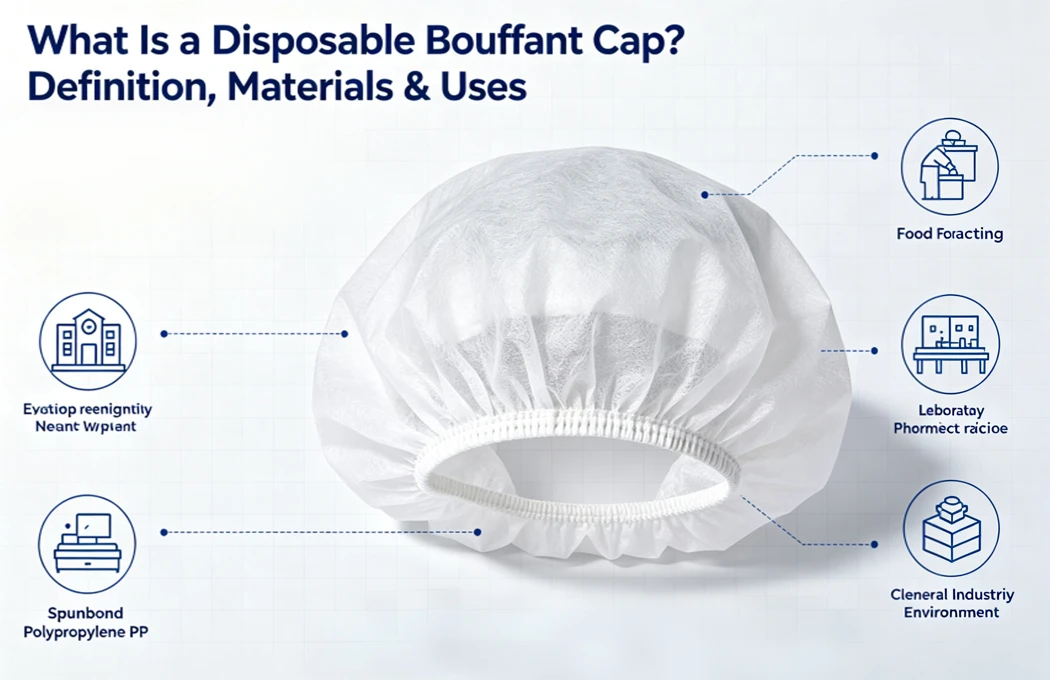
A disposable bouffant cap is a lightweight, loose-fitting head cover designed to contain hair and support hygiene and contamination-control practices in workplaces where loose hair or particles may be undesirable.
Made primarily from non-woven materials such as spunbond polypropylene (PP), disposable bouffant caps are widely used in healthcare facilities, food processing plants, laboratories, pharmaceutical manufacturing, clean production areas and general industrial environments.
Unlike reusable fabric headwear, disposable bouffant caps are intended for short-term use and convenient replacement. Their lightweight construction, elastic edge and expandable shape allow them to accommodate different hair lengths while maintaining a comfortable fit.
For procurement teams, distributors and facility managers, understanding the material, size, construction and intended application of a disposable bouffant cap is essential when selecting the right head protection product.
What Is a Bouffant Cap?
A bouffant cap is a disposable, expandable head cover with a loose and rounded shape. The word “bouffant” refers to its full or puffy appearance.
Most bouffant caps are manufactured with pleated non-woven fabric and an elastic edge. Before use, the cap is compressed into a compact strip or folded shape. When opened, it expands to provide enough interior space to contain the wearer’s hair.
The primary purpose of a bouffant cap is hair containment.
It helps reduce the possibility of loose hair entering controlled environments, work areas, production lines or sensitive processes.
Disposable bouffant caps are also commonly referred to as:
- Disposable hair caps
- Disposable hair covers
- Non-woven bouffant caps
- PP bouffant caps
- Disposable head covers
- Mop caps
- Mob caps
Terminology may vary depending on the region, industry and purchasing market.
How Does a Disposable Bouffant Cap Work?
The design of a disposable bouffant cap is simple but effective.
The non-woven material forms a lightweight cover around the hair, while the elastic edge keeps the cap positioned around the head.
The expandable structure allows the cap to accommodate:
- Short hair
- Long hair
- Thick hair
- Curly hair
- Tied or bundled hair
By containing hair within the cap, the product supports workplace hygiene and contamination-control procedures.
However, the actual level of protection depends on the material, fabric weight, construction and intended application. Standard disposable bouffant caps should not automatically be considered sterile or designed for protection against hazardous substances unless specifically tested and certified for those purposes.
What Materials Are Disposable Bouffant Caps Made From?
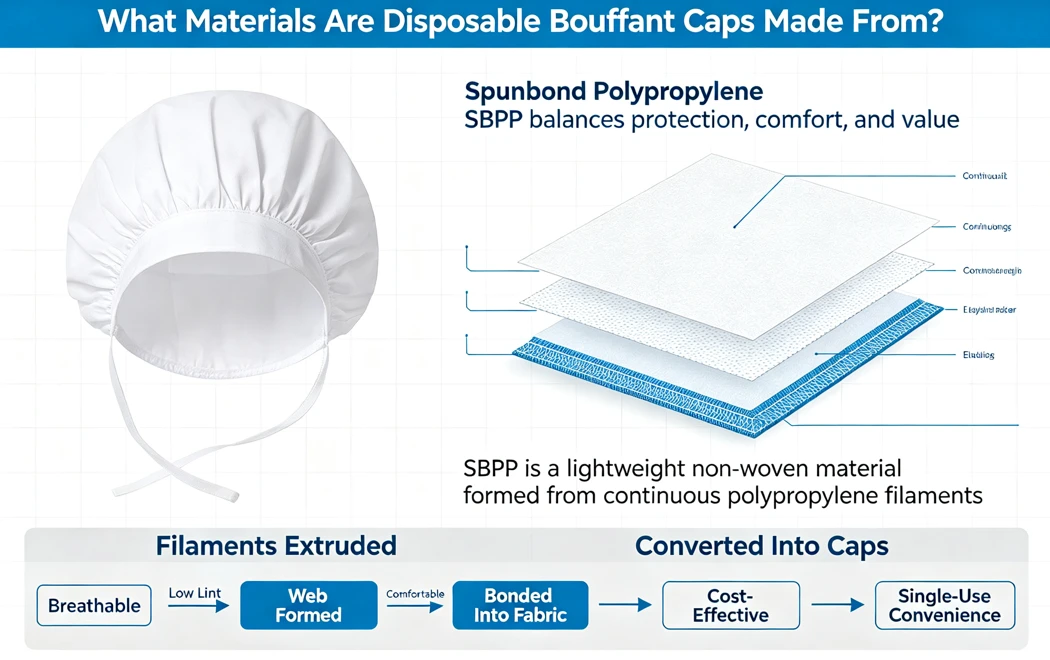
The most common material used for disposable bouffant caps is spunbond polypropylene.
Spunbond Polypropylene (SBPP)
Spunbond polypropylene is a lightweight non-woven material commonly used in disposable protective products.
Its main advantages include:
- Lightweight construction
- Good breathability
- Comfortable wear
- Low lint generation
- Cost-effective production
- Easy disposal after use
The material is formed from continuous polypropylene filaments that are bonded together to create a non-woven fabric.
Because it does not require traditional weaving or knitting, spunbond polypropylene can be efficiently manufactured for high-volume disposable PPE production.
Typical Fabric Weight
Disposable bouffant caps are commonly produced in lightweight GSM ranges.
Typical options include:
| Fabric Weight | Typical Characteristics |
|---|---|
| 10 GSM | Lightweight and economical for general use |
| 12 GSM | Improved durability and coverage |
| 14 GSM | Higher material strength for demanding applications |
| OEM Options | Customized according to application requirements |
The appropriate GSM should be selected based on comfort, durability, cost and workplace requirements.
Why Are Non-Woven Bouffant Caps Widely Used?
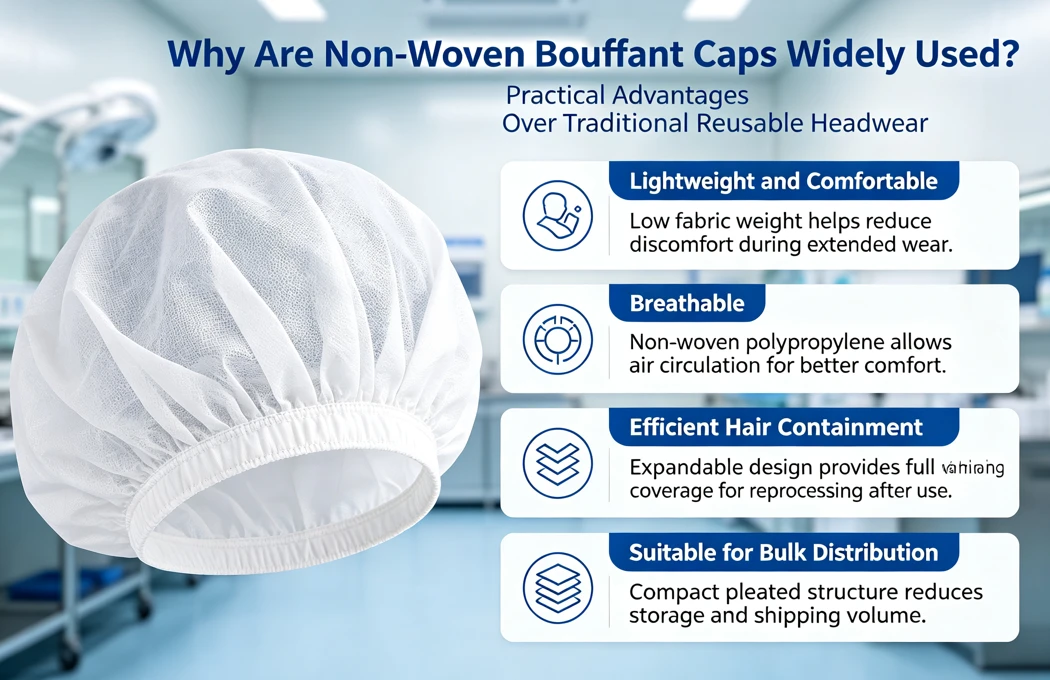
A non-woven bouffant cap offers several practical advantages compared with traditional reusable headwear.
Lightweight and Comfortable
The low fabric weight helps reduce discomfort during extended working periods.
Breathable
Non-woven polypropylene allows air circulation, helping improve wearer comfort in indoor production and work environments.
Efficient Hair Containment
The expandable design provides full coverage for different hair volumes.
Convenient for Single Use
Disposable caps eliminate the need for washing and reprocessing after use.
Suitable for Bulk Distribution
The compact pleated structure reduces storage and shipping volume, making bouffant caps suitable for large-scale distribution and procurement.
Main Uses of Disposable Bouffant Caps
Disposable bouffant caps are used across a wide range of industries where hair containment and workplace hygiene are important.
Healthcare and Medical Facilities
Hospitals, clinics and healthcare facilities may use disposable head covers as part of their hygiene and protective clothing procedures.
Typical applications include:
- General patient care areas
- Examination rooms
- Medical processing areas
- Visitor protection programs
- Controlled healthcare environments
Specific requirements vary depending on the facility and procedure. For healthcare environments with specific product requirements, medical hair caps may be selected according to the intended application and facility hygiene procedures.
Food Processing and Food Manufacturing
Hair containment is essential in food production environments.
Disposable bouffant caps are commonly used by employees working in:
- Food processing plants
- Commercial kitchens
- Bakeries
- Meat processing facilities
- Beverage production lines
- Food packaging areas
Different cap colors may also be used to support personnel identification or workplace management systems.
Pharmaceutical Manufacturing
Pharmaceutical production environments often require controlled hygiene procedures.
Disposable head covers may be used alongside other protective clothing to help manage hair and particle shedding during manufacturing and packaging processes.
Laboratories
Laboratory personnel may wear disposable bouffant caps when working in environments where sample protection or contamination control is required.
Electronics and Clean Manufacturing
Sensitive manufacturing processes may require workers to control hair and particle shedding.
Depending on the cleanliness classification of the environment, specialized head covers and complete cleanroom garments may be required.
General Industrial Applications
Disposable bouffant caps are also used in:
- Manufacturing plants
- Cleaning services
- Painting preparation areas
- Maintenance operations
- Visitor management programs
Bouffant Cap vs. Hairnet: What Is the Difference?
Bouffant caps and hairnets both help contain hair, but their construction and applications are different.
| Feature | Bouffant Cap | Hairnet |
|---|---|---|
| Material | Non-woven fabric | Mesh or net material |
| Coverage | Full hair coverage | Primarily hair restraint |
| Structure | Expandable and pleated | Open mesh structure |
| Comfort | Lightweight and loose-fitting | Lightweight and close-fitting |
| Common Uses | Medical, food, laboratory and industrial environments | Food service and general hair restraint |
A hairnet is primarily designed to hold hair in place.
A disposable bouffant cap provides broader coverage because the hair is contained inside a non-woven material structure.
The correct choice depends on workplace hygiene requirements and operational conditions.
Common Bouffant Cap Sizes
Disposable bouffant caps are commonly available in several diameters.
Typical sizes include:
| Size | Suitable For |
|---|---|
| 18 inch | Short or low-volume hair |
| 19 inch | General use |
| 21 inch | Common universal size |
| 24 inch | Long or thick hair |
Larger caps provide additional space for users with longer or thicker hairstyles.
For B2B procurement, manufacturers may also provide customized sizes according to customer requirements.
Single Elastic vs. Double Elastic Bouffant Caps
The elastic edge plays an important role in fit and comfort.
Single Elastic Bouffant Cap
Single-elastic caps are commonly used for standard applications.
Advantages include:
- Lightweight design
- Economical cost
- Comfortable fit
- Suitable for general workplace use
Double Elastic Bouffant Cap
Double-elastic designs provide additional elasticity around the edge.
They may offer:
- More secure positioning
- Improved fit
- Better stability during active work
The choice depends on the working environment and customer requirements.
Key Specifications to Consider When Buying Disposable Bouffant Caps
When sourcing disposable bouffant caps from a manufacturer or supplier, buyers should evaluate more than just price.
1. Material
Confirm whether the cap is made from:
- PP spunbond non-woven fabric
- Other customized non-woven materials
Material selection affects comfort, breathability and durability.
2. Fabric Weight
Common options include 10 GSM, 12 GSM and 14 GSM.
Higher fabric weight may provide improved material strength, but it can also affect cost and breathability.
3. Cap Size
Choose the appropriate diameter based on the expected users and hair volume requirements.
Common sizes include:
- 18 inch
- 19 inch
- 21 inch
- 24 inch
4. Elastic Type
Buyers should confirm:
- Single elastic or double elastic
- Latex-free options
- Elastic recovery performance
- Fit requirements
5. Color
Common colors include:
- Blue
- White
- Green
- Yellow
- Pink
Custom colors may also be available for large-volume orders.
6. Packaging
Packaging options can include:
- Bulk bags
- Cartons
- Individual packaging
- Customized retail packaging
- Private-label packaging
Typical Disposable Bouffant Cap Specifications
| Specification | Common Options |
|---|---|
| Product Type | Disposable Bouffant Cap |
| Material | PP Spunbond Non-Woven Fabric |
| Fabric Weight | 10–14 GSM or OEM |
| Sizes | 18″, 19″, 21″, 24″ or OEM |
| Colors | Blue, White, Green and OEM |
| Elastic | Single or Double Elastic |
| Usage | Single Use |
| Packaging | Bulk or Customized |
| OEM/ODM | Available from Qualified Manufacturers |
Actual specifications may vary depending on customer requirements and intended applications.
Manufacturing and Quality Control
The quality of a disposable bouffant cap depends on material consistency, elastic performance and production control.
Professional manufacturers typically monitor several key factors during production.
Material Inspection
Incoming non-woven materials should be checked for:
- Fabric consistency
- Weight variation
- Surface defects
- Material strength
Elastic Performance
The elastic edge should provide sufficient stretch and recovery without excessive tightness.
Poor-quality elastic may affect wearer comfort or cause the cap to lose its position during use.
Size Consistency
Manufacturers should maintain consistent dimensions and expansion performance across production batches.
Packaging Inspection
Finished products should be checked before shipment to ensure:
- Correct quantities
- Clean packaging
- Proper labeling
- Consistent product appearance
For international procurement, buyers may also request relevant quality management documentation and product specifications from the manufacturer.
How to Choose the Right Disposable Bouffant Cap for Your Application
The best bouffant cap depends on the working environment.
For Food Processing
Focus on:
- Reliable hair containment
- Comfortable wear
- Lightweight material
- High-visibility colors
- Cost efficiency for high-volume use
For Healthcare Facilities
Consider:
- Material quality
- Comfortable fit
- Appropriate coverage
- Latex-free options where required
- Compatibility with facility hygiene procedures
For Laboratories
Consider:
- Low-lint materials
- Comfortable extended wear
- Compatibility with other protective equipment
For Industrial Applications
Focus on:
- Cost efficiency
- Bulk packaging
- Size availability
- Color management
- Reliable supply capacity
For buyers comparing different disposable head protection options, the caps and hairnets range can be evaluated according to material, size, application and procurement requirements.
Disposable Bouffant Cap Manufacturer and Supplier
When sourcing disposable head protection products, working directly with an experienced manufacturer can help buyers maintain more consistent product specifications and supply.
Hubei Ruichen Protective Products Co., Ltd. is a manufacturer and supplier of disposable non-woven protective products.
For bulk procurement and OEM projects, buyers can evaluate material specifications, sizes, colors, packaging and customization options based on their specific market requirements.
Working with a qualified disposable PPE manufacturer can also simplify supplier management when multiple non-woven protective products are required.
Conclusion
A disposable bouffant cap is a lightweight non-woven head cover primarily designed for hair containment and hygiene management in controlled work environments.
Its expandable structure, elastic edge and disposable design make it widely used across healthcare, food processing, laboratories, pharmaceutical manufacturing and industrial facilities.
When selecting a disposable bouffant cap, buyers should evaluate the material, fabric weight, size, elastic design, color and packaging requirements.
For large-volume procurement, choosing a reliable manufacturer with stable production capacity and customization capabilities can help ensure consistent product quality and long-term supply.
FAQ
1. What is a disposable bouffant cap?
A disposable bouffant cap is a lightweight, expandable head cover designed to contain hair and support hygiene and contamination-control practices. It is commonly made from PP spunbond non-woven fabric and features an elastic edge.
2. Why is it called a bouffant cap?
The term “bouffant” refers to the cap’s full and rounded shape. When expanded, the pleated material creates enough interior space to accommodate different hair volumes.
3. What is the difference between a hairnet and a bouffant cap?
A hairnet typically uses an open mesh structure to restrain hair. A bouffant cap uses non-woven fabric to provide broader hair coverage and containment.
4. What material is used for disposable bouffant caps?
Most disposable bouffant caps are made from spunbond polypropylene (PP), a lightweight non-woven material known for breathability and cost-efficient production.
5. What sizes are available for bouffant caps?
Common sizes include 18 inch, 19 inch, 21 inch and 24 inch. Larger sizes are generally more suitable for long or thick hair.
6. Are disposable bouffant caps suitable for food processing?
Yes. Disposable bouffant caps are commonly used in food processing and manufacturing environments where hair containment is part of workplace hygiene procedures.
7. Can bouffant caps be customized?
Yes. Depending on the manufacturer, disposable bouffant caps can often be customized by material weight, size, color, elastic design, packaging and private labeling.
8. How long can a disposable bouffant cap be worn?
Usage time depends on workplace procedures and the condition of the cap. Disposable caps should be replaced if they become damaged, visibly soiled or contaminated according to the facility’s hygiene requirements.
Authoritative References
The following organizations provide guidance and standards relevant to workplace hygiene, protective equipment, food handling and material testing: