

Blog
Medical Grade Face Mask: What Makes a Mask Medical Grade?

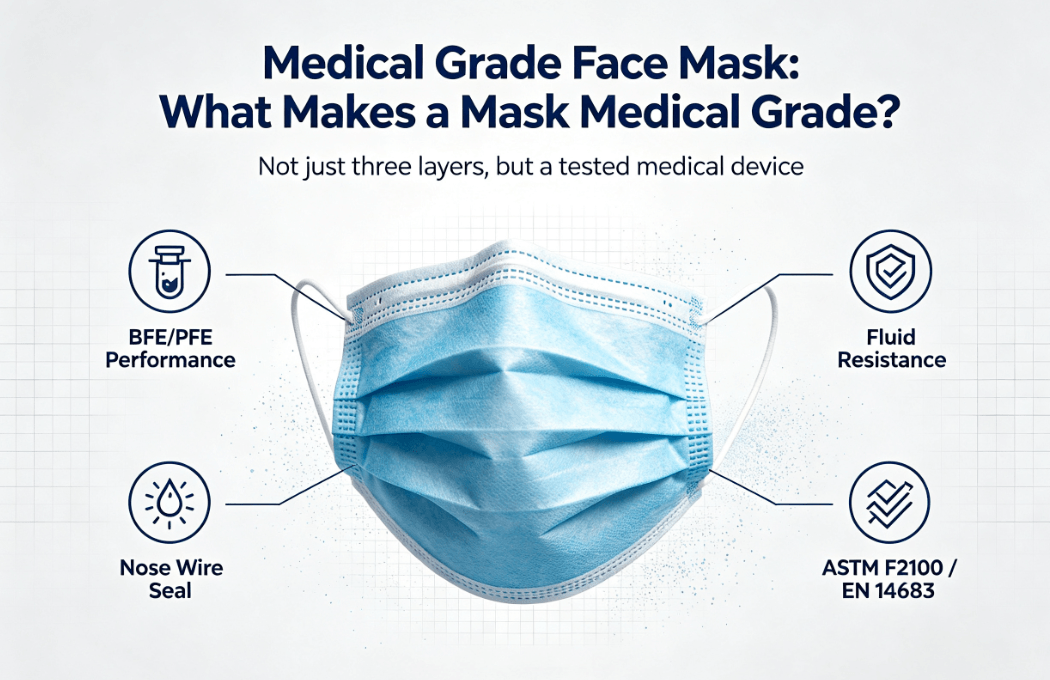
In the global Personal Protective Equipment (PPE) market, the term “medical grade” is frequently used but often misunderstood. For hospital procurement managers, infection control specialists, and industrial safety officers, distinguishing between a standard hygiene mask and a genuine medical grade face mask is critical for ensuring healthcare worker safety and patient protection.
A medical grade mask is not merely a three-layer fabric product; it is a precision-engineered medical device designed to provide a specific level of bacterial filtration and fluid resistance. Whether it is used in a surgical suite or a general clinic, the “medical grade” designation implies that the product has undergone rigorous testing according to international standards such as ASTM F2100 in the United States or EN 14683 in Europe.
The Material Science: The Role of Meltblown Polypropylene
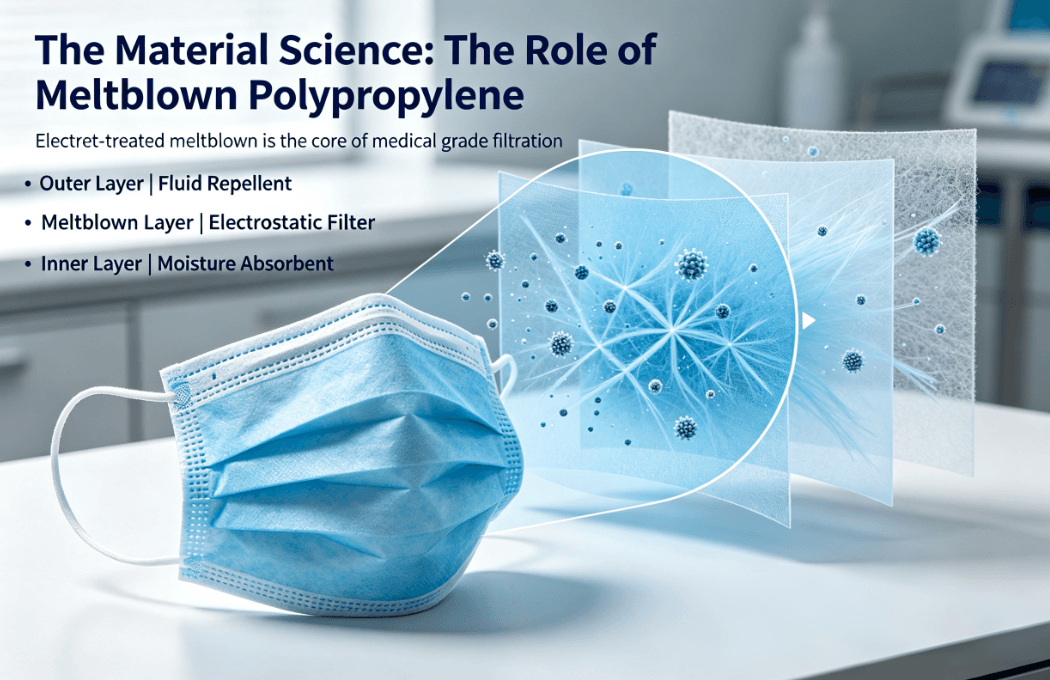
The primary differentiator of a medical grade mask lies in its middle layer. While the inner and outer layers are typically made of Spunbonded Polypropylene (SBPP), the “heart” of the mask is the meltblown nonwoven fabric.
- Outer Layer (Hydrophobic): This layer repels fluids and helps prevent blood or bodily fluid splashes from soaking through the mask.
- Middle Layer (The Filter): This is high-density meltblown polypropylene. Through a process of electrostatic charging (electret treatment), this layer captures microscopic particles and bacteria that are far smaller than the physical gaps between the fibers.
- Inner Layer (Hydrophilic): This layer absorbs moisture from the wearer’s breath, helping maintain comfort and reduce skin irritation during long shifts.
Without a high-quality meltblown layer with a high Bacterial Filtration Efficiency (BFE) rating, a mask cannot technically or legally be classified as medical grade.
Key Technical Metrics for Medical Grade Certification
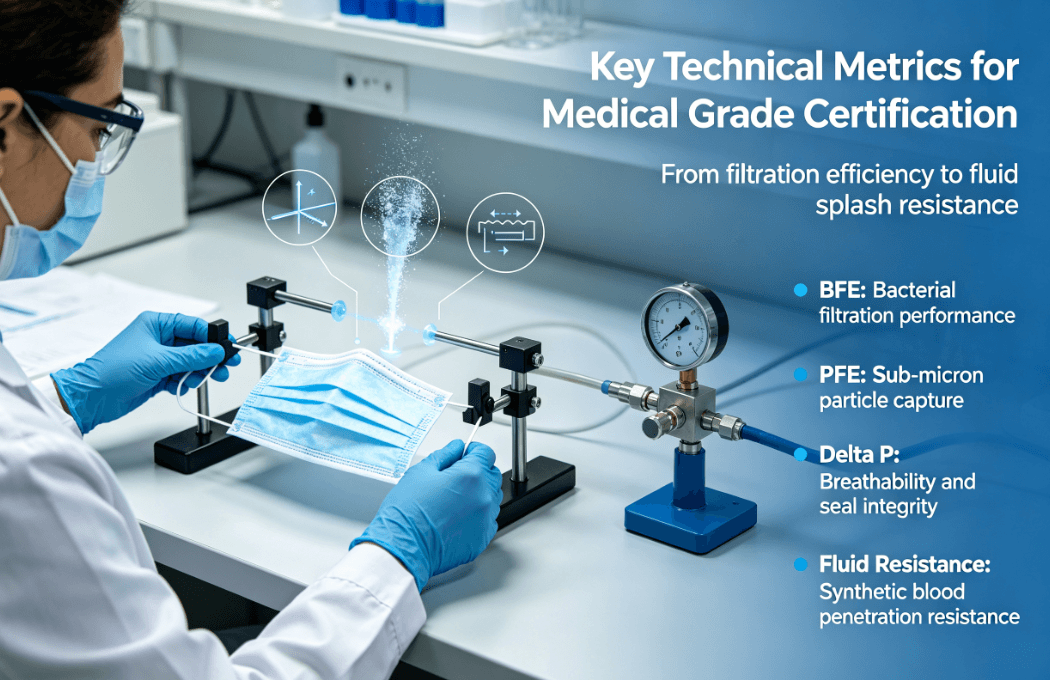
To be classified as a medical grade face mask, a product must meet specific performance thresholds. Manufacturers must submit their products to third-party laboratories to verify these metrics:
- Bacterial Filtration Efficiency (BFE): BFE measures the mask’s ability to filter out bacteria-containing droplets. Medical Grade Requirements: Medical-grade masks typically need to achieve a BFE of ≥95% for Level 1 or ≥98% for Levels 2 and 3.
- Particulate Filtration Efficiency (PFE): PFE measures the filtration of sub-micron particles, typically sized at 0.1 microns. This is a critical metric for protecting against viral particles and fine aerosols.
- Differential Pressure (Delta P): This measures breathability. A mask with high filtration but poor breathability will cause “leakage” as air escapes through the sides rather than passing through the filter.
- Fluid Resistance (Synthetic Blood Penetration): This is the most significant difference between a “procedure mask” and a “surgical mask,” testing the ability to resist pressurized fluid splashes.
Comparing International Standards: ASTM vs. EN 14683
Professional buyers must understand the two primary regulatory frameworks used to define medical grade masks.
| Feature | ASTM F2100 (USA) | EN 14683 (Europe) |
|---|---|---|
| Classification | Level 1, 2, or 3 | Type I, II, or IIR |
| BFE Requirements | Level 1 (≥95%), Level 2/3 (≥98%) | Type I (≥95%), Type II/IIR (≥98%) |
| Fluid Resistance | 80, 120, or 160 mmHg | Type I/II (None), Type IIR (120 mmHg) |
| PFE (0.1 micron) | Required (≥95% to ≥98%) | Not Required by Standard |
Sterile vs. Non-Sterile Medical Masks
In procurement, you will often encounter the choice between a standard medical mask and a sterile face mask.
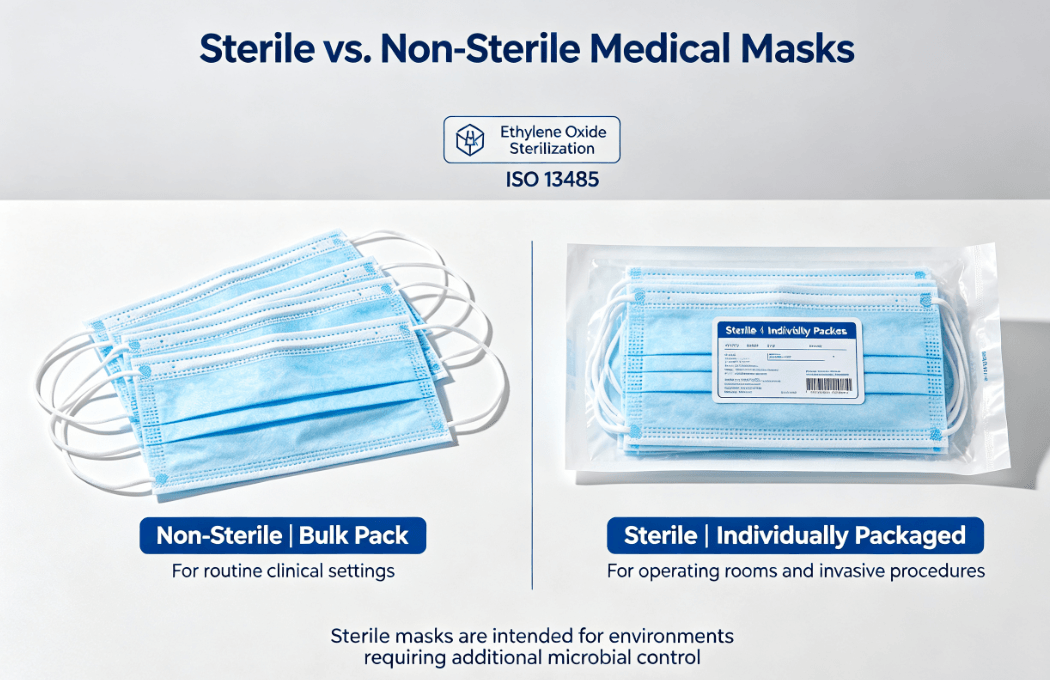
- Non-Sterile Medical Masks: These are the standard for most clinical environments, including outpatient clinics, dental offices, and general wards.
- Sterile Face Masks: Healthcare facilities use these masks in highly sensitive environments, such as operating rooms during invasive surgery. Manufacturers typically sterilize sterile face masks with Ethylene Oxide (EO) gas and package each mask individually.
For Hubei Ruichen, maintaining ISO 13485 certification is crucial; this ensures that both our sterile and non-sterile products meet the rigorous consistency standards required for medical applications.
Application Scenarios: Choosing the Right Protection
Selecting the appropriate mask depends entirely on the risk profile of the environment:
- Low-Risk (Type I / Level 1): Ideal for general visitors, reception staff, or patients in non-respiratory wards.
- Moderate-Risk (Type II / Level 2): These masks suit standard clinical examinations and laboratory work where users expect minimal splashing.
- High-Risk (Type IIR / Level 3): Mandatory for emergency departments, surgical procedures, and any situation involving potential exposure to blood or pressurized fluids.
Exploring Professional Medical Protection Solutions
For organizations looking to source high-specification protective equipment, it is vital to partner with manufacturers who control the entire supply chain. At Hubei Ruichen, we produce our own PE and CPE films and utilize advanced non-woven technology to ensure every mask meets international medical standards.
To learn more about specific product specifications and certifications, explore our specialized categories:
Conclusion
A medical grade face mask is defined by its ability to act as a reliable barrier against pathogens and fluids. By understanding the nuances of BFE, PFE, and fluid resistance—as well as the differences between ASTM and EN standards—healthcare and procurement professionals can make informed decisions that protect both staff and patients. When safety is the priority, the technical data behind the “medical grade” label is the only metric that matters.
FAQ
1. Can a 3-ply mask be non-medical grade?
Yes. Many “civilian” or “hygiene” masks are 3-ply but lack the high-density meltblown filter and the fluid-resistant properties required for medical certification. Always check for ASTM or EN 14683 ratings.
2. What is the difference between a medical mask and a respirator?
A medical mask is designed for source control and protection against droplets and splashes (loose-fitting). A respirator is designed to filter out airborne particles and requires a tight face-to-mask seal.
3. How can I verify if a mask is actually medical grade?
Request a technical data sheet and a third-party test report from recognized labs that confirms the BFE, PFE, and fluid resistance levels according to specific international standards.
4. Does a sterile face mask provide better filtration?
Not necessarily. Sterility refers to the absence of living microorganisms on the mask itself, which is vital for surgical sites. The filtration efficiency is usually identical to a high-quality non-sterile medical mask.
5. Why is breathability (Delta P) important in medical masks?
If a mask is too difficult to breathe through, air will take the path of least resistance through the gaps between the mask and the face, rendering the filter ineffective for protection.
Reference Sources
ASTM International: Standard for Medical Face Mask Materials.