

Blog
What Is a Disposable Medical Mask and When to Use One?

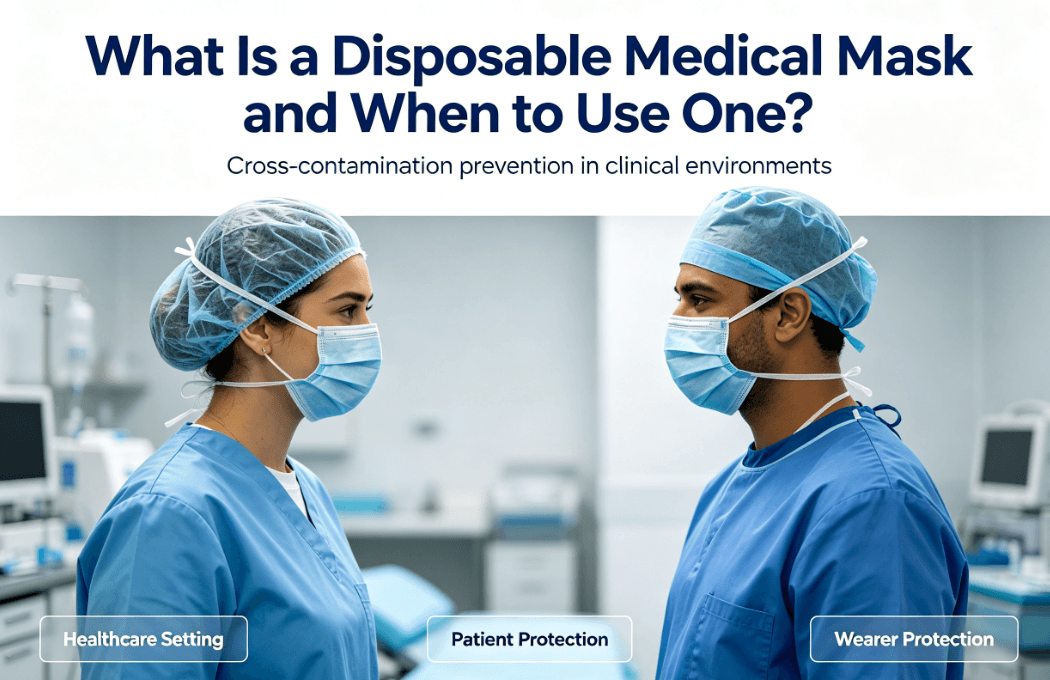
In the hierarchy of Personal Protective Equipment (PPE), the disposable medical mask serves as a primary barrier designed to prevent the cross-contamination of large-particle droplets and microorganisms between healthcare providers and patients. While they have become a staple in public life, their technical engineering and specific application protocols are rooted in rigorous clinical standards.
Understanding the distinction between a standard face mask for single use and a certified medical procedure mask is critical for hospital procurement managers, safety officers, and health-conscious organizations. This guide provides a technical deep-dive into the anatomy, standards, and strategic usage of these essential protective tools.
The Technical Anatomy: More Than Just Fabric
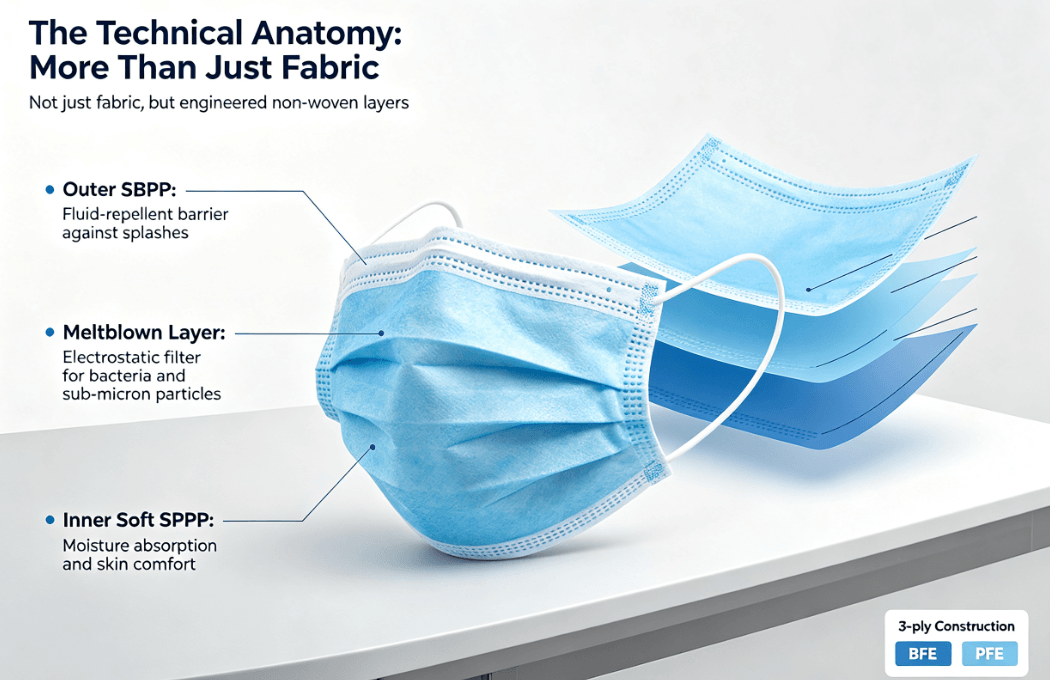
A high-quality disposable medical face mask is not a single layer of cloth; it is a sophisticated, multi-layered non-woven engineered product. Most professional-grade masks utilize a “3-ply” construction, typically consisting of three distinct layers of polypropylene:
- Outer Layer (Spunbond Polypropylene – SBPP): This is the fluid-repellent layer. Blood and Fluid Resistance: The mask resists blood and bodily fluid splashes, helping prevent liquids from soaking through the material.
- Middle Layer (Meltblown Polypropylene): This is the “heart” of the mask. Meltblown fabric acts as an electrostatic filter. It is capable of capturing microscopic bacteria and sub-micron particles through physical entrapment and electrostatic attraction.
- Inner Layer (Soft SBPP): This layer is optimized for comfort and moisture absorption. It absorbs the wearer’s exhaled breath to prevent skin irritation and maintain the integrity of the filter layer.
From a manufacturing perspective, the quality of the meltblown layer determines the Bacterial Filtration Efficiency (BFE) and Particulate Filtration Efficiency (PFE).
Understanding the Standards: Procedure vs. Surgical Masks
In the PPE industry, terminology matters. While many use the terms interchangeably, there are technical nuances between medical procedure masks and surgical masks, primarily defined by how they are secured and their intended environment.
| Performance Requirement | ASTM Level 1 (Low Risk) | ASTM Level 2 (Moderate Risk) | ASTM Level 3 (High Risk) | EN 14683 Type IIR |
|---|---|---|---|---|
| Bacterial Filtration (BFE) | ≥ 95% | ≥ 98% | ≥ 98% | ≥ 98% |
| Fluid Resistance (mmHg) | 80 | 120 | 160 | 120 |
| Differential Pressure (Breathability) | < 5.0 | < 6.0 | < 6.0 | < 5.0 |
| Particulate Filtration (PFE) | ≥ 95% | ≥ 98% | ≥ 98% | Not Required |
For most clinical environments, a medical procedure mask (usually with earloops) is used for “clean” tasks where the risk of heavy fluid spray is minimal. Surgical masks (usually with ties) are preferred in the operating theater where higher fluid resistance and a more customized fit are required.
When Should You Use a Disposable Medical Mask?
The decision to deploy a face mask for single use should be based on a risk assessment of the environment and the task at hand.
Clinical and Healthcare Settings
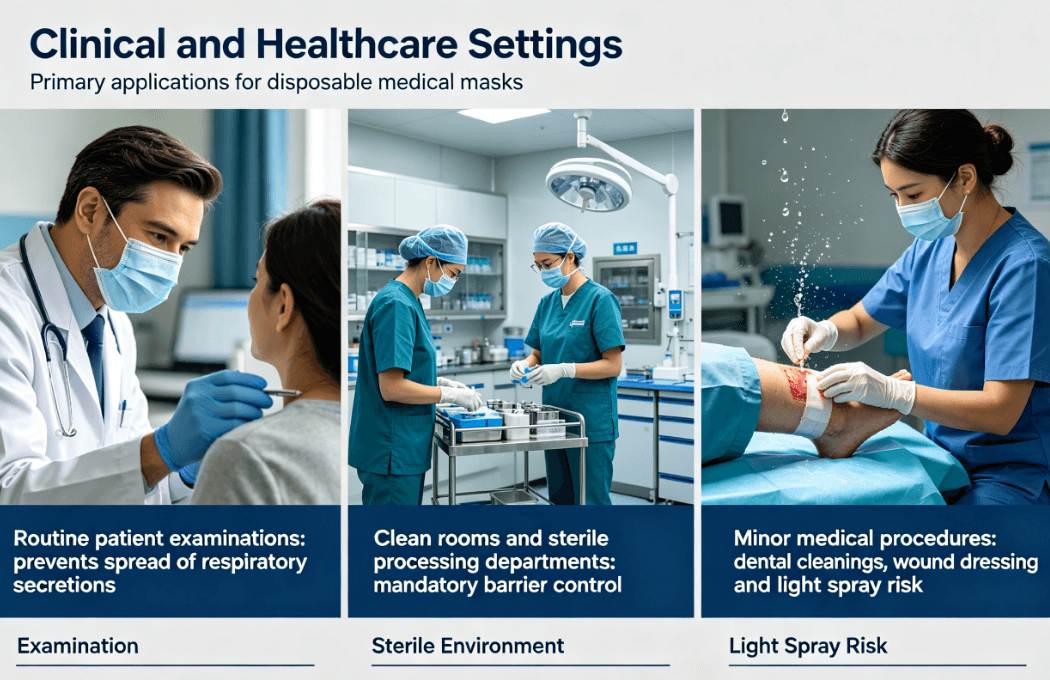
This is the primary application. Medical masks are mandatory when:
- Performing routine patient examinations to prevent the spread of respiratory secretions.
- Working in “clean rooms” or sterile processing departments.
- Engaging in minor medical procedures where there is a risk of light spray (e.g., dental cleanings or wound dressing).
High-Traffic Public Environments
In scenarios involving large crowds or poorly ventilated spaces (airports, public transit, or government buildings), a disposable medical face mask provides a critical layer of “source control.” By trapping droplets at the source (the wearer’s mouth and nose), it significantly reduces the community viral load.
Industrial and Laboratory Protection
In pharmaceutical labs or electronic component manufacturing, masks are used less for biological protection and more for contamination control. They prevent human saliva or skin flakes from compromising sensitive products or chemical reactions.
Home and Caregiving
When caring for an immunocompromised family member or someone with a respiratory infection, using medical-grade protection is superior to cloth alternatives. The high BFE of a professional mask offers a measurable barrier that fabric cannot replicate.
Proper Protocol: Donning, Doffing, and Disposal
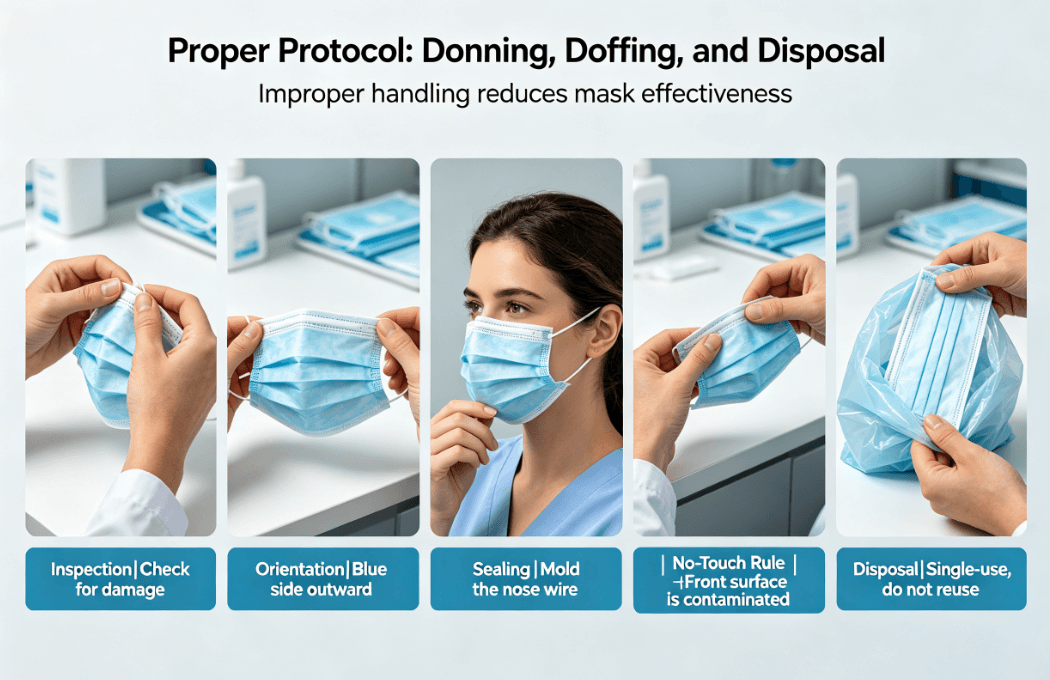
The efficacy of a disposable medical mask is compromised by improper handling. As PPE manufacturers, we emphasize the following technical protocol:
- Inspection: Before use, ensure the mask has no holes or tears. Check that the nose wire is intact.
- Orientation: The colored side (usually blue) almost always faces outward, as it is the fluid-repellent layer. The white side faces the skin.
- The mask resists blood or bodily fluid splashes and helps prevent these liquids from soaking through. This prevents “leakage” where unfiltered air bypasses the meltblown layer.
- The “No-Touch” Rule: Once the mask is on, do not touch the front of it. Inner Layer (Soft SBPP): This layer improves comfort and absorbs moisture.
- Disposal: These are face masks for single use. Sealing: After securing the loops, the wearer should mold the nose wire to the bridge of the nose. Reusing a medical mask collapses the electrostatic charge in the meltblown layer, rendering it ineffective.
Procurement Considerations for Institutional Buyers
For institutional buyers and distributors, selecting a mask is not just about price; it is about the reliability of the supply chain and compliance. Hubei Ruichen Protective Products Co., Ltd has observed that the most resilient procurement strategies focus on manufacturers who control their raw materials.
By producing our own PE and CPE films and specializing in non-woven conversion for over a decade, we ensure that the SBPP and meltblown layers meet the stringent ISO13485 and CE requirements. When evaluating a supplier, always verify:
- Certifications: Are they ISO13485 certified for medical device manufacturing?
- Material Traceability: Can they confirm the origin and grade of the polypropylene used?
- Manufacturing Environment: Is the facility capable of maintaining the hygiene standards required for medical-grade products?
For those looking to explore specific product lines, you can view our technical specifications here:
Conclusion
The disposable medical mask is a cornerstone of modern infection control. Its effectiveness relies on the synergy between high-tech non-woven materials, adherence to international testing standards, and proper user compliance. Whether you are a healthcare professional or a procurement manager, understanding these technical foundations ensures that you select the right level of protection for your specific environment.
FAQ
1. Can I wash a disposable medical face mask?
No. Washing or spraying a medical mask with alcohol destroys the electrostatic properties of the meltblown filter layer. This significantly reduces the PFE (Particulate Filtration Efficiency). These are designed for single use only.
2. What is the difference between a medical mask and an N95 respirator?
A medical mask protects others from the wearer’s droplets and provides fluid resistance for the wearer. An N95 respirator is designed to provide a tight facial seal and filter at least 95% of airborne particles, protecting the wearer from inhaling aerosols.
3. How long can a single-use mask be worn safely?
Generally, a medical mask should be replaced every 4 to 6 hours, or sooner if it becomes physically soiled, damp, or if breathing resistance increases.
4. Does the color of the mask matter?
While color doesn’t change the filtration, the industry standard uses blue for the outer fluid-repellent layer to help users easily identify which side faces outward.
5. What does “Type IIR” mean on a mask box?
This is a European standard (EN 14683). “Type II” indicates a BFE of ≥ 98%, and the “R” indicates splash resistance, making it suitable for surgical environments where fluid contact is likely.
Reference Sources
WHO: When and how to use masks for the public