

Coveralls vs Overalls: What’s Difference?

If you work in a factory, workshop, construction site, or healthcare facility, choosing the right workwear is more than a matter of appearance. The garment needs to suit the tasks being performed and the conditions workers face every day.
Coveralls and overalls are often mentioned together, and the names can be confusing. Some people even use them interchangeably. However, they generally describe two different types of workwear.
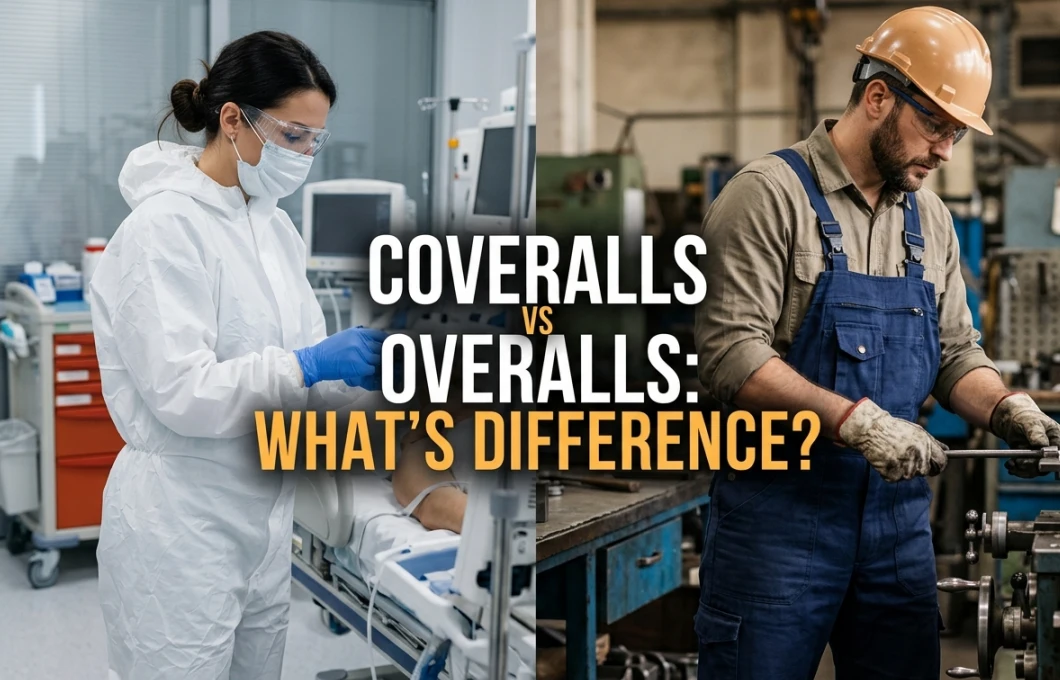
The easiest way to tell them apart is to look at how much of the body they cover. Overalls usually have a bib and shoulder straps, leaving the arms and upper body exposed. Coveralls are typically one-piece garments with sleeves and full-length legs, offering more extensive body coverage.
That difference may seem small when looking at product names. In practice, it can affect comfort, movement, and the level of protection a worker needs.
What Is the Difference Between Coveralls and Overalls?
The main difference between coveralls and overalls is their construction and coverage.
Overalls usually consist of trousers with an attached front bib and shoulder straps. They cover the lower body and part of the chest but leave the arms and shoulders uncovered. Workers often wear them over a shirt or other everyday clothing.
Coveralls are generally made as a single garment with a connected upper and lower section. Most designs include sleeves and full-length legs, covering the torso, arms, and legs. Depending on the material and design, they can serve as everyday workwear or as protective clothing for specific industrial and medical environments.
| Feature | Overalls | Coveralls |
|---|---|---|
| Basic design | Trousers with a bib and shoulder straps | One-piece garment |
| Upper-body coverage | Partial chest coverage | Covers the torso |
| Arm coverage | Usually no sleeves | Usually includes sleeves |
| Leg coverage | Full-length trousers | Full-length legs |
| Common materials | Denim, cotton, and workwear fabrics | Cotton, polyester blends, nonwoven fabrics, and specialty materials |
| Typical applications | Farming, carpentry, painting, and general trades | Manufacturing, maintenance, industrial work, and selected medical applications |
| Main purpose | Protects clothing and lower body from everyday dirt and wear | Provides broader body coverage and, when properly designed, task-specific protection |
One detail is easy to overlook: the words are not always used consistently across countries. In some British workwear settings, the terms may overlap. For buyers comparing products from different suppliers, checking the garment’s actual design is more reliable than relying on its name alone.
What Are Overalls Used For?
Overalls have a long history in practical workwear. Farmers and railway workers were among the groups traditionally associated with this style. Their simple construction made them useful for jobs involving frequent movement, physical effort, and contact with dirt or rough surfaces.
The design became more widely recognized during the 1960s and 1970s, when denim overalls also gained popularity as casual fashion. Over time, different fabrics, colors, and styles became available.
Today, bib-and-brace overalls are still common in many hands-on occupations.
Common Applications of Overalls
- Farming and agriculture: Useful for everyday outdoor work where clothing may come into contact with soil, dust, and general dirt.
- Carpentry and woodworking: Allow workers to move their arms freely while keeping tools and small items within reach, depending on the design.
- Painting and decorating: Help protect trousers and part of the upper clothing from paint splashes and everyday stains.
- Factory and workshop work: Suitable for general tasks where lower-body and clothing protection are needed.
- Railway and maintenance work: Provide practical clothing for workers who spend long periods moving, bending, and handling equipment.
The open upper-body design is one of the main reasons some workers prefer overalls. It allows them to wear their usual shirts underneath without feeling as covered as they might in a full-body garment.
There is a trade-off, though.
Overalls do not usually cover the arms or the entire upper body. If a task involves splashes, dust, or other hazards that may reach exposed areas, workers may need additional protective clothing.
What Are Coveralls Used For?
Coveralls are designed to cover more of the body than traditional bib overalls. A typical design connects the upper section and trousers into one garment, with sleeves, long legs, and a front fastening.
They are widely used in industries where workers want to keep their regular clothing covered or need a garment designed for a particular working environment.
The material and construction can vary considerably. Some coveralls are made from cotton or blended fabrics for repeated industrial use. Others use nonwoven materials for disposable applications.
A coverall intended for general workshop use is not necessarily suitable for chemical handling or biological exposure. The actual protection depends on its fabric, seams, closures, design, and applicable testing or certification.
Common Applications of Coveralls
1. Industrial Manufacturing
Factories often use coveralls to keep workers’ clothing away from dust, dirt, grease, and routine production residue. Breathability, durability, and freedom of movement are practical considerations when selecting reusable workwear.
2. Mechanical Maintenance and Engineering
Maintenance workers may encounter oil, dirt, and other substances while inspecting or repairing equipment. Coveralls provide a convenient way to cover everyday clothing during these activities.
3. Chemical and Hazardous Work Environments
Certain specialized coveralls are designed for specific chemical or liquid hazards. Their suitability depends on the tested protection type and the substances involved. Ordinary work coveralls should not be treated as chemical protective clothing without supporting product specifications.
4. Medical and Healthcare Settings
Disposable coveralls are used in selected healthcare and laboratory environments where broader clothing coverage is needed. Depending on their construction and tested performance, they may help reduce contamination of the wearer’s clothing and skin.
The right garment should match the exposure risk and the facility’s infection-control requirements. A disposable coverall is not automatically equivalent to a medical isolation gown or a certified biological protective suit.
5. Military and Aviation
Coveralls are also used in military and aviation settings. Flight suits are a familiar example of one-piece garments designed around the practical requirements of their users.
Coveralls vs Overalls Workwear: Which One Should You Choose?
The choice between coveralls and overalls usually comes down to the type of work being performed.
If workers mainly need protection against ordinary dirt and wear while keeping their arms free, bib overalls may be a practical option.
If the task requires the torso, arms, and legs to be covered, coveralls are generally the more suitable design.
Here are a few points worth checking before making a purchase.
1. Consider the Working Environment
Start by looking at what workers actually encounter during a normal shift.
For carpentry, farming, and general workshop activities, traditional overalls may provide sufficient clothing coverage. For factory maintenance, dusty production areas, or tasks involving more extensive contact with workplace contaminants, coveralls may be more appropriate.
Medical and industrial environments with specific exposure risks require a closer assessment of the garment’s protective properties.
2. Check the Fabric and Material
Material selection affects comfort, durability, and the intended use of the garment.
Reusable coveralls commonly use cotton or blended fabrics. These are often selected for general workwear because they can be worn repeatedly and are available in different weights and constructions.
Disposable coveralls may use materials such as spunbond polypropylene (PP), SMS nonwoven fabric, or microporous laminated fabric.
Each option has different characteristics:
- PP nonwoven: Commonly used for lightweight disposable garments in general-purpose environments.
- SMS nonwoven: Combines spunbond and meltblown layers, making it a common option for disposable protective clothing.
- Microporous laminated fabric: Uses a film-based structure designed to provide a barrier against certain liquids and particles, depending on the product’s tested performance.
The fabric name alone does not establish a garment’s protection level. Buyers should review the manufacturer’s technical specifications and relevant test reports before choosing material for a specific hazard.
3. Think About Comfort and Mobility
Workers may wear protective clothing for several hours at a time. A garment that restricts movement or traps too much heat can become uncomfortable during a long shift.
Overalls leave the upper body more open, which some workers prefer in warm conditions or physically demanding jobs.
Coveralls provide broader coverage, but the fit, fabric weight, ventilation, and garment design all affect comfort. When selecting disposable styles, check the available sizes and whether the garment allows enough room for the clothing worn underneath.
4. Check the Required Protection
This is particularly important for buyers in medical, pharmaceutical, food processing, and industrial sectors.
A garment’s appearance cannot tell you whether it meets a particular protective requirement. Check the intended application, material specifications, seam construction, closure design, and applicable standards.
For example, a general-purpose disposable PP coverall should not be assumed to provide the same barrier performance as a tested microporous protective suit.
The right product is the one that matches the actual workplace risk, not simply the one with the most extensive coverage.
When to Wear Coveralls Instead of Overalls
There is no single answer for every workplace, but a few situations make the choice easier.
Consider coveralls when:
- Workers need their arms, torso, and legs covered.
- Tasks involve frequent contact with dust, dirt, grease, or workplace residues.
- A disposable garment is required to reduce contamination of personal clothing.
- The working environment calls for a specialized protective garment with documented performance.
- Workers need a one-piece design that can be worn over their regular clothes.
Overalls may be more practical when:
- The work mainly involves lower-body protection.
- Workers need unrestricted upper-body movement.
- The task involves general dirt and wear rather than specific exposure hazards.
- A durable, reusable garment is preferred for routine trade work.
For healthcare and laboratory applications, the choice should follow the facility’s risk assessment and clothing requirements. A coverall may be suitable for some tasks, while an isolation gown or another form of protective clothing may be more appropriate for others.
A Closer Look at Disposable Protective Coveralls
Not every coverall is designed for the same purpose. Disposable protective coveralls deserve particular attention because their materials and construction can differ significantly.
PP, SMS, and microporous coveralls are common options in disposable protective clothing. Buyers often compare them based on breathability, liquid resistance, particle barrier performance, and intended application.
However, these properties should be evaluated using product-specific test results rather than general material descriptions.
For businesses purchasing disposable coveralls in bulk, it is useful to confirm:
- Material composition and fabric weight.
- Available sizes and garment dimensions.
- Hood, zipper, elastic cuff, and ankle designs.
- Packaging specifications and minimum order quantities.
- Applicable certifications and test documentation.
- Whether OEM branding, packaging, or other customization is available.
These details help procurement teams compare suppliers more accurately and avoid ordering garments that do not match the requirements of the end user.
Frequently Asked Questions
1. Are coveralls and overalls the same thing?
Not usually. Overalls generally refer to trousers with a bib and shoulder straps, while coveralls are typically one-piece garments covering the torso, arms, and legs. Some regional workwear terminology uses the two words interchangeably, so checking the actual garment design is important.
2. What is the main difference between a coverall and an overall?
The main difference is body coverage. Overalls usually cover the lower body and part of the chest, leaving the arms exposed. Coveralls generally include sleeves and full-length legs, providing more extensive coverage.
3. When should workers wear coveralls?
Workers may wear coveralls when their tasks require broader clothing coverage, such as industrial maintenance, manufacturing, certain laboratory activities, or selected healthcare applications. The garment should match the specific workplace hazards and protection requirements.
4. Are disposable coveralls better than reusable coveralls?
Neither option is automatically better. Disposable coveralls are convenient when single-use clothing is required or when laundering reusable garments is impractical. Reusable coveralls may be more suitable for routine work where durability and repeated use are priorities. The decision depends on the application, cleaning requirements, and overall cost.
5. What materials are commonly used for disposable coveralls?
Common materials include polypropylene (PP), SMS nonwoven fabric, and microporous laminated fabric. They have different characteristics in terms of weight, breathability, and barrier performance. Buyers should check the technical specifications and test documentation for the exact product.
6. Can disposable coveralls be used in medical environments?
Yes, certain disposable coveralls are used in medical and laboratory environments. However, suitability depends on the intended task, exposure risk, applicable healthcare requirements, and the garment’s verified protective performance. Not every disposable coverall is suitable for every medical application.
7. Do coveralls protect against chemicals and biological hazards?
Some specialized coveralls are designed and tested for specific chemical or biological hazards. General-purpose coveralls should not be assumed to provide this protection. Always check the applicable standards, test results, and manufacturer’s instructions before selecting a garment for hazardous work.
Choosing Workwear That Fits the Job
The difference between coveralls and overalls comes down to their design, coverage, and intended use. Overalls are a practical choice for many everyday trades, particularly when workers want lower-body coverage and freedom around the arms. Coveralls offer a more complete garment design and are available in options for general industrial work, disposable applications, and specialized protective tasks.
For buyers, the garment name is only the starting point. Material, construction, comfort, and verified protective performance deserve just as much attention.
Taking time to compare these details makes it easier to select workwear that fits the job and the people wearing it.